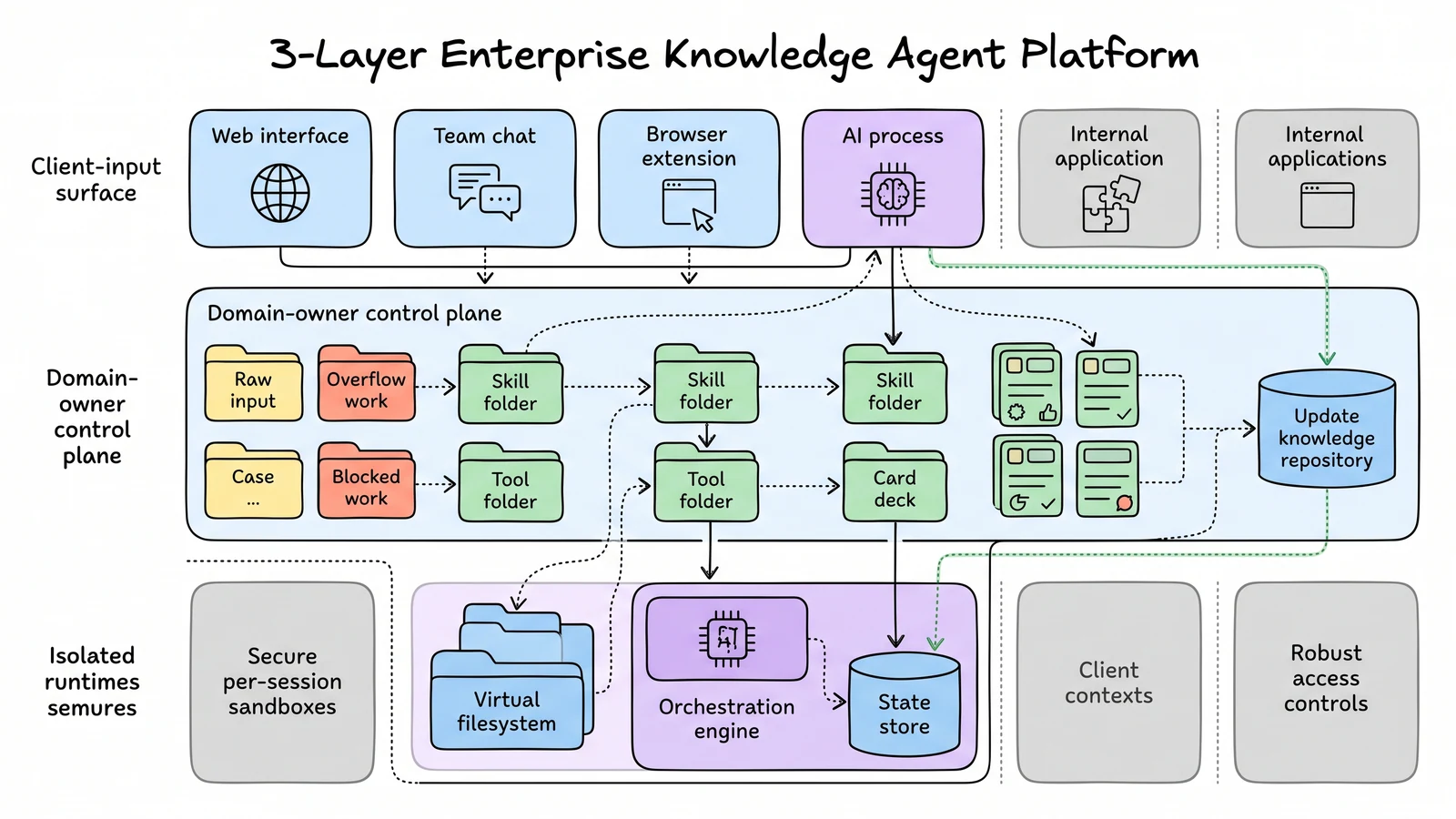
Stripe’s Knowledge AI Platform, Kai, is a useful counterexample to the idea that knowledge work needs thousands of independent micro-agents.
Before Kai, Stripe employees had built more than 4,000 workflow-specific agents. Prompt quality varied, ownership fragmented, and maintenance became difficult. Coding agents offered more power but introduced security and support assumptions that did not fit finance, sales, compliance, or customer operations.
Kai uses three layers. Surface-agnostic APIs let the same agent appear in a web app, Slack, browser extensions, and internal tools. AgentStudio gives domain owners control over skills, tool selections, custom agents, usage, and quality signals. A shared execution layer provides the harness, Kubernetes runtime, per-session sandbox, virtual filesystem, orchestration, and access controls.
The platform is connected to more than 1,000 internal tools and skills. It maintains state across long projects; Stripe cites one conversation reaching 932 turns. Active model context and extended state in stores such as S3 or the virtual filesystem are managed separately so multi-day work does not require replaying everything on every turn.
Adoption is already broad: Stripe reports 83% weekly active usage, including nearly all go-to-market staff. The company also reports 25,000 hours per year shifted away from administrative work, though these are internal observational measures rather than a controlled product benchmark.
The architecture is the durable part. A shared platform owns identity, isolation, state, and runtime controls. Domain teams own what good work means. Interfaces meet people inside existing workflows. That is closer to an organizational operating layer than a general chatbot rollout.