Genkit Adds Progressive Disclosure For Agent Skills

Genkit now loads Agent Skills through middleware that discovers SKILL.md metadata first and activates full instructions, references, and scripts only when needed.

Retrieval answer

Genkit now loads Agent Skills through middleware that discovers SKILL.md metadata first and activates full instructions, references, and scripts only when needed. Google added Agent Skills support to Genkit across TypeScript, Go, Dart, and Python. The implementation makes progressive disclosure a harness behavior rather than a prompting convention. A skill remains a normal directory.

New Runtime synthesiseditorial-diagram
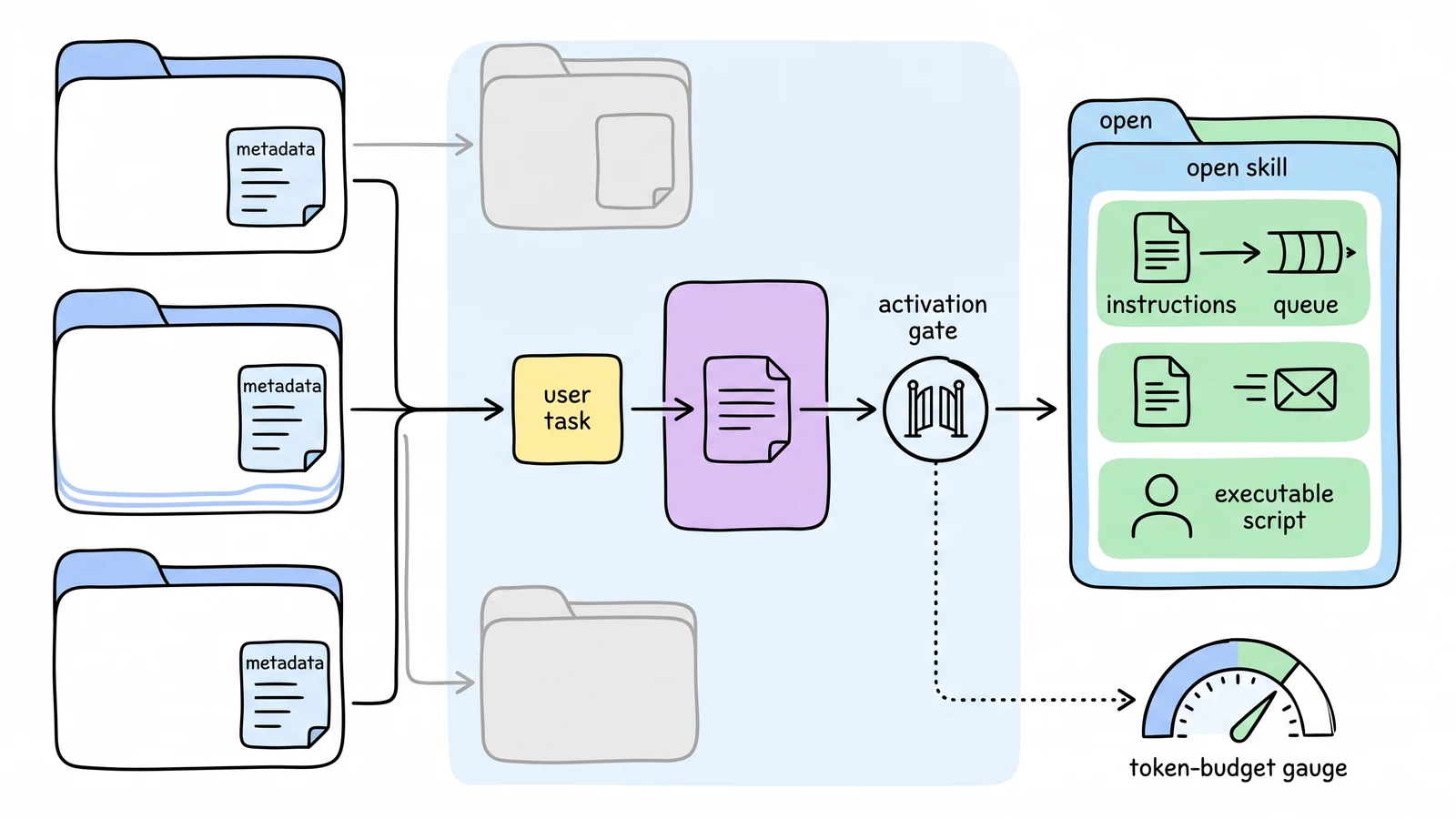
Hand-drawn progressive disclosure flow where skill metadata is scanned first, a matching request activates one SKILL file, and references or scripts load only for execution.
Genkit makes skill activation a middleware lifecycle instead of permanent prompt stuffing.New Runtime synthesis from Google Developers BlogOriginal source ↗
  1. DiscoveryThe harness scans skill folders and exposes compact frontmatter descriptions.
  2. ActivationA matching request triggers the full SKILL instructions through a dedicated tool.
  3. ExecutionReferences, assets, and scripts load only when the active workflow requires them.

Google added Agent Skills support to Genkit across TypeScript, Go, Dart, and Python. The implementation makes progressive disclosure a harness behavior rather than a prompting convention.

A skill remains a normal directory. SKILL.md contains metadata and instructions, while optional scripts, references, and assets hold executable or supporting resources. At initialization, Genkit scans configured skill paths and puts only frontmatter metadata into the system prompt.

When a request matches a skill description, middleware exposes a use_skill activation path and loads the full instructions. The active skill can then pull its own references or execute bundled scripts. Unrelated skills stay out of the model’s working context.

In Genkit Go, this is implemented through the middleware lifecycle. Model wrappers handle individual calls, tool wrappers intercept executions, and generate wrappers see complete tool-loop iterations. The Skills middleware uses those hooks to discover, activate, and execute specialized knowledge without requiring a separate service.

The minimum integration is small: install the Genkit Go SDK, point the Skills middleware at one or more directories, and pass it through ai.WithUse during generation. That simplicity preserves a useful property of skills: they can be versioned and distributed like code.

The quality risk moves to metadata. If hundreds of skills have vague or overlapping descriptions, progressive disclosure still selects poorly. Genkit solves the loading mechanism. Teams still need ownership, collision checks, trace-based usage audits, and tests for when a skill should activate.

Recommendation

Genkit now loads Agent Skills through middleware that discovers SKILL.md metadata first and activates full instructions, references, and scripts only when needed.

Discovery graph / next reads

Continue through New Runtime

Open the graph
  1. 01topicContext engineering - New RuntimeExplore the context engineering topic hub.
  2. 02topicAgent skills - New RuntimeExplore the skills topic hub.
  3. 03related materialChatGPT Cuts Repeated Work Across The Agent StackShares agent harnesses and context engineering.
  4. 04related materialAnthropic Moves Large Tool Libraries Out Of ContextShares agent harnesses and context engineering.
  5. 05related materialDr. Skill Audits What An Agent Loads Before It WorksShares context engineering and skills.

These links are also published in this page’s JSON twin and as typed edges in DiscoveryGraph v1.

Who read this page?Machine requests, hidden until opened

Loading the privacy-safe route aggregate…

Open the JSON contract