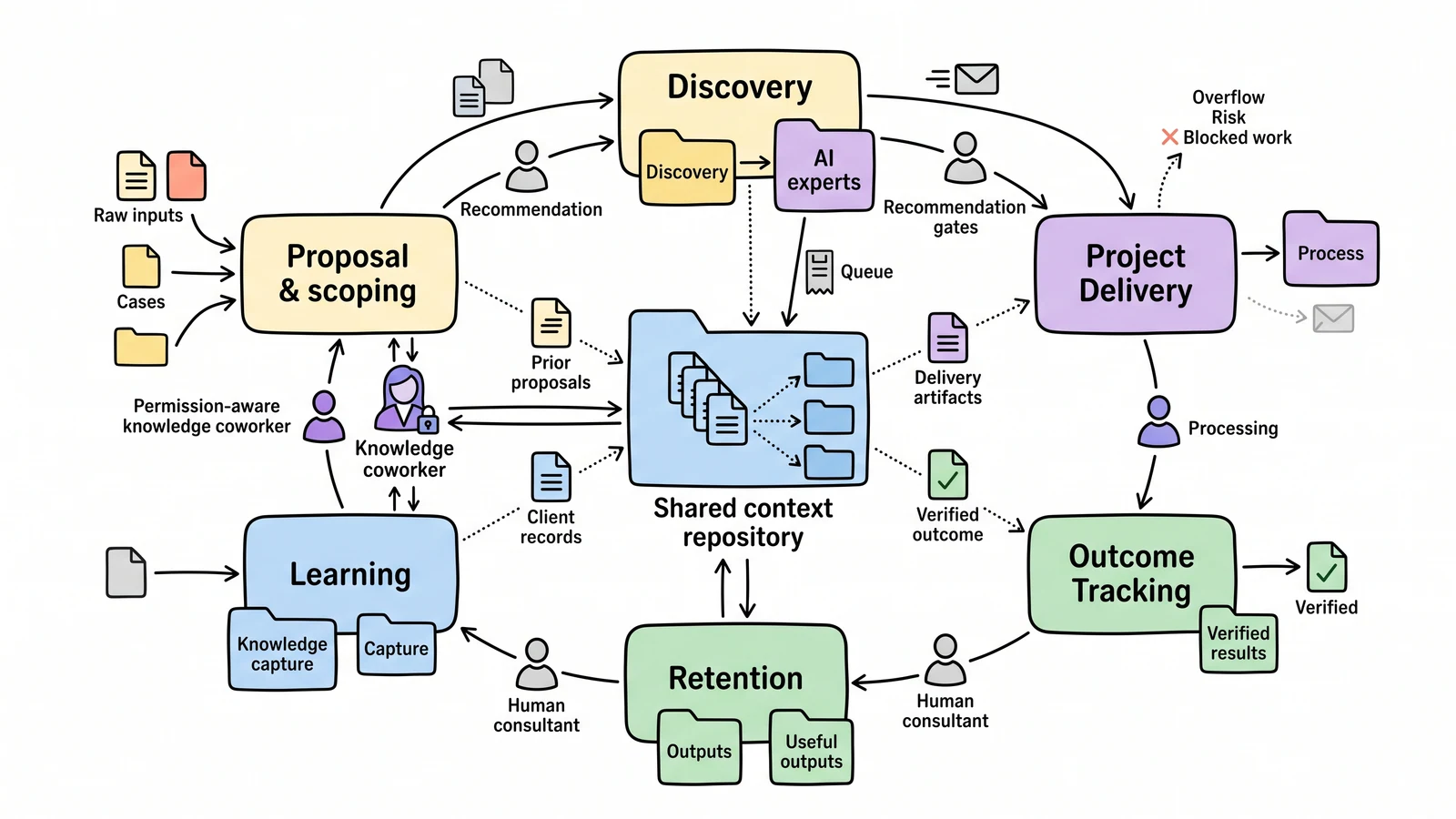
Glean’s consulting analysis is relevant because it focuses on the firm’s operating model, not on a generic consultant chatbot.
Consulting knowledge is distributed across proposals, decks, CRM records, staffing histories, project decisions, delivery artifacts, expert networks, and outcome reports. Point copilots can accelerate one document but create another isolated context boundary. The larger opportunity is a permission-aware layer that carries firm and client context across the engagement lifecycle.
In business development, that means finding relevant cases and prior proposals, combining internal and public account evidence, and producing a grounded first draft. During discovery, the system can locate experts, retrieve lessons from similar engagements, and make assumptions explicit. During implementation, it can preserve decisions, prepare handoffs, update risk and dependency records, and surface schedule or quality problems earlier.
Post-delivery is where the model can change. Benefits can be checked against promised KPIs, account health can be summarized across signals, and verified outcomes can become reusable proof for renewals and future proposals. That moves AI from faster production of deliverables toward measurable client impact and institutional learning.
The organizational effect is a shift in roles. Junior staff spend less time searching and assembling. Engagement leaders gain more continuous visibility. Domain experts encode repeatable methods. Senior consultants remain responsible for judgment, client trust, and decisions whose context cannot be reduced to a retrieval result.
This is also a warning for AI consulting itself. A firm cannot credibly sell agentic transformation while its own delivery knowledge remains fragmented and its outcomes unmeasured. Internal operating evidence becomes part of the consulting product.