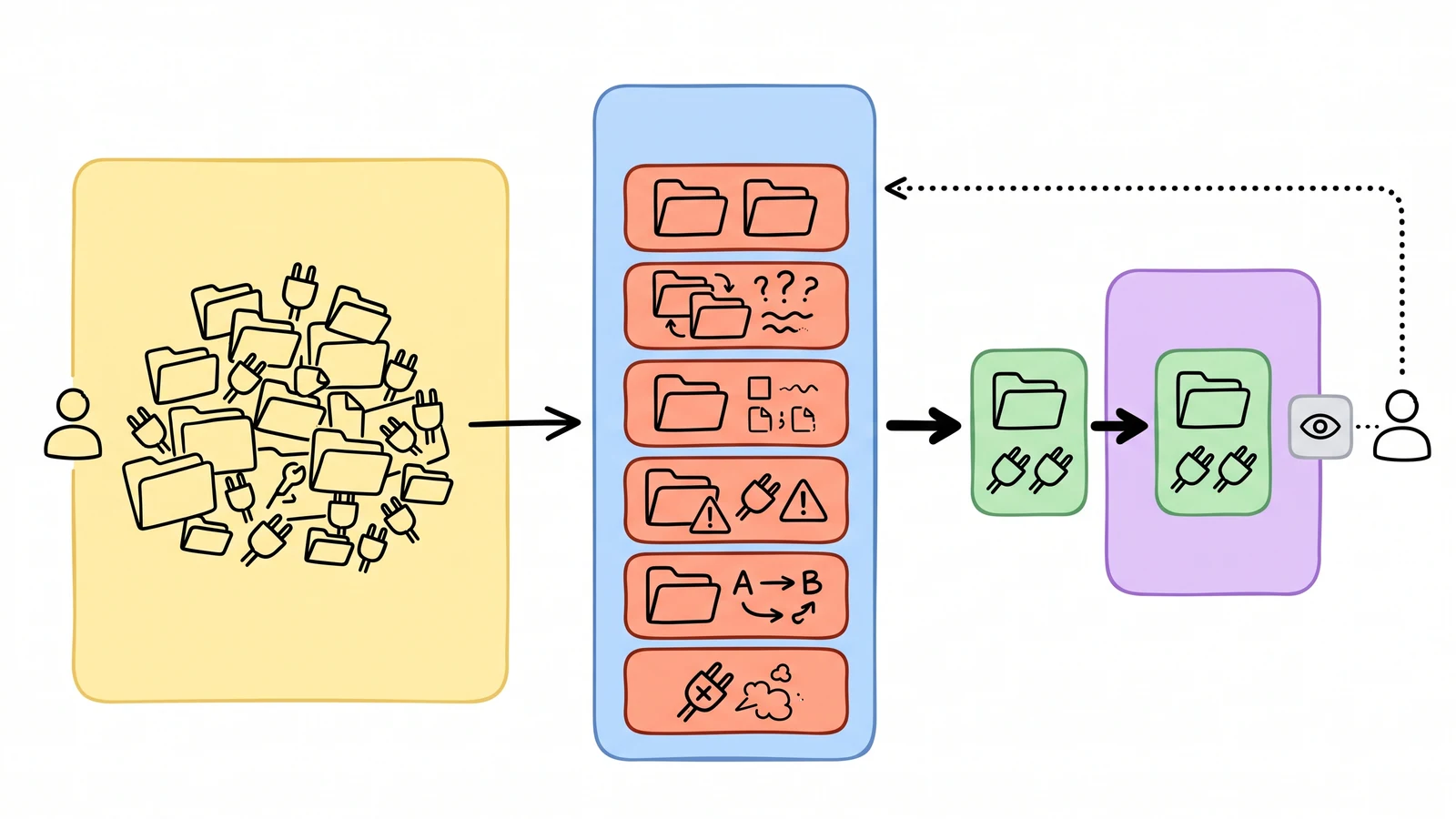
Skill libraries can degrade an agent before the first user message. Drew Breunig describes an enterprise agent loading more than 600 skills by default and a Hermes installation selecting the wrong note-taking skill from a much smaller but still crowded loadout.
Dr. Skill treats that loadout like dependencies that need inspection. drskill scan checks skills and MCP servers across global and project environments. The tool currently looks for 34 issue categories, including missing descriptions, duplicate installations, secrets in committed configuration, unpinned server packages, and drift from a lockfile.
An optional --deep pass uses an LLM to judge whether two skills are genuinely distinct, whether their descriptions collide, or whether their scopes overlap. That is useful only after deterministic checks have narrowed the field; otherwise the audit becomes another expensive all-to-all comparison.
drskill list shows the current loadout and can restrict the view to a specific harness such as Claude Code. drskill audit reads traces to show which skills and tools were actually called and which queries activated them. That turns cleanup from opinion into usage evidence.
Installation is direct: uv tool install drskill or pip install drskill, followed by drskill scan. The commands are designed for local use and CI, so a changed skill set can be reviewed like a dependency update.
New Runtime already uses progressive disclosure to keep full skill bodies out of context. Dr. Skill covers the next failure mode: even compact metadata becomes noise when names, descriptions, and scopes collide. A healthy skill system needs both lazy loading and loadout hygiene.