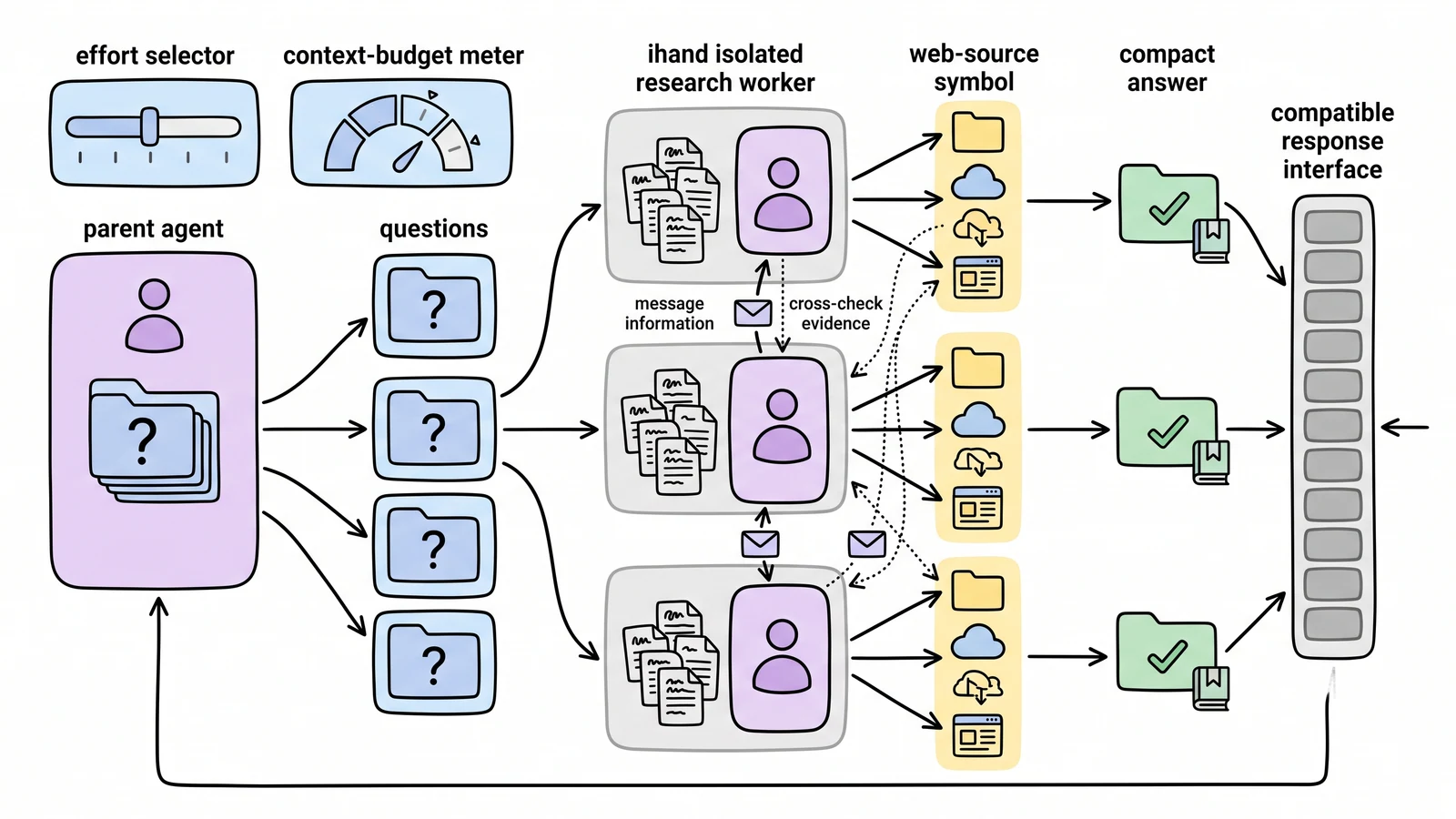
Parallel’s Responses API turns web research into a specialized agent boundary rather than another search tool that dumps pages into the parent context.
The endpoint accepts the OpenAI Responses wire format and returns synthesized answers with citations. It supports structured outputs, server-sent streaming, follow-up state through response IDs, and three effort levels. Parallel positions it for latency-sensitive work, while its Task API remains the slower asynchronous lane.
The architectural use is a research subagent. A parent agent sends one well-scoped question. The research worker runs multi-step searches, cross-checks sources, and returns the final answer. Raw pages and intermediate search traces stay outside the expensive orchestrator’s context.
That separation changes both cost and concurrency. The parent is not repeatedly billed for tens of thousands of web tokens on every later turn. Independent research questions can fan out at the same time, so ten lookups approach the wall-clock time of one instead of forming a serial chain.
The compatibility layer makes an experiment small: point an OpenAI SDK client at https://api.parallel.ai/v1, use model="parallel", and preserve the surrounding Responses API integration. The harder work remains in the caller: define a narrow question, require citations, set an effort budget, and decide which claims need independent verification.
For New Runtime, this fits the broader model-routing pattern. Research is a workload class with its own provider, context budget, evidence contract, and latency tier. It should be delegated because the boundary is inspectable, not because another agent is automatically trustworthy.