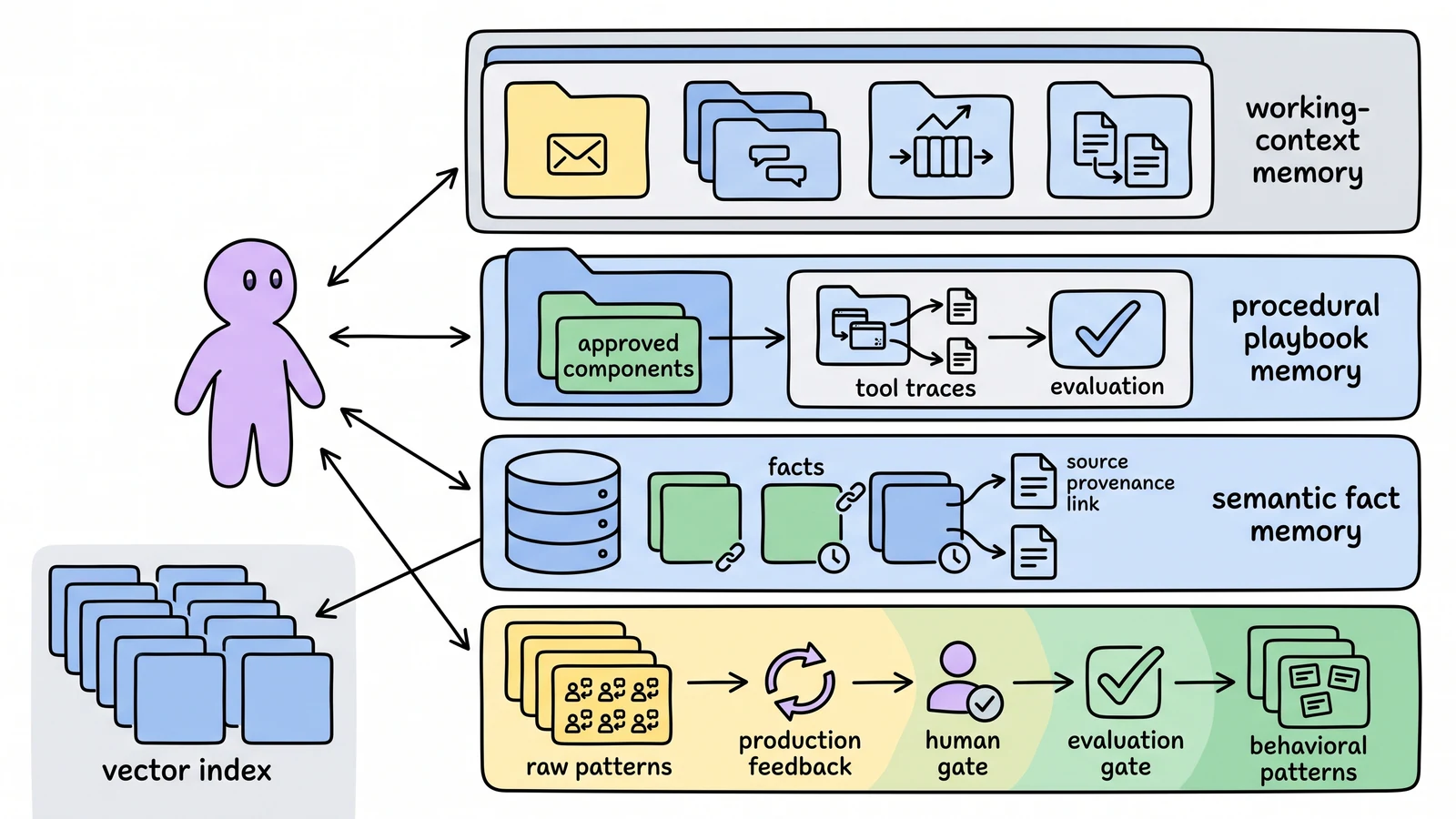
External memory is often more practical than training facts and behavior into model weights. It can be inspected, updated, validated, and carried across model upgrades. Contextual AI argues that this flexibility requires a real write and retrieval policy rather than a vector database filled with old interactions.
A vector index can retrieve something similar. It does not decide what deserves to be remembered, when information has expired, how a noisy trace becomes a durable lesson, whether a proposed update is safe, or how evidence survives compaction. Those decisions form the memory system.
Contextual separates four layers. Working memory holds the current request, recent turns, tool results, intermediate state, and source evidence under a finite context budget. Procedural memory stores validated lessons about how to search a particular corpus. Semantic memory holds stable domain facts and authoritative-source rules. Behavioral memory captures recurring patterns in production feedback and updates how the agent responds.
The separation prevents a correction from automatically becoming the wrong kind of state. Not every interaction belongs in an embedding, every lesson in a prompt, or every user preference in long-term behavior. Tool traces can improve a procedural playbook, while domain definitions need provenance and a different lifecycle.
Writes are the higher-risk operation. Retrieved memories become stale, summaries discard decisive evidence, prompt memory competes with task context, and optimization loops overfit narrow evaluations. Contextual therefore places evaluation gates before updates, relevance checks on retrieval, provenance on semantic facts, and citation preservation inside compaction.
For New Runtime, memory should be modeled as typed records with separate owners and promotion rules. The immediate audit is straightforward: identify which state is session-only, which operational lessons can be proposed from traces, which facts need source lineage, and which production patterns may change behavior only after an evaluation proves the change helps.