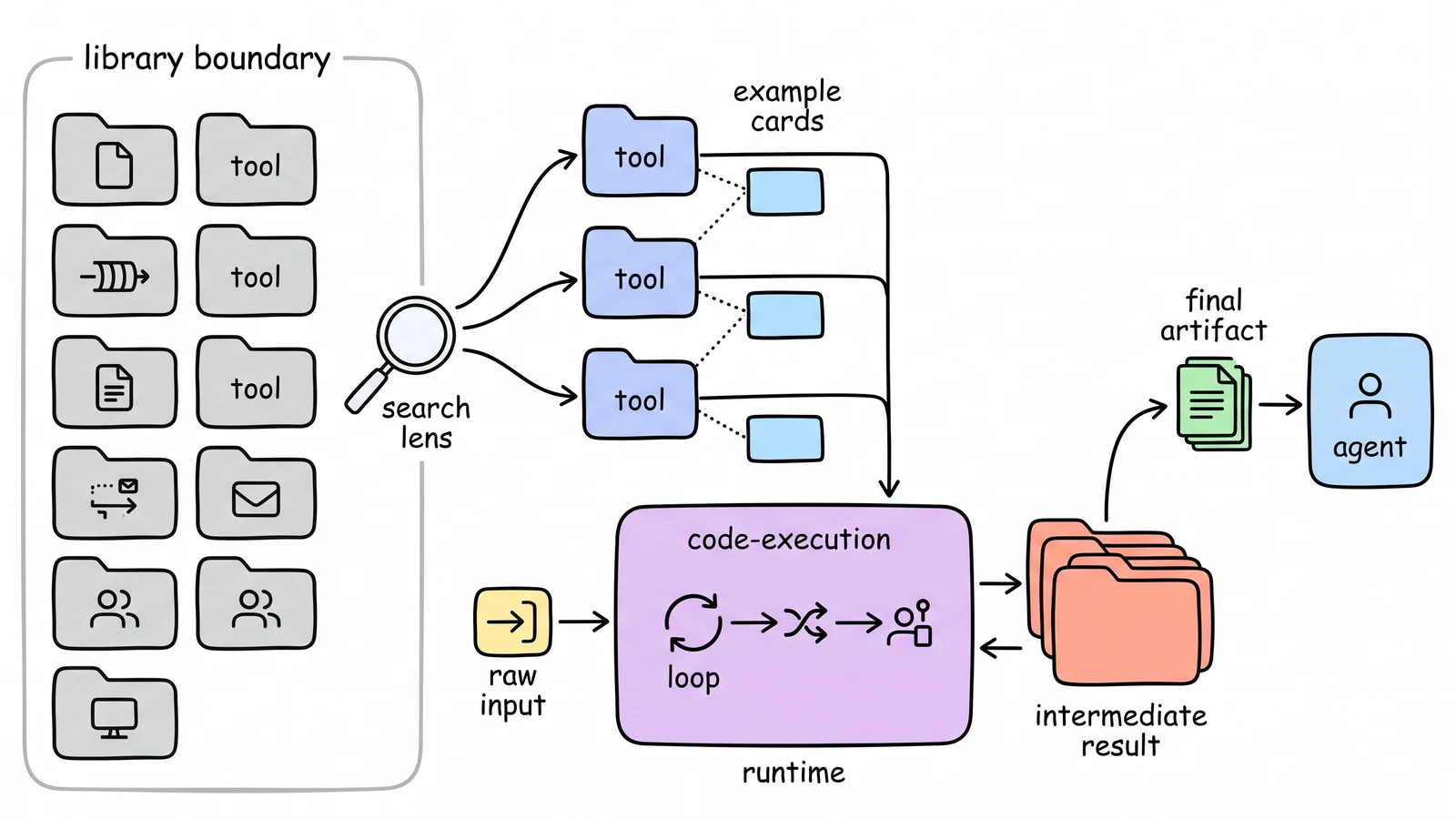
Anthropic’s advanced tool-use release addresses three separate failure modes that appear when an agent connects to dozens of systems.
First, tool definitions consume context before work begins. Anthropic’s example combines GitHub, Slack, Sentry, Grafana, and Splunk into 58 tools and roughly 55,000 tokens of definitions. The company says it has observed 134,000 tokens of tool definitions in larger setups. Similar names then make selection harder, not easier.
The Tool Search Tool changes the loading model. Developers can mark tools or whole MCP servers with defer_loading: true. Claude starts with the search capability and a few essential tools, then expands only the definitions needed for the task. Anthropic reports an 85% reduction in tool-definition token use in one internal setup, alongside better MCP evaluation accuracy for Opus models.
Second, Programmatic Tool Calling lets Claude express orchestration as code. Loops, conditions, joins, and data transformations run in a code-execution environment. Large intermediate tool results are processed there, and only the compact output returns to model context. That avoids a full model round trip for every mechanical step.
Third, Tool Use Examples cover semantics that schemas miss. A JSON schema can say an optional field is valid. It cannot reliably teach when the field should be used, which parameter combinations are conventional, or what an API expects in a real workflow.
The combined pattern is stronger than adding a larger context window. Keep discovery cheap, orchestration explicit, and examples close to the tool contract. Load tokens only when the current task proves they are necessary.