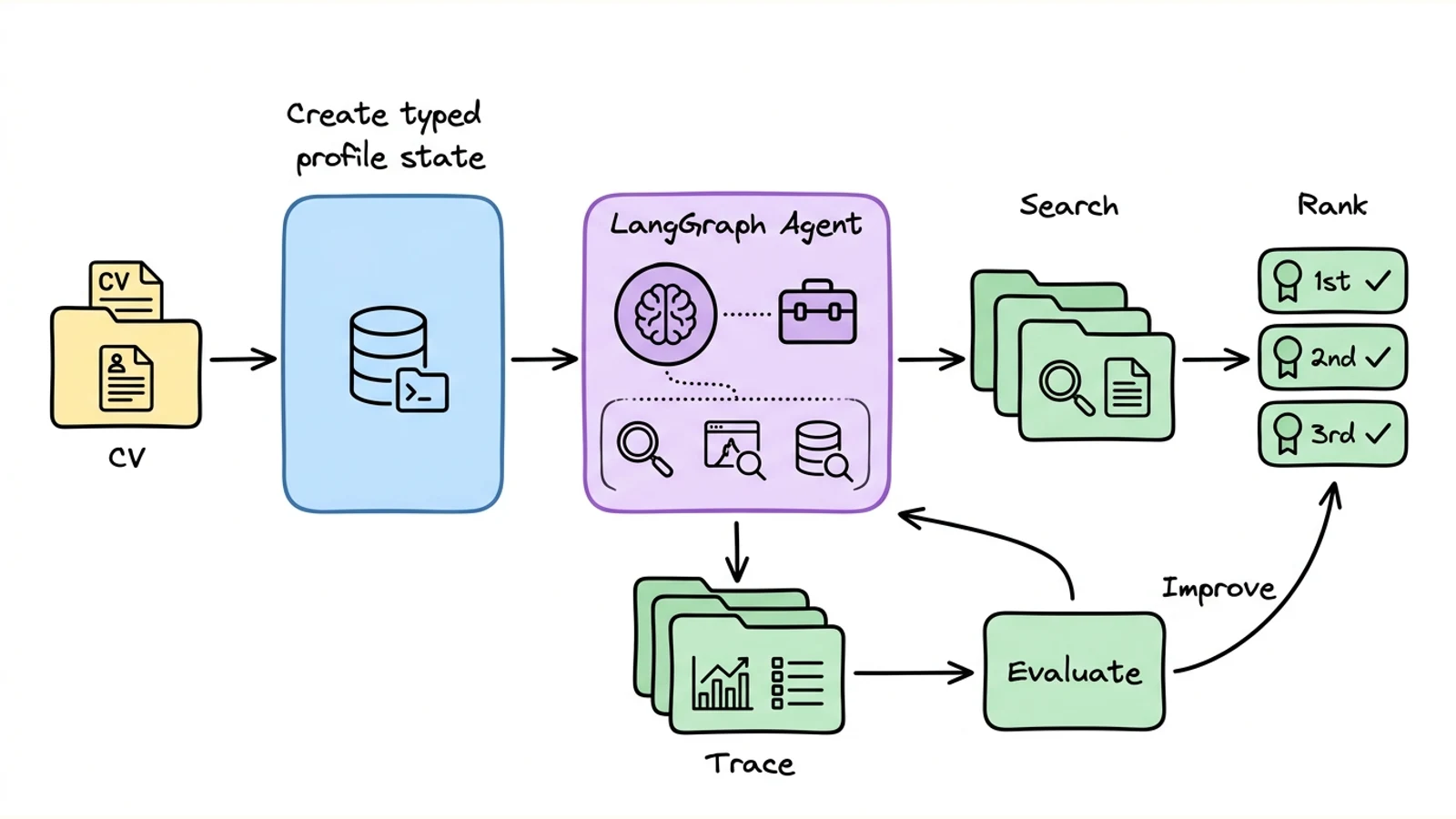
The Observable Job Agent is not important because job search is unique. It is useful because it is a compact template for turning an agent demo into an inspectable product workflow.
The architecture has the right bones: a CV becomes typed profile state, a LangGraph graph owns state and nodes, the model chooses search arguments through a tool, loop guards bound reformulation and cost, and Opik traces every run. The user still applies manually; the agent does not auto-submit applications.
That last boundary matters. The product avoids automating the legally and socially dangerous end of the workflow, while attacking the real bottleneck: research, matching, ranking, and tailoring. This is a practical shape for agent products in domains where full autonomy is premature.
The series also treats observability as part of the build, not an afterthought. Traces, baseline batches, prompt versions, and later evals are built into the work from the start. That means quality can improve against recorded evidence rather than vibe.
New Runtime synthesis: the smallest credible agent product has state, tools, loop bounds, traces, and a human boundary. Without those, it is only a scripted demo with an LLM call inside.