Mem0 Shows Agent Memory Should Not All Live in Context

Mem0's Claude Code experiment separates durable memory from the conversation window: retrieve the relevant slice, survive /clear, and avoid loading every memory file up front.

Retrieval answer

Mem0's Claude Code experiment separates durable memory from the conversation window: retrieve the relevant slice, survive /clear, and avoid loading every memory file up front. Mem0's Claude Code write-up is worth reading as an architecture note, not just as a vendor benchmark. The first experiment used Claude Code v2.1.209 on the same repository, with and without the Mem0 plugin.

New Runtime synthesiseditorial-diagram
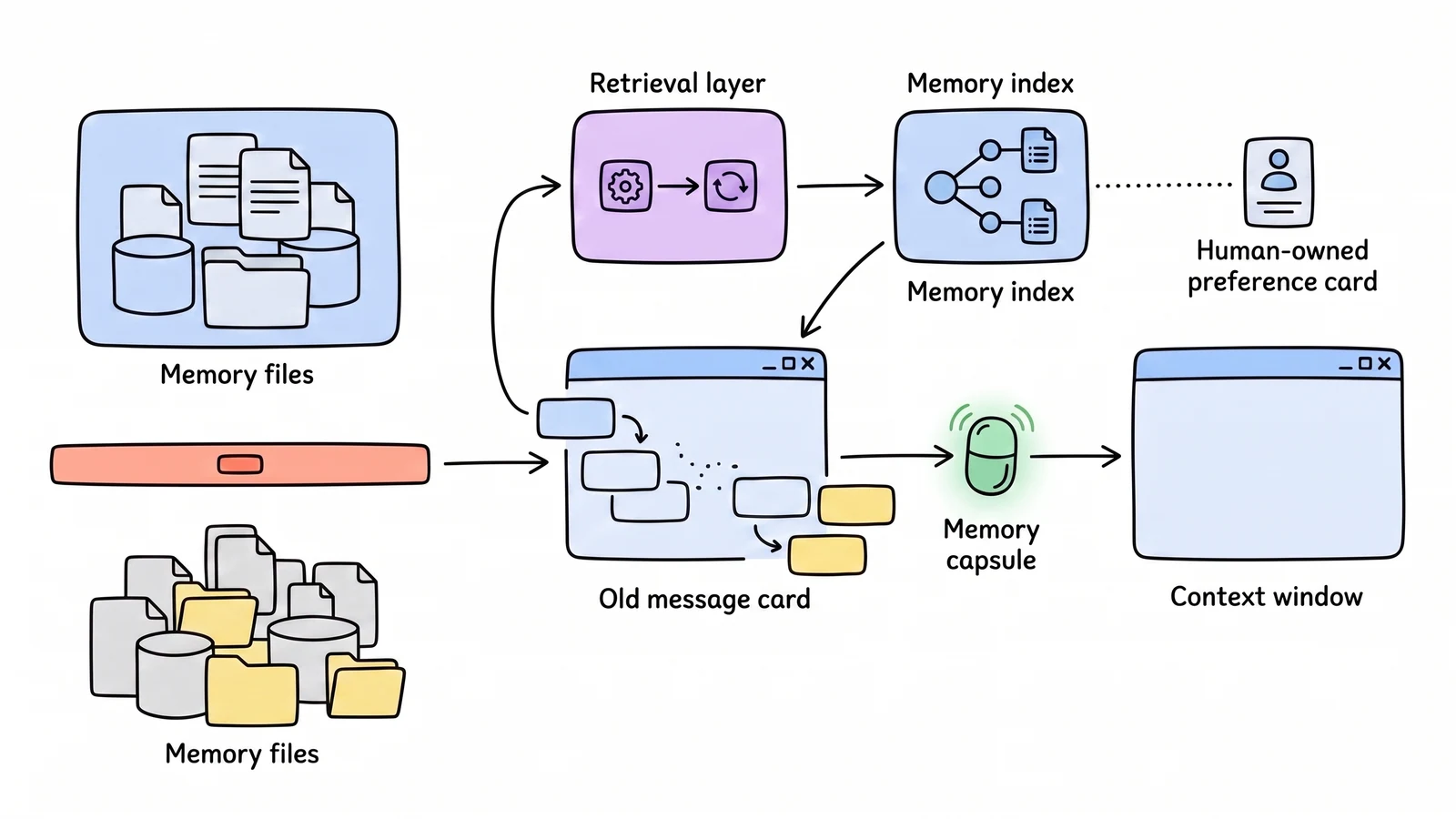
Hand-drawn memory architecture diagram where a messy file stack stays outside the context window while a retrieval layer returns one memory capsule after a context wipe.
Mem0 frames memory as a retrieval layer outside the temporary conversation window, not as unconditional prompt material.New Runtime synthesis from public source inspectionOriginal source ↗
  1. BaselineThe comparison baseline loaded three memory files totaling 13,700 tokens.
  2. RetrievalThe Mem0 session retrieved a 445-token slice for the same task.
  3. RecallA preference survived `/clear` because it lived outside the conversation window.

Mem0’s Claude Code write-up is worth reading as an architecture note, not just as a vendor benchmark.

The first experiment used Claude Code v2.1.209 on the same repository, with and without the Mem0 plugin. The no-Mem0 session loaded three memory files totaling 13,700 tokens. The Mem0 session retrieved a 445-token slice. Mem0 reports total context at 75,011 tokens without Mem0 and 67,291 with Mem0, while both sessions produced accurate answers.

The second experiment tested recall across /clear. A preference stated once earlier in the session was not available to the baseline after the context wipe. With Mem0 connected, the new session recalled and applied the preference without being reminded.

The important caveat is in the source: this was not a Mem0-versus-CLAUDE.md comparison. The baseline was no memory layer connected. Mem0 also does not extrapolate from one 26-memory project to every possible repository. The result is useful because it shows a mechanism, not because it proves a universal slope.

That mechanism is the point. Durable memory can live outside the context window, while retrieval decides what re-enters the prompt for the current task. The alternative is to front-load all accumulated memory and pay the token, latency, and contamination cost every time.

New Runtime Read

This connects directly to the site’s context-cruft and shared-context-layer threads. The win is not “remember more.” The win is separating memory storage, memory retrieval, context injection, and trust.

For production agents, retrieved memory should still be inspectable and scoped. A memory layer that survives /clear is powerful, but it also becomes a privileged input path. The runtime needs provenance, deletion, review, and conflict handling, not only better recall.

Recommendation

Mem0's Claude Code experiment separates durable memory from the conversation window: retrieve the relevant slice, survive /clear, and avoid loading every memory file up front.

Discovery graph / next reads

Continue through New Runtime

Open the graph
  1. 01topicAgent memory - New RuntimeExplore the agent memory topic hub.
  2. 02topicContext engineering - New RuntimeExplore the context engineering topic hub.
  3. 03related materialDr. Skill Audits What An Agent Loads Before It WorksShares context engineering and developer tools.
  4. 04related materialCopilotKit Brings MCP Tool Calls Into The React InterfaceShares developer tools and mcp.
  5. 05related materialAnthropic Moves Large Tool Libraries Out Of ContextShares context engineering and mcp.

These links are also published in this page’s JSON twin and as typed edges in DiscoveryGraph v1.

Who read this page?Machine requests, hidden until opened

Loading the privacy-safe route aggregate…

Open the JSON contract