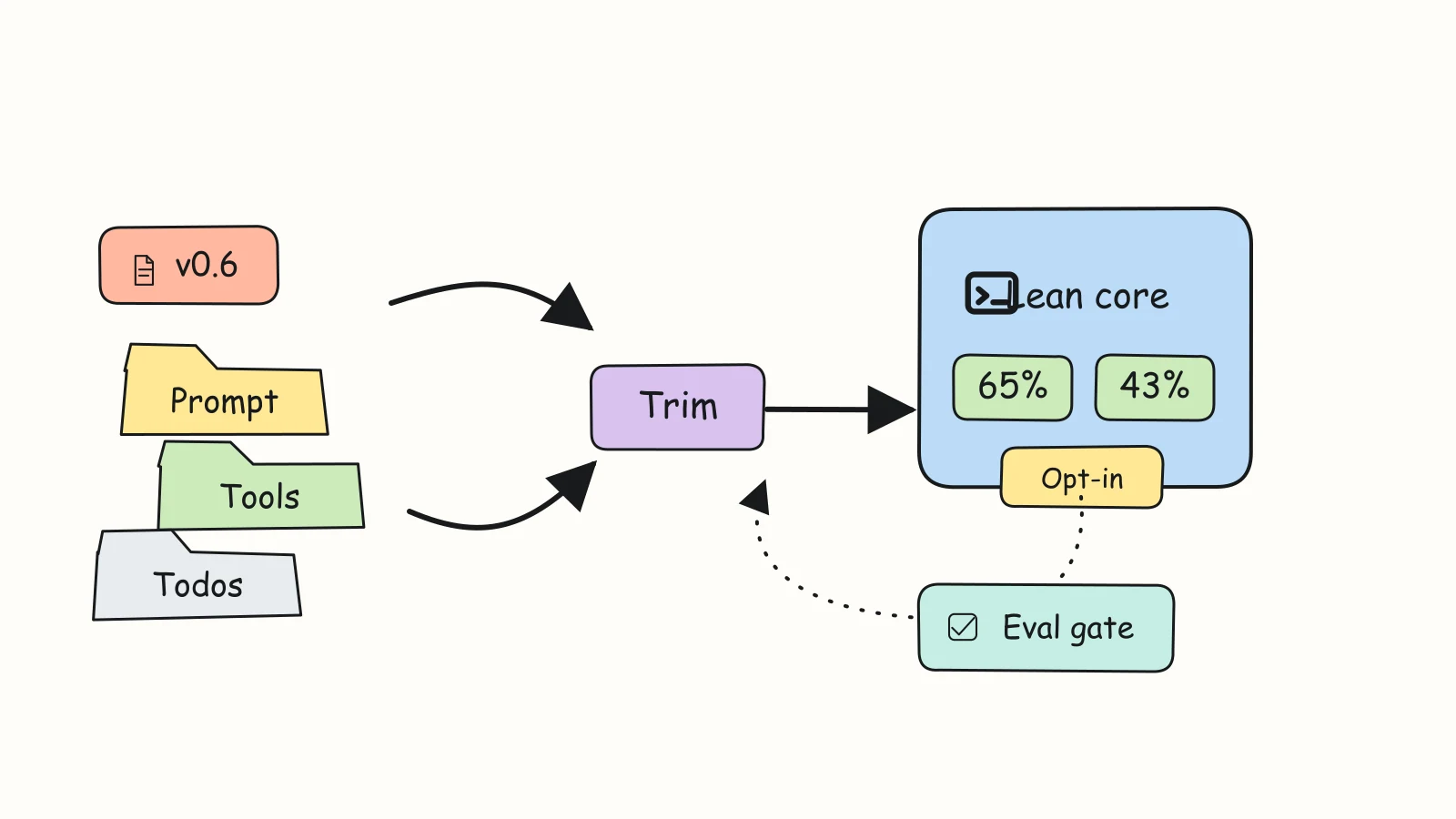
LangChain’s Deep Agents v0.7.0b2 release is a useful counter-signal to the usual agent pattern: add more instructions, add more tools, add more planning text, then hope a stronger model absorbs the mess.
The changelog says the default harness is now leaner. On a default-agent turn, input tokens drop 65% compared with v0.6.12, from 5,395 to 1,895. Tool-description tokens drop 43%, from 4,005 to 2,302. LangChain says this was validated against a revamped evaluation suite with no quality regression.
What changed
The release trims duplicated tool-usage prose, starts the authored base prompt empty, and makes planning todos opt-in. The filesystem tools also become more practical: better delete/write behavior, tool allowlists, paginated reads, bounded grep/glob output, and a 1,000-match grep cap.
There is also more prompt-caching support and an NVIDIA Nemotron 3 Ultra harness profile.
New Runtime Read
This is a harness story, not a model story. The agent system becomes better by reducing unnecessary prompt mass and making tool surfaces more explicit.
That matters because token volume is not only a cost line. It is also latency, context pressure, tool confusion, cache behavior, and verification burden. A smaller harness that keeps quality flat is real product work.
The broader pattern: useful agent frameworks will compete on evaluation-backed harness design, not on prompt theater. If a framework cannot show what got smaller, what stayed compatible, and what the eval gate protected, the release is harder to trust.