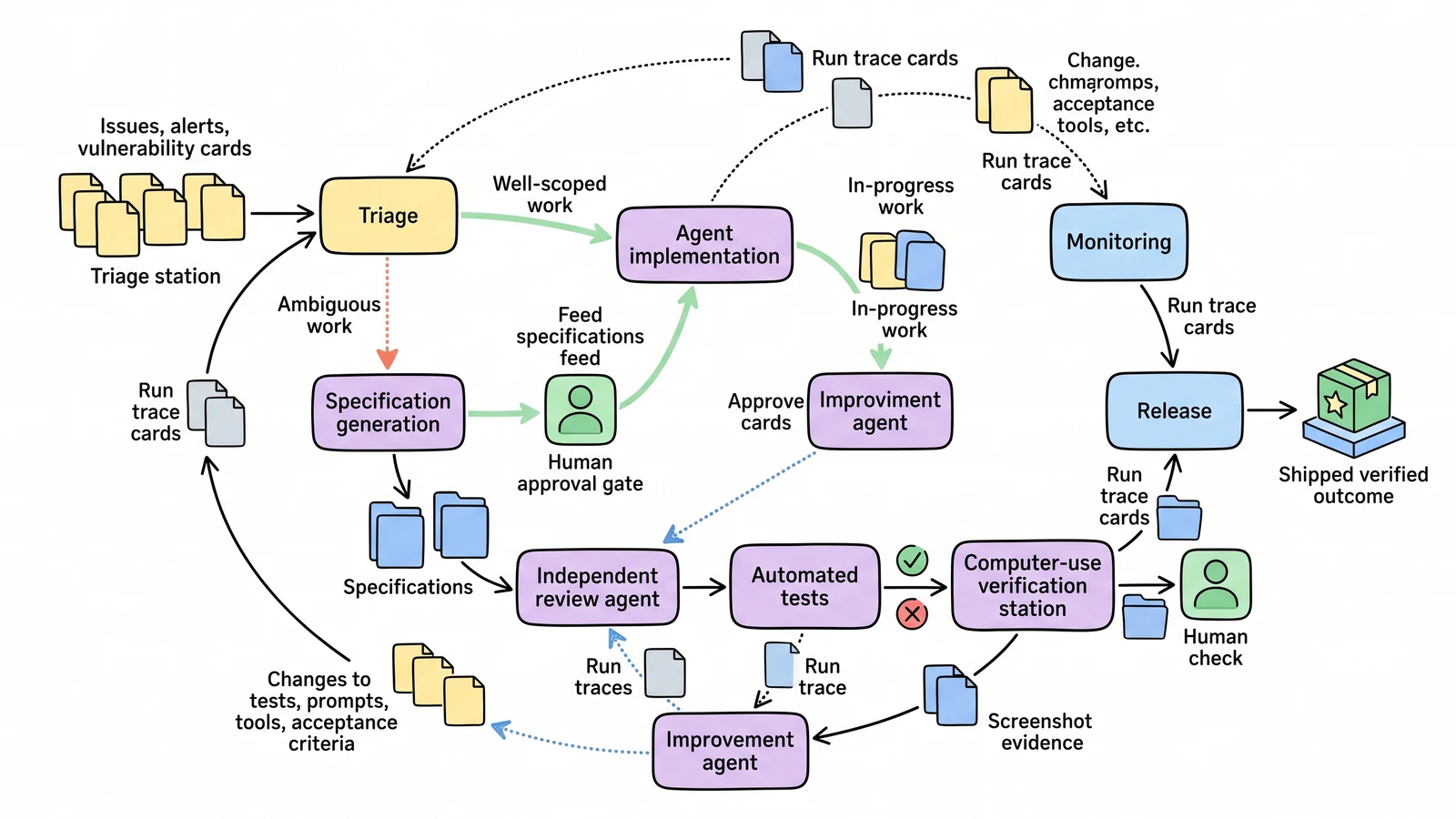
Individual coding agents optimize a developer’s current task. Augment and Warp describe a larger operating unit: a standing team workflow that accepts a trigger and remains responsible until a verified outcome is shipped.
Augment’s outer loop is trigger, execution, verification, outcome, and improvement. An alert, pull request, vulnerability, or ticket starts the run. Specialist agents investigate, implement, and test. Humans enter where intent, risk, or missing context requires judgment. The run finishes only when acceptance criteria are met, and its trace can improve prompts, tools, tests, and escalation rules.
Warp turns that pattern into a staged GitHub Actions implementation. Issue triage reproduces and sorts incoming work. Ambiguous features become PRODUCT.md and TECH.md, which a person approves before code generation. A separate review agent tests its suggestions, and an outer-loop agent can propose updates to the review skill from human feedback.
Computer-use verification closes another gap. An implementation agent should exercise the resulting user flow and attach reviewable evidence such as screenshots or recordings. That moves the human review task from discovering whether the feature works toward confirming evidence against the approved specification.
The human checkpoints are deliberately upstream and risk-sensitive. Too early, and the system becomes a notification bot. Too late, and agents produce a large unreviewed branch. The system should escalate ambiguity before implementation and preserve an independent verification path after it.
For New Runtime, a software factory should be measured in outcomes per dollar: merged fixes, mitigated incidents, closed vulnerabilities, and verified features. Generated diffs and token volume are intermediate activity. The compounding asset is the connected loop plus the trace that makes its next run more reliable.