Amazon Quick Makes Catalog Semantics The Agent Boundary

Amazon Quick's Agentic Catalog Experience turns upstream definitions and relationships into inherited, reviewable context for grounded Q&A and deterministic dashboards.

Retrieval answer

Amazon Quick's Agentic Catalog Experience turns upstream definitions and relationships into inherited, reviewable context for grounded Q&A and deterministic dashboards. Natural-language analytics fails when the model receives table names without the business definitions that make those tables meaningful. Amazon Quick's Agentic Catalog Experience treats that as a semantic last-mile problem.

New Runtime synthesiseditorial-diagram
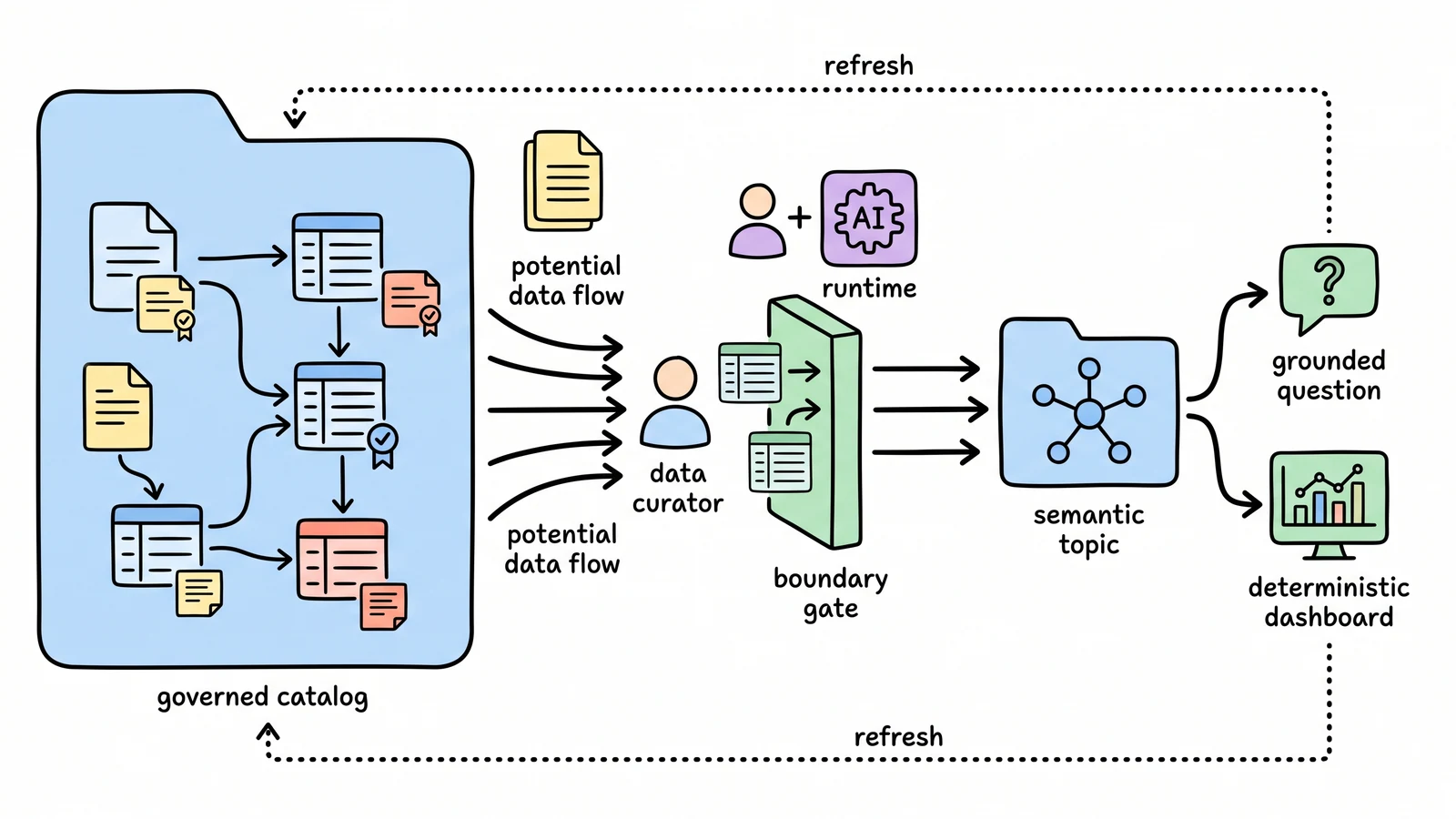
Hand-drawn data architecture where governed catalog metadata and relationships pass through a curator-defined boundary into datasets, semantic topics, grounded questions, and trusted dashboards.
Amazon Quick keeps the catalog authoritative while an agent assembles a bounded semantic layer for questions and dashboards.New Runtime synthesis from AWS Machine Learning BlogOriginal source ↗
  1. Catalog truthDefinitions, relationships, classifications, and governance metadata stay upstream.
  2. Curated boundaryA data curator selects the relevant tables and confirms the generated dataset and topic structure.
  3. Grounded useInherited semantics support natural-language answers and deterministic dashboards.

Natural-language analytics fails when the model receives table names without the business definitions that make those tables meaningful. Amazon Quick’s Agentic Catalog Experience treats that as a semantic last-mile problem.

Enterprises already maintain descriptions, keys, relationships, glossary terms, quality signals, and metric definitions in systems such as AWS Glue Data Catalog and Databricks Unity Catalog. The Quick Agent searches that catalog using the curator’s use case, surfaces relevant tables and relationships, assesses metadata readiness, and proposes a bounded set of datasets and topics.

The upstream catalog remains authoritative. Inherited table and column definitions are read-only in Quick, while primary and foreign key relationships can become preconfigured joins inside a Topic. The initial scope is deliberately narrow: richer metadata helps discovery, but only selected definitions and relationships are inherited into generated assets.

AWS’s walkthrough connects Glue for metadata and Athena for the query path. The agent explores a finance catalog, detects a star schema, then creates seven datasets and six joins in a Financial Analytics Topic. The result is immediately available for grounded questions and deterministic dashboards. Metadata refresh is manual today; scheduled synchronization is still on the roadmap.

This complements the governed context approach in WrenAI. The agent does not become the source of truth. It helps a curator turn an existing governed catalog into a smaller operational context boundary, with lineage back to the definitions and relationships that humans already maintain.

Recommendation

Amazon Quick's Agentic Catalog Experience turns upstream definitions and relationships into inherited, reviewable context for grounded Q&A and deterministic dashboards.

Discovery graph / next reads

Continue through New Runtime

Open the graph
  1. 01topicAgents - New RuntimeExplore the agents topic hub.
  2. 02topicAI Adoption - New RuntimeExplore the ai adoption topic hub.
  3. 03related materialWrenAI Puts a Governed Context Layer Under Agent-Generated BIShares agents and data engineering.
  4. 04related materialField Service Agents Need An Operating Loop, Not A Chat WindowShares agents and ai adoption.
  5. 05related materialGusto Solves The Agent Blank Canvas With Scheduled WorkShares agents and ai adoption.

These links are also published in this page’s JSON twin and as typed edges in DiscoveryGraph v1.

Who read this page?Machine requests, hidden until opened

Loading the privacy-safe route aggregate…

Open the JSON contract