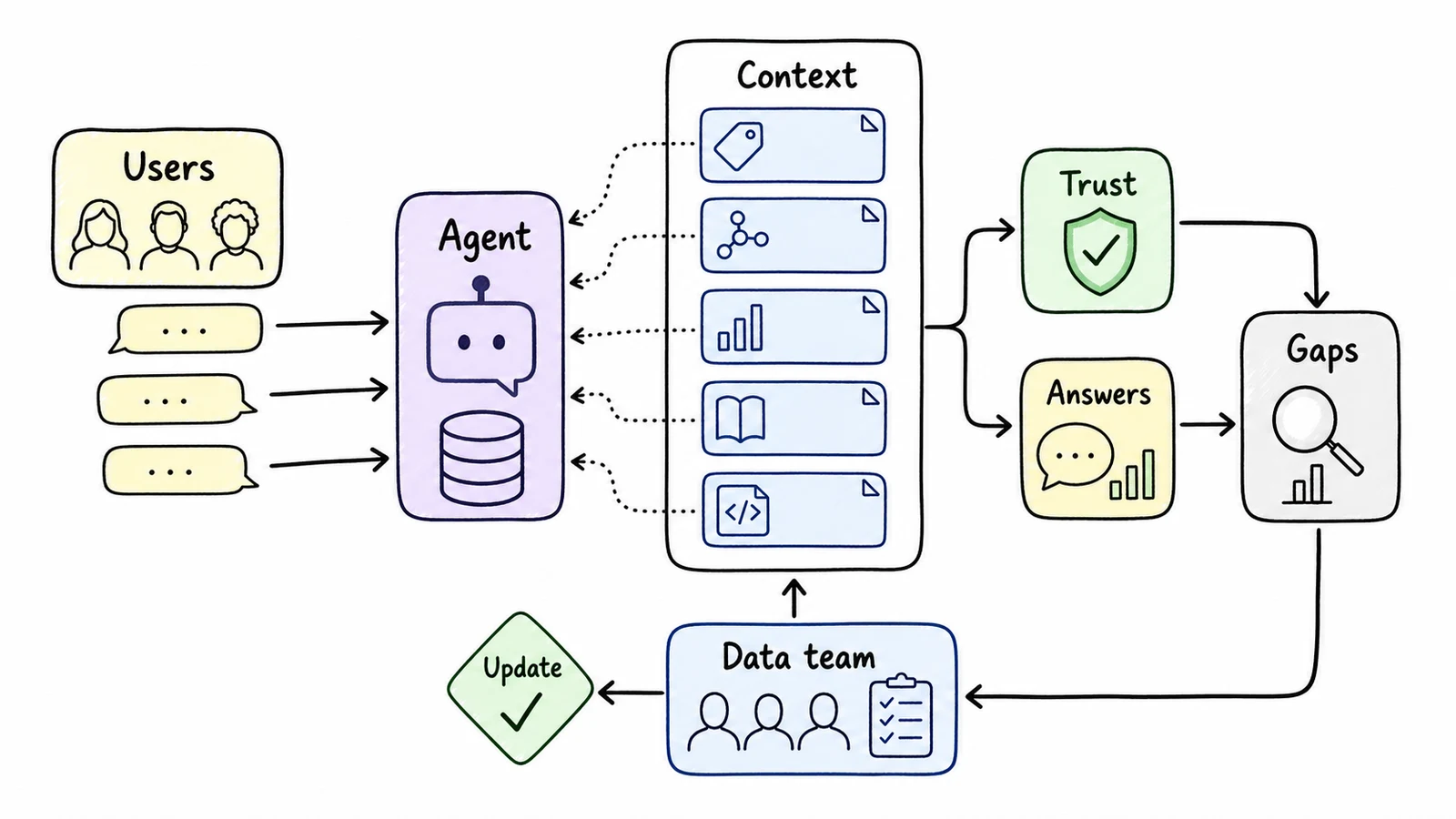
LangChain’s write-up on its agent-first data stack is a useful field report because the punchline is not “we added a data chatbot.” The punchline is that the chatbot forced the data stack to become a maintained context system.
The reported scale is meaningful. LangChain says its self-serve data agent now handles roughly 40x the request volume its three-person data team could manage directly. In the last 30 days, nearly all provisioned users used the agent, representing about a third of the company, with roughly 2,200 agent conversations and an average of 23 conversations per month per user.
The migration also changed the data team’s job. They moved fully off the old BI tool in six weeks, but the data team did not disappear. It shifted toward maintaining models, definitions, trust signals, guides, observability, and future evals.
The real stack
The important pieces are context layers:
- dbt table and column definitions explain grain, meaning, defaults, and edge cases;
- the semantic model defines metrics and relationships;
- workspace guides capture business processes, reporting conventions, and when to route to humans;
- endorsements mark trusted dashboards and assets;
- GitHub context lets technical users trace implementation logic;
- observability surfaces repeated questions, warnings, and context gaps.
That is why the post matters. A data agent with only table access can write SQL, but it can still pick the wrong business meaning. A data agent with maintained context can become a self-service interface.
New Runtime Read
Reliable agents move work from “answer every request” to “maintain the context that makes many requests answerable.” That is a different operating model for data teams.
For New Runtime, this strengthens the shared-context-infrastructure pattern. The valuable artifact is not a single answer. It is a loop: people ask, the agent exposes gaps, the team updates context and trust signals, and future answers improve.