Gusto Solves The Agent Blank Canvas With Scheduled Work

Gusto Cofounder starts from recurring payroll and HR workflows, giving the agent an assigned job, schedule, context, and decision boundary before the user has to invent a prompt.

Retrieval answer

Gusto Cofounder starts from recurring payroll and HR workflows, giving the agent an assigned job, schedule, context, and decision boundary before the user has to invent a prompt. A capable agent can still be a weak product if the user has to invent its first job.

New Runtime synthesiseditorial-diagram
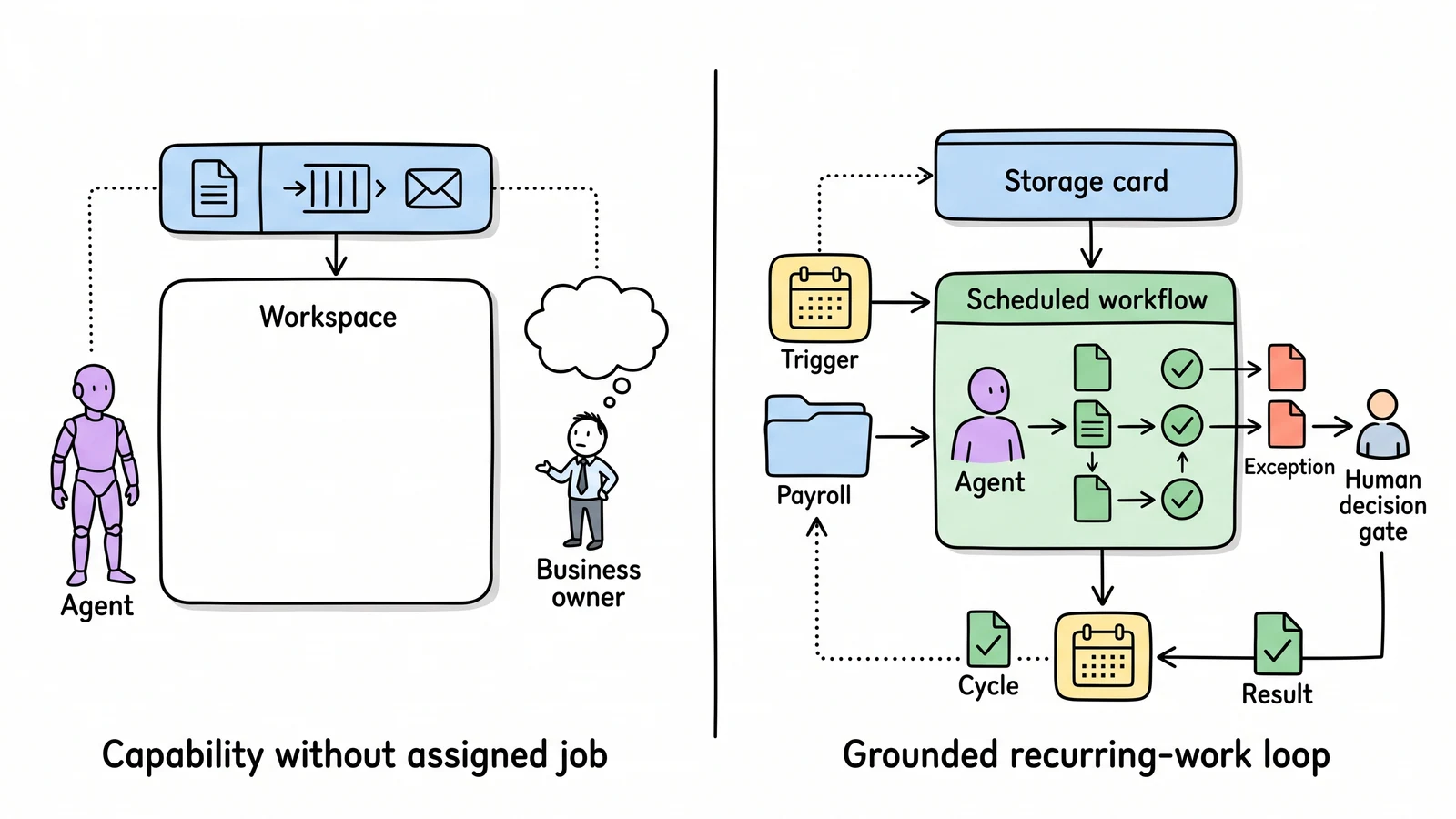
Hand-drawn contrast between an empty general-purpose agent and a scheduled business workflow that observes recurring work, proposes automation, runs it, and asks a human only for decisions.
The blank canvas disappears when the product already knows which recurring job, schedule, context, and decision boundary to offer.New Runtime synthesis from Browserbase's interview with GustoOriginal source ↗
  1. Recurring workThe product recognizes a known payroll or HR process instead of waiting for an open-ended prompt.
  2. Scheduled agentThe workflow runs with existing business context and checks in when a decision is required.
  3. Human boundaryThe owner approves exceptions and decisions rather than continuously steering every step.

A capable agent can still be a weak product if the user has to invent its first job. Browserbase’s interview with Gusto co-founder Eddie Kim calls this the blank canvas problem: install OpenClaw or open a powerful coding assistant, then fall back to search because the product has not connected capability to a recurring responsibility.

Gusto’s answer is Cofounder, an agent built around work the company already understands. Small businesses run payroll on a schedule, approve time off, administer benefits, and handle recurring HR tasks. Those workflows already have data, timing, exceptions, and decision owners. Cofounder can propose a concrete automation, run it on schedule, and interrupt the owner only when judgment is needed.

This is a different product contract from a general chat box. The starting point is not “what would you like to do?” It is evidence that the customer performs a known task repeatedly. The product turns that evidence into a suggested delegation with an explicit schedule and human boundary.

The development story reinforces the same point. Browserbase reports that four engineers and one designer built Cofounder in ten weeks, producing roughly 1,000 pull requests with a nine-minute median review time. Kim’s emphasis is that the coding agent became productive through concentrated feedback from the team. Capability was available; the scarce input was teaching the system what good work looked like.

For New Runtime, this is a useful adoption test. Before adding another autonomous surface, identify one repeated job with a stable trigger, observable completion state, and named decision owner. If the system cannot propose that job from existing operational context, the user is still holding the blank canvas.

Recommendation

Gusto Cofounder starts from recurring payroll and HR workflows, giving the agent an assigned job, schedule, context, and decision boundary before the user has to invent a prompt.

Discovery graph / next reads

Continue through New Runtime

Open the graph
  1. 01topicAgents - New RuntimeExplore the agents topic hub.
  2. 02topicAI Adoption - New RuntimeExplore the ai adoption topic hub.
  3. 03related materialAmazon Quick Makes Catalog Semantics The Agent BoundaryShares agents and ai adoption.
  4. 04related materialField Service Agents Need An Operating Loop, Not A Chat WindowShares agents and ai adoption.
  5. 05related materialBCG Recasts The Transformation Office As An Agentic Control LoopShares agents and ai adoption.

These links are also published in this page’s JSON twin and as typed edges in DiscoveryGraph v1.

Who read this page?Machine requests, hidden until opened

Loading the privacy-safe route aggregate…

Open the JSON contract