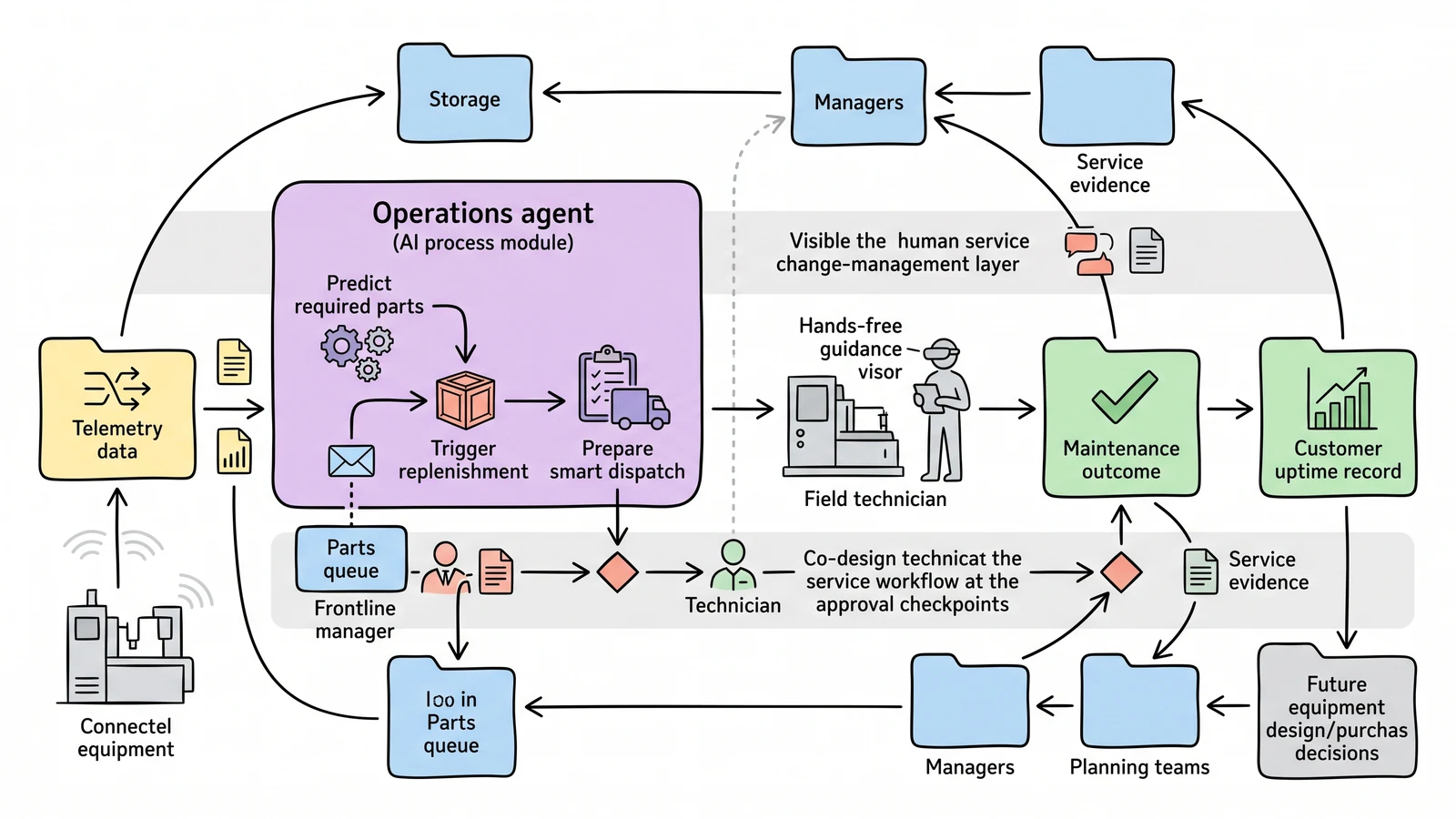
Field service is a useful test of whether agent adoption changes an operating model or merely adds another interface. BCG connects AI agents with equipment telemetry, dispatch, parts, technician hardware, customer relationships, and the management layer between strategy and frontline execution.
The mechanism starts before a technician arrives. Connected equipment provides operating data. Agents can predict parts usage and trigger replenishment, rank service needs, improve scheduling, and prepare the next action. In the field, guided workflows and extended-reality hardware deliver institutional knowledge while the technician remains hands-on.
BCG reports a transport-maintenance engagement where extended-reality guidance and the surrounding process redesign reduced rework by 40% and shortened maintenance execution by 25%. It estimates broader productivity gains of 20% to 30% and profit per technician improvements of up to 80%. These are BCG calculations and case outcomes, not universal benchmarks.
The article attributes 70% of the value-unlocking effort to organization and change management rather than code. Its emphasis on the “messy middle” is concrete: frontline managers activate the new process, technicians co-design it, and training makes the workflow usable. Without those roles, isolated predictions do not alter dispatch, maintenance, or commercial decisions.
BCG recommends moving from individual pilots to a portfolio: diagnose the worst pain points, build a roadmap and initial pilots, turn evidence into a business case, then redesign the full workflow with user testing, data enablers, and iteration. The target can extend beyond cost reduction to outcome-based service contracts where customers pay for uptime.
For New Runtime, this gives AI consulting a stronger unit of work. The deliverable is not an agent demo. It is a connected decision loop with measurable field outcomes, explicit owners, edge hardware, institutional knowledge, and a change program that makes the loop operable after the consultants leave.