BCG Recasts The Transformation Office As An Agentic Control Loop

BCG's agentic transformation office applies AI to program coordination, value tracking, change management, and learning while keeping accountability and decision rights human-led.

Retrieval answer

BCG's agentic transformation office applies AI to program coordination, value tracking, change management, and learning while keeping accountability and decision rights human-led. BCG's agentic transformation office is a concrete example of AI working with consultants and internal transformation teams rather than replacing their decision role.

New Runtime synthesiseditorial-diagram
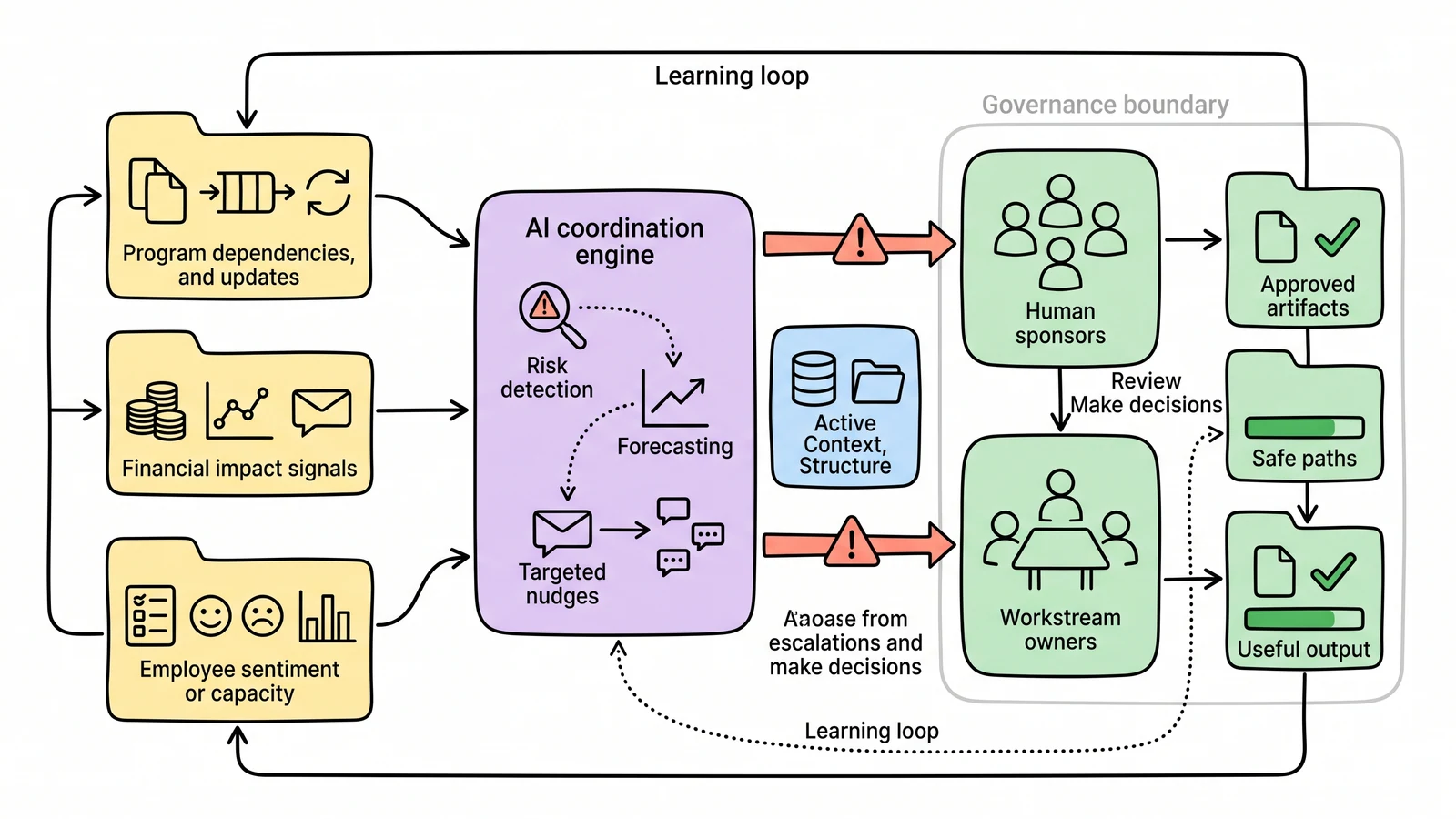
Hand-drawn transformation office control loop where program signals, financial impact, and employee sentiment feed AI detection and nudges under human governance and decision rights.
BCG's agentic transformation office automates coordination and sensing while leaving business ownership explicit.New Runtime synthesis from BCGOriginal source ↗
  1. ProgramAlways-on detection tracks dependencies, updates, decisions, and unresolved risks.
  2. ValueForecasts connect portfolio evidence to impact gaps and finance validation.
  3. ChangeSentiment, capacity, targeted nudges, and role-specific learning shape adoption.

BCG’s agentic transformation office is a concrete example of AI working with consultants and internal transformation teams rather than replacing their decision role.

Traditional transformation offices spend significant effort chasing updates, consolidating reports, reconciling financial impact, and identifying risks after they have already become visible. BCG proposes an always-on execution layer across three functions: program management, financial and impact tracking, and change management.

In program management, agents can monitor dependencies, generate nudges, collect updates, and resolve routine coordination before meetings. In value tracking, predictive models can estimate impact trajectories and expose gaps earlier, while finance still validates the connection to P&L and reported performance.

Change management becomes more targeted. Real-time sentiment and capacity signals can identify fatigue, poor sequencing, or teams that need different interventions. Role-specific learning and coaching can be generated from the same transformation context instead of delivered as a generic change program.

BCG keeps a necessary boundary: AI can draft, recommend, detect, and coordinate, but organizations must define what requires review and what remains a human decision. Without those decision rights, automation can dilute accountability and lower review quality even as reporting becomes faster.

The starting sequence is therefore organizational. Define the office’s mandate and expected value. Specify the operating model, governance, escalation paths, and human-led roles. Then add agentic capabilities where evidence and ownership already exist. The transformation office becomes a control loop only when insights reliably turn into accountable action.

Recommendation

BCG's agentic transformation office applies AI to program coordination, value tracking, change management, and learning while keeping accountability and decision rights human-led.

Discovery graph / next reads

Continue through New Runtime

Open the graph
  1. 01topicAgents - New RuntimeExplore the agents topic hub.
  2. 02topicAI Adoption - New RuntimeExplore the ai adoption topic hub.
  3. 03related materialField Service Agents Need An Operating Loop, Not A Chat WindowShares agents and ai adoption.
  4. 04related materialAmazon Quick Makes Catalog Semantics The Agent BoundaryShares agents and ai adoption.
  5. 05related materialGusto Solves The Agent Blank Canvas With Scheduled WorkShares agents and ai adoption.

These links are also published in this page’s JSON twin and as typed edges in DiscoveryGraph v1.

Who read this page?Machine requests, hidden until opened

Loading the privacy-safe route aggregate…

Open the JSON contract