GitHub Stacked PRs Turn Large Agent Changes Into Reviewable Chains

GitHub's stacked pull request preview gives large dependent code changes a native review path, which matters as agents produce broader diffs.

Retrieval answer

GitHub's stacked pull request preview gives large dependent code changes a native review path, which matters as agents produce broader diffs. GitHub's stacked pull requests preview gives teams a native way to break one large code change into a chain of smaller dependent pull requests.

New Runtime synthesiseditorial-diagram
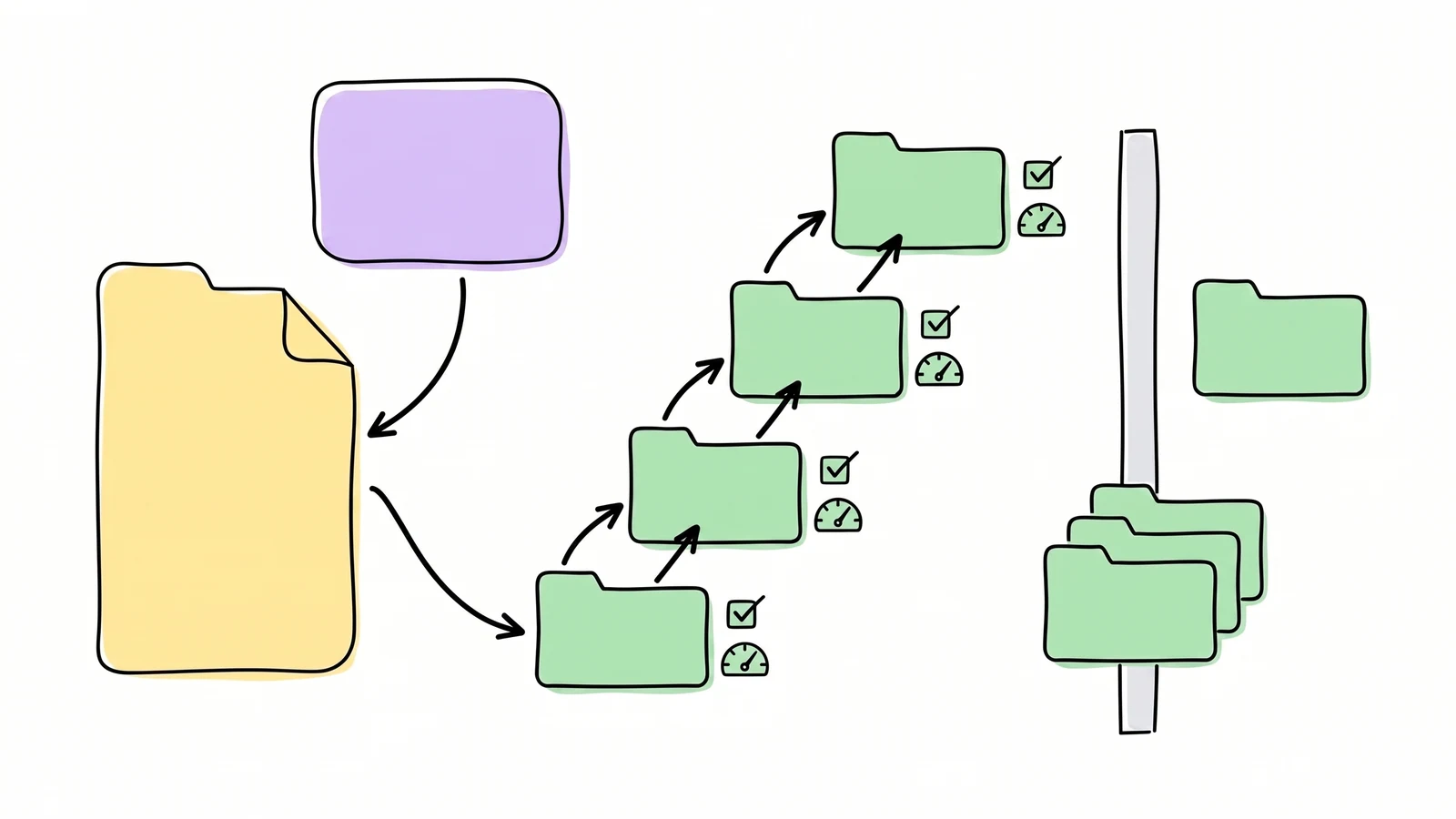
Hand-drawn review diagram where a large agent code change is split into a chain of smaller dependent pull requests with review, CI, and merge gates.
Stacked PRs give dependent code changes a smaller review surface without hiding the order of the full change.New Runtime synthesis from public source inspectionOriginal source ↗
  1. ChainA large change becomes a sequence of smaller dependent pull requests.
  2. ReviewEach pull request can be reviewed and merged independently.
  3. CIGitHub documents stack metadata and ways to reduce redundant CI usage.

GitHub’s stacked pull requests preview gives teams a native way to break one large code change into a chain of smaller dependent pull requests. The docs position the feature around review and mergeability: each pull request in the chain can be reviewed and merged independently.

That matters even more in agent-assisted development than in manual development. Agents are good at producing broad patches. Teams are still bottlenecked by understanding, reviewing, testing, and safely merging those patches. A stack makes the work legible: foundation change first, dependent change next, product surface after that.

GitHub’s docs cover creating stacked pull requests with the gh stack extension or directly on GitHub, restructuring stacks, rebasing branches, merging from the bottom up, merging individually, merging contiguous groups, and optimizing GitHub Actions for stack-aware CI.

The important product move is that the stack is not a private convention hidden in branch names. It becomes a review object with documented CLI behavior, web review, merge strategy, and CI metadata.

New Runtime Read

The scarce resource in coding-agent workflows is not code generation. It is review bandwidth.

Stacked PRs are a useful answer because they make a large agent output decomposable without pretending the pieces are independent. The better default for agent work is not “one giant PR with a heroic reviewer.” It is a chain where each layer has its own diff, evidence, CI result, and merge decision.

Recommendation

GitHub's stacked pull request preview gives large dependent code changes a native review path, which matters as agents produce broader diffs.

Discovery graph / next reads

Continue through New Runtime

Open the graph
  1. 01topicCoding agents - New RuntimeExplore the coding agents topic hub.
  2. 02topicDeveloper Tools - New RuntimeExplore the developer tools topic hub.
  3. 03related materialReviewBench Turns Code Review Into An Agent EvalShares coding agents and developer tools.
  4. 04related materialCursor Treats the Cloud Agent Environment as the ProductShares coding agents and developer tools.
  5. 05related materialCursor's SQLite Swarm Makes Coordination the Expensive PartShares coding agents and developer tools.

These links are also published in this page’s JSON twin and as typed edges in DiscoveryGraph v1.

Who read this page?Machine requests, hidden until opened

Loading the privacy-safe route aggregate…

Open the JSON contract