Cursor returned to an experiment its earlier coding swarm had struggled with: implement the 835-page SQLite manual in Rust without access to SQLite’s source, test suite, binary, or the internet. The new harness performed better than the old one under every tested model configuration.
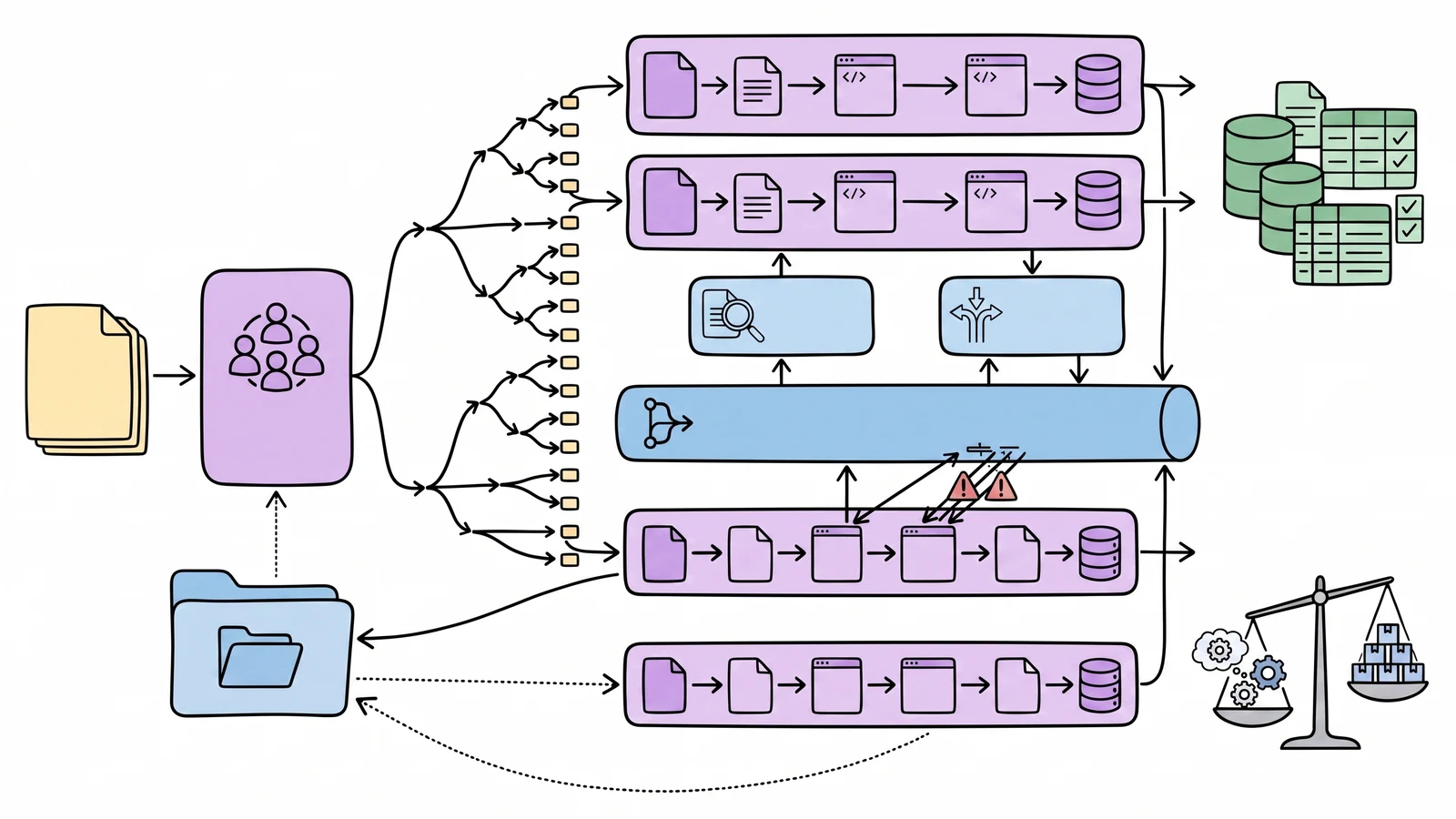
The result is useful because the task is too large for “one agent, one context window” to explain it. Cursor splits the system into planners and workers. Planners keep the goal and design tree in view; workers spend their context on narrow leaves. The claimed scaling benefit comes from context isolation as much as parallelism.
That decomposition creates a second problem: coordination at machine tempo. Cursor says its swarm can peak near 1,000 commits per second, so normal Git locks, human review queues, and informal ownership no longer fit. It built a dedicated version-control layer where collisions become visible, used neutral agents to resolve merge conflicts, recorded shared design decisions, and blocked work on “megafiles” until an outside agent decomposed them.
The memory mechanism is also explicit. A shared Field Guide is injected into new agents under a line budget. Agents are expected to capture surprising failures and reusable discoveries so later trajectories get shorter. Review is not one final pass: several decorrelated review lenses inspect different views of the work.
What changed in the economics?
Cursor tested four planner/worker model mixes. The new harness eventually passed the full held-out suite in every configuration, but reported total costs ranging from about $1,339 to $10,565. Workers consumed at least 69% of tokens and more than 90% in most runs. In the hybrid where an expensive planner directed cheaper workers, the planner produced a small fraction of tokens while worker execution stayed inexpensive.
This is stronger than the vague claim that “small models can do easy work.” The valuable boundary is uncertainty. Expensive reasoning belongs where the system must decompose intent, choose architecture, reconcile disagreement, or review a consequential change. Once that ambiguity becomes an explicit task, cheaper workers can carry most of the token volume.
The experiment is still vendor-reported, and passing a held-out SQL suite does not by itself establish maintainability or production safety. The released miniSQLite repository makes the artifact inspectable, which is why it matters as a separate piece of evidence.
New Runtime read
The scarce component in a swarm is not parallel inference. It is a coordination substrate that turns intent into bounded work, preserves decisions, detects collisions, and spends review compute before errors become architecture.