Cursor’s cloud-agent environment post is one of the clearest public descriptions of what it takes to make cloud coding agents useful inside a real engineering organization.
The headline number is striking: Cursor says cloud agents authored roughly one in ten PRs merged to its monorepo in December, and now write more than half. The more useful part is how they got there.
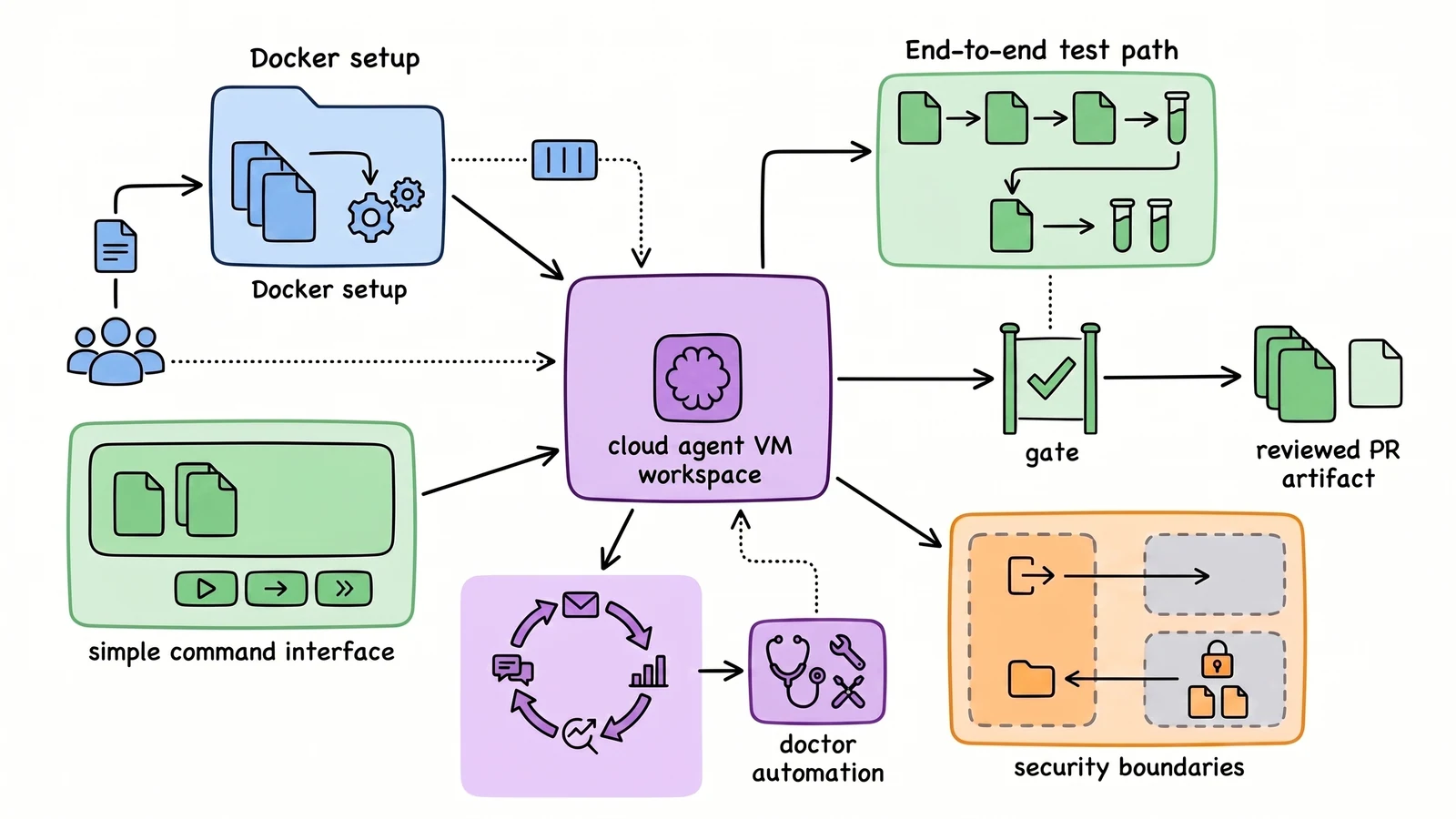
Cursor had to make a local Mac-oriented development workflow work on Ubuntu VMs. It added critical development dependencies to a Cursor-defined Dockerfile, then built a CLI called anydev so agents could start services and run common utilities through one simpler interface. anydev also has a supervisor for long-running build commands, removing that burden from the model.
Security had to become product surface too. Cursor describes network egress restrictions, scoped and proxied git remote access, commit and commit-message secret scanning, and redaction in tool results so an agent cannot read secret values even when it tries.
The most interesting layer is repair. Cursor Cloud MCP lets agents inspect their own environment for setup failures, egress policy, changed secrets, and related state. Cloud Doctor periodically checks failures, separates transient from salient errors, does root-cause analysis, and can open PRs to fix issues with high confidence.
New Runtime Read
This is the same lesson as the site’s harness and verification notes: the chat box is not the product boundary for an agent. The real product is the environment the agent can operate inside.
For agent teams, that means measuring the setup path, command surface, secrets boundary, testability, and repair loop. A model that can reason well still fails if the runtime makes it juggle hidden build steps, stale dependencies, and opaque failures.