A Codex Skill Turns Multi-Agent Work Into a Reusable Control Surface

A shared Codex orchestration skill points to a future where agent workflows are packaged as portable operational routines.

Retrieval answer

A shared Codex orchestration skill points to a future where agent workflows are packaged as portable operational routines. The Codex orchestration skill signal is small but structurally important. It points to a workflow where a reusable skill becomes the control surface for multi-agent work: it can define the task shape, spawn or coordinate workers, collect artifacts, and return the result.

New Runtime synthesiseditorial-diagram
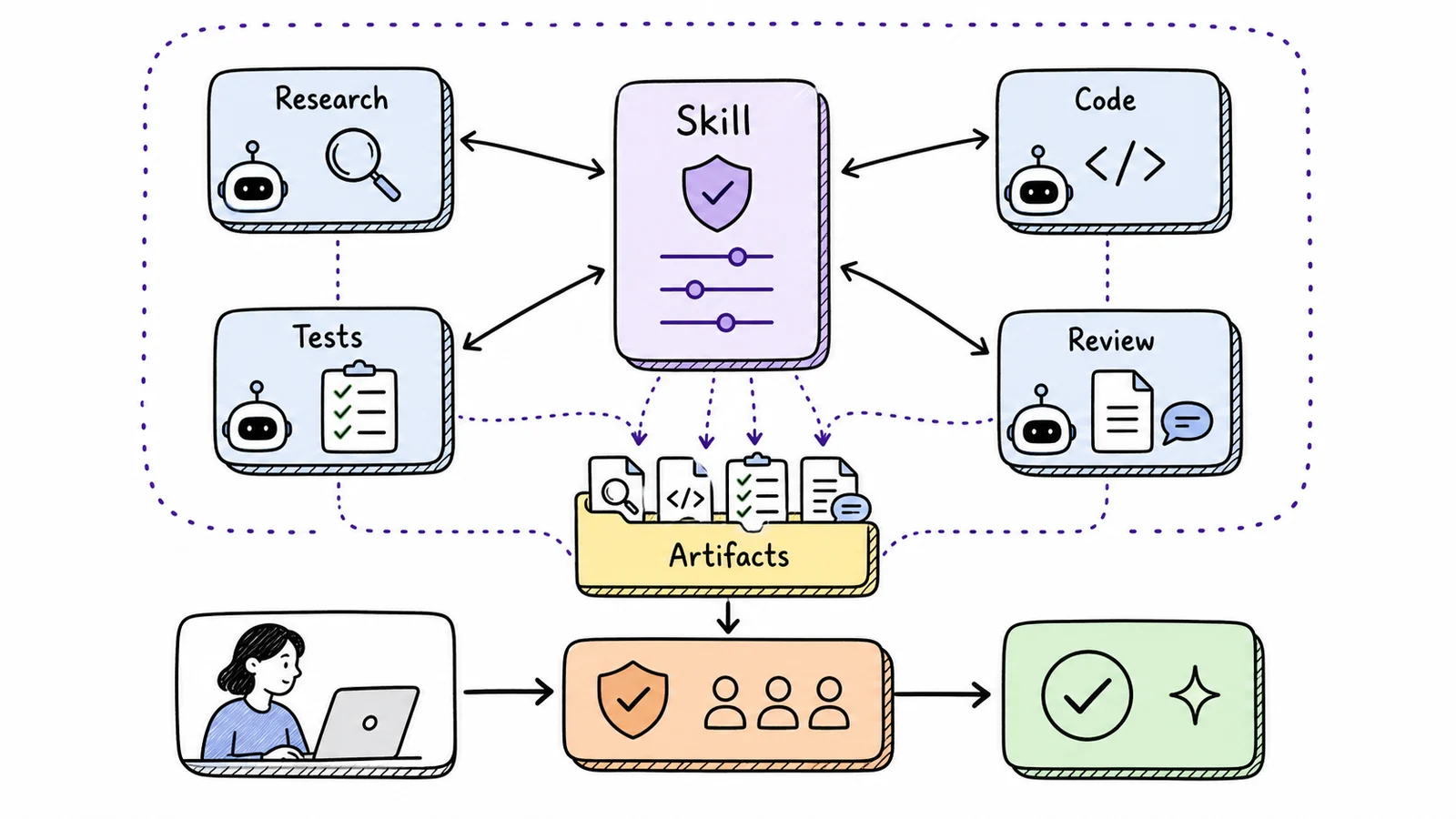
Hand-drawn hub-and-spoke diagram where a reusable skill coordinates research, code, tests, review, and artifacts.
A reusable skill is a control surface: it scopes worker lanes, gathers artifacts, and routes the result back to human review.New Runtime synthesisOriginal source ↗

The Codex orchestration skill signal is small but structurally important. It points to a workflow where a reusable skill becomes the control surface for multi-agent work: it can define the task shape, spawn or coordinate workers, collect artifacts, and return the result to a human review lane.

That is more durable than a one-off prompt. A prompt can describe what the agent should do now. A skill can preserve how a team does this kind of work repeatedly: which files matter, which checks must run, how outputs are grouped, and what evidence is needed before the result is trusted.

This is also where multi-agent systems get practical. The hard problem is usually not creating more agents; it is constraining the work so parallelism does not create unreadable output or conflicting changes. Skills are a natural place to encode those boundaries.

What is the measurable signal?

This note is intentionally based on 1 public source, so the evidence level is narrow. The durable signal is the package shape: a skill can turn a repeatable multi-agent procedure into an artifact that is shared, inspected, and revised instead of being lost inside a one-off chat.

For New Runtime, the pattern is clear: agent capability is becoming portable. The artifact is not just model output. It is the packaged procedure that turns model output into repeatable work.

Source

Recommendation

A shared Codex orchestration skill points to a future where agent workflows are packaged as portable operational routines.

Discovery graph / next reads

Continue through New Runtime

Open the graph
  1. 01topicAI Infrastructure - New RuntimeExplore the ai infrastructure topic hub.
  2. 02topicCoding agents - New RuntimeExplore the coding agents topic hub.
  3. 03related materialClaude.md Shrinkage Says the Harness Is Learning What Not to SayShares ai infrastructure and coding agents.
  4. 04related materialCodex Hooks Close the Type Error LoopShares ai infrastructure and coding agents.
  5. 05related materialPrompt Caching Turns Agent Context Into InfrastructureShares ai infrastructure and coding agents.

These links are also published in this page’s JSON twin and as typed edges in DiscoveryGraph v1.

Who read this page?Machine requests, hidden until opened

Loading the privacy-safe route aggregate…

Open the JSON contract