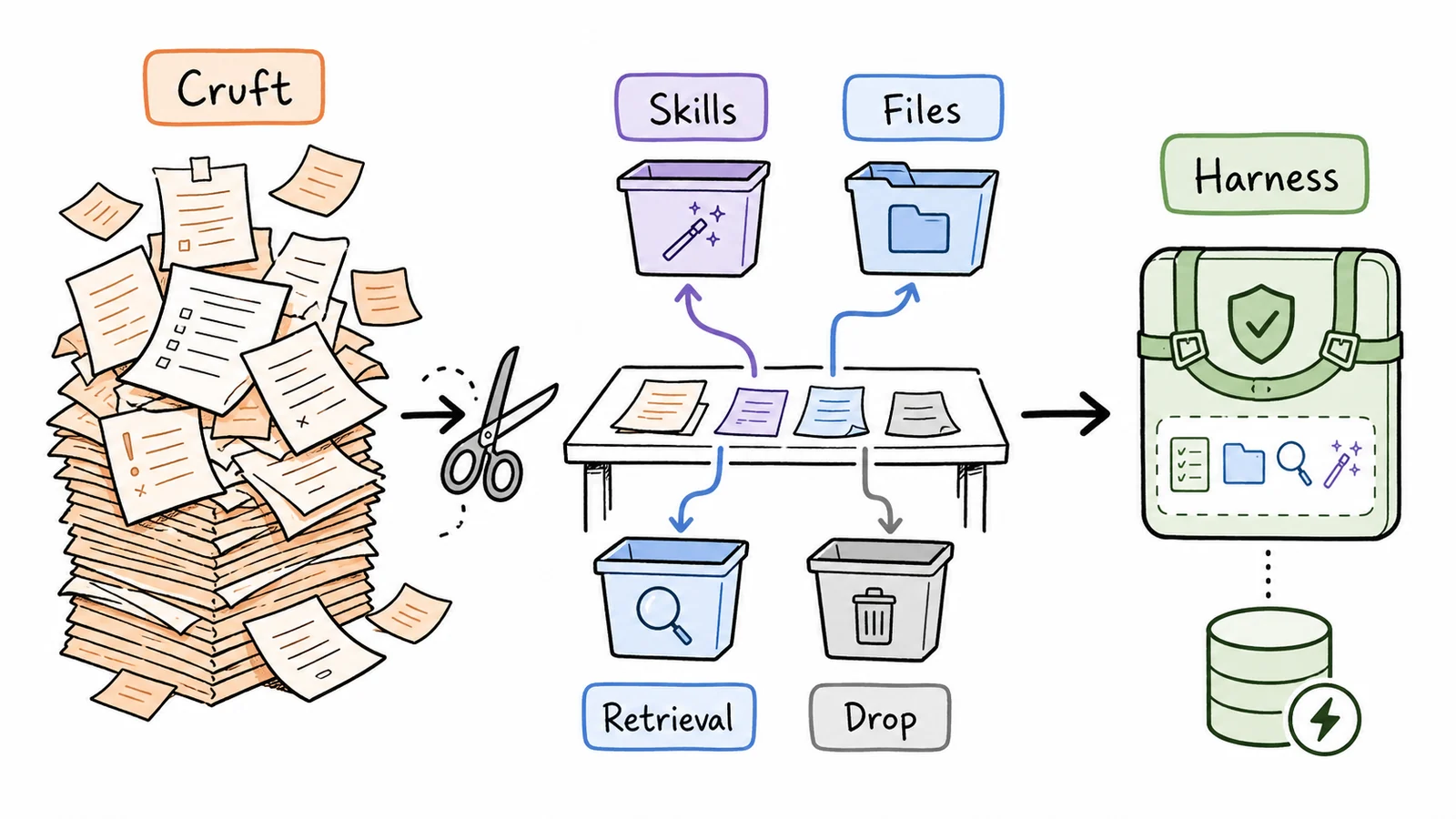
The important part of the Claude Code prompt-shrinkage note is the direction of travel. Early agent harnesses often accumulate instructions like sediment: every failure adds another rule, another paragraph, another warning. Over time that creates a prompt that is expensive, hard to debug, and full of stale compromises.
Removing most of that material says the harness is learning what should not live in the global context. Some knowledge belongs in skills, some in project files, some behind retrieval, and some should be dropped because it only encoded a workaround for an older model or workflow.
That makes prompt design less like writing a giant constitution and more like runtime architecture. The question becomes where each instruction belongs, how often it is needed, whether it should be cached, and whether it changes the model behavior in a measurable way.
What does an 80% reduction imply?
This note uses 1 public source for the reported 80% shrinkage, but the architectural claim is not that every prompt should become short. The claim is that stable context should be factored into skills, files, retrieval, or deletion so the global prompt stops carrying stale operational debt.
This is a strong New Runtime signal because it reframes agent quality as context engineering. The winning harness may be the one that says less by default and routes sharper context only when the task actually needs it.