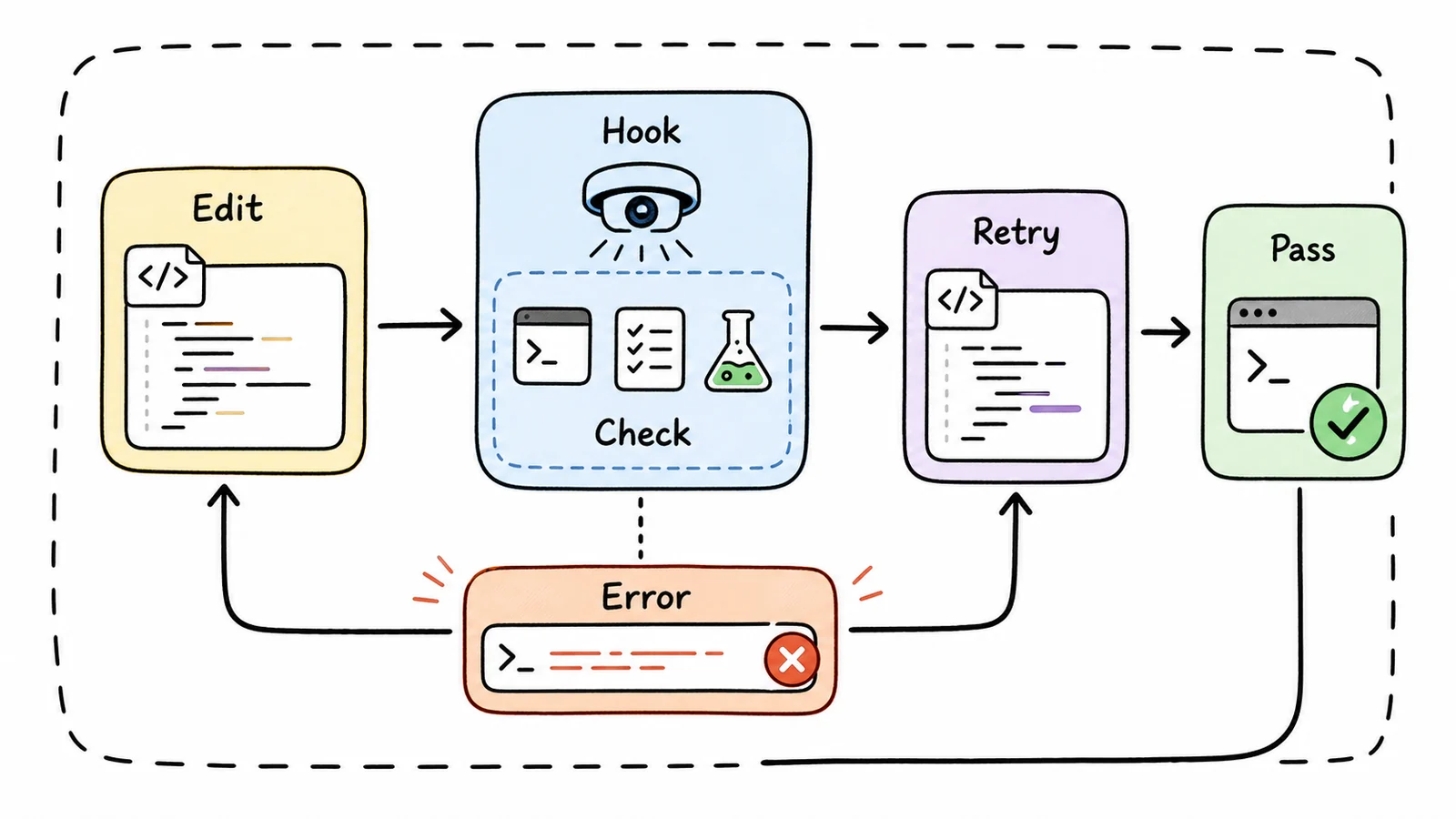
Codex hooks matter because they make validation output part of the live agent loop. A type error, lint failure, or project-specific check can be returned while the agent is still inside the task, before the work drifts into a larger and harder-to-review change.
That changes the role of deterministic tooling. Tests and typecheckers are not only final gates after a developer thinks the work is done. They become sensors inside the loop, giving the agent a hard signal that its last edit violated the system.
The result is a tighter generate, verify, retry cycle. The model still proposes changes, but the workflow does not rely on the model to know whether those changes are valid. The hook supplies a stricter source of truth and lets the agent adjust while context is fresh.
What loop gets closed?
This note tracks 1 public source and 1 mechanism: a hook that returns deterministic check output to the agent while the task is still active. That is enough to change the workflow from final inspection to live correction, especially for type errors, lint failures, and project-specific checks.
For New Runtime, this is one of the cleanest examples of agent-ready software. The useful product surface is not just a chat box; it is the runtime boundary where ordinary engineering tools become feedback channels for an agent.