Claude Cowork Turns Screen Recordings Into Reusable Skills

Claude Cowork's recorded-skill flow makes workflow capture a first-party path from human demonstration to reusable agent capability.

Retrieval answer

Claude Cowork's recorded-skill flow makes workflow capture a first-party path from human demonstration to reusable agent capability. Claude Cowork is moving skill creation from written instructions toward observed work. The reported flow records a screen walkthrough while the user narrates the task, then turns that demonstration into a skill Claude can reuse later.

New Runtime synthesiseditorial-diagram
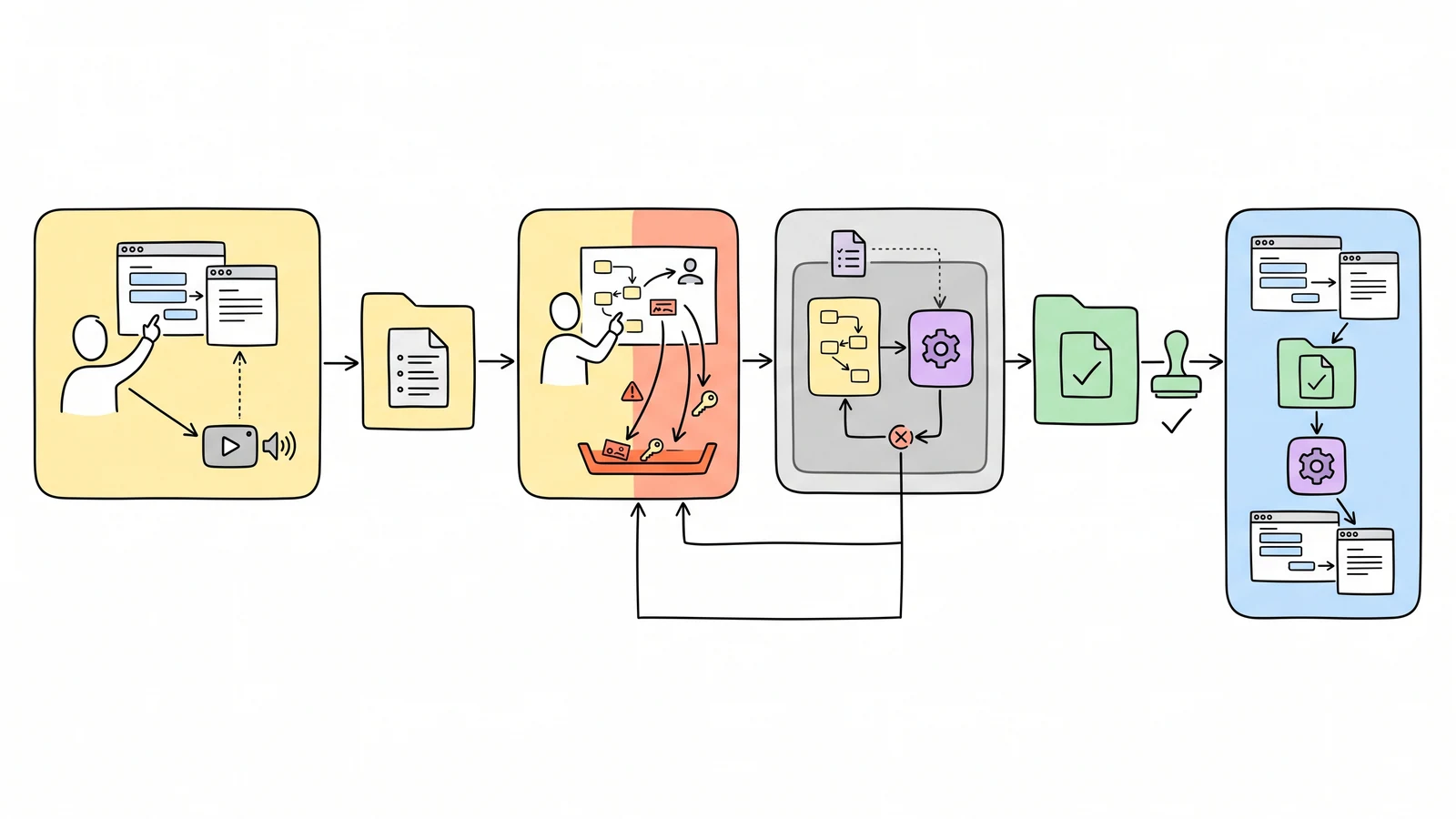
A six-stage workflow turns a narrated screen demonstration into an inspected, tested, versioned, and reusable agent skill with a failure loop back to review.
Recorded workflows are draft automation: record, extract, inspect, test, version, and only then reuse.New Runtime synthesis from Claude Cowork's recorded-skill workflowOriginal source ↗
  1. RecordCapture the human demonstration and narrated intent across the relevant work surfaces.
  2. ExtractTurn the observed sequence into a draft procedure instead of preserving a raw transcript.
  3. InspectRemove accidental clicks, hidden credentials, fragile UI assumptions, and outdated business rules.
  4. TestRun the cleaned procedure on a real bounded task and route failures back to inspection.
  5. VersionApprove and store an inspectable skill package only after the behavior is reproducible.
  6. ReuseCall the versioned skill in later sessions while keeping the procedure editable.

Claude Cowork is moving skill creation from written instructions toward observed work. The reported flow records a screen walkthrough while the user narrates the task, then turns that demonstration into a skill Claude can reuse later.

That is a different product boundary from “save this prompt.” The reusable unit is no longer only a paragraph of process advice. It can include the demonstrated sequence, the intent behind the sequence, and the operational context needed to repeat it.

What changed?

The important signal is not that Claude can watch a video. The signal is that a mainstream agent surface is treating human demonstration as a capability authoring path.

Recorded skills make the agent memory loop more concrete: watch work, extract procedure, package the procedure, and make it callable in later sessions. If the generated skill remains inspectable and editable, the result starts to look like lightweight process automation rather than a chat transcript.

New Runtime Read

Teams should treat recorded skills as draft automation, not as finished infrastructure.

The high-value loop is record, inspect, test, version, and then reuse. Without review, a recorded workflow can preserve accidental clicks, fragile UI assumptions, hidden credentials, or outdated business rules. With review, it becomes a fast way to turn tacit work into a portable agent capability.

Recommendation

Claude Cowork's recorded-skill flow makes workflow capture a first-party path from human demonstration to reusable agent capability.

Discovery graph / next reads

Continue through New Runtime

Open the graph
  1. 01topicAgent memory - New RuntimeExplore the agent memory topic hub.
  2. 02related materialHermes Agent Makes the Learning Loop Part of the RuntimeShares agent memory and agent skills.
  3. 03related materialABBEL Treats Memory as an Explicit Belief StateShares agent memory.
  4. 04related materialOpenWorker Brings The Coworker Agent Back To The DesktopShares workflow automation.
  5. 05related materialMem0 Shows Agent Memory Should Not All Live in ContextShares agent memory.

These links are also published in this page’s JSON twin and as typed edges in DiscoveryGraph v1.

Who read this page?Machine requests, hidden until opened

Loading the privacy-safe route aggregate…

Open the JSON contract