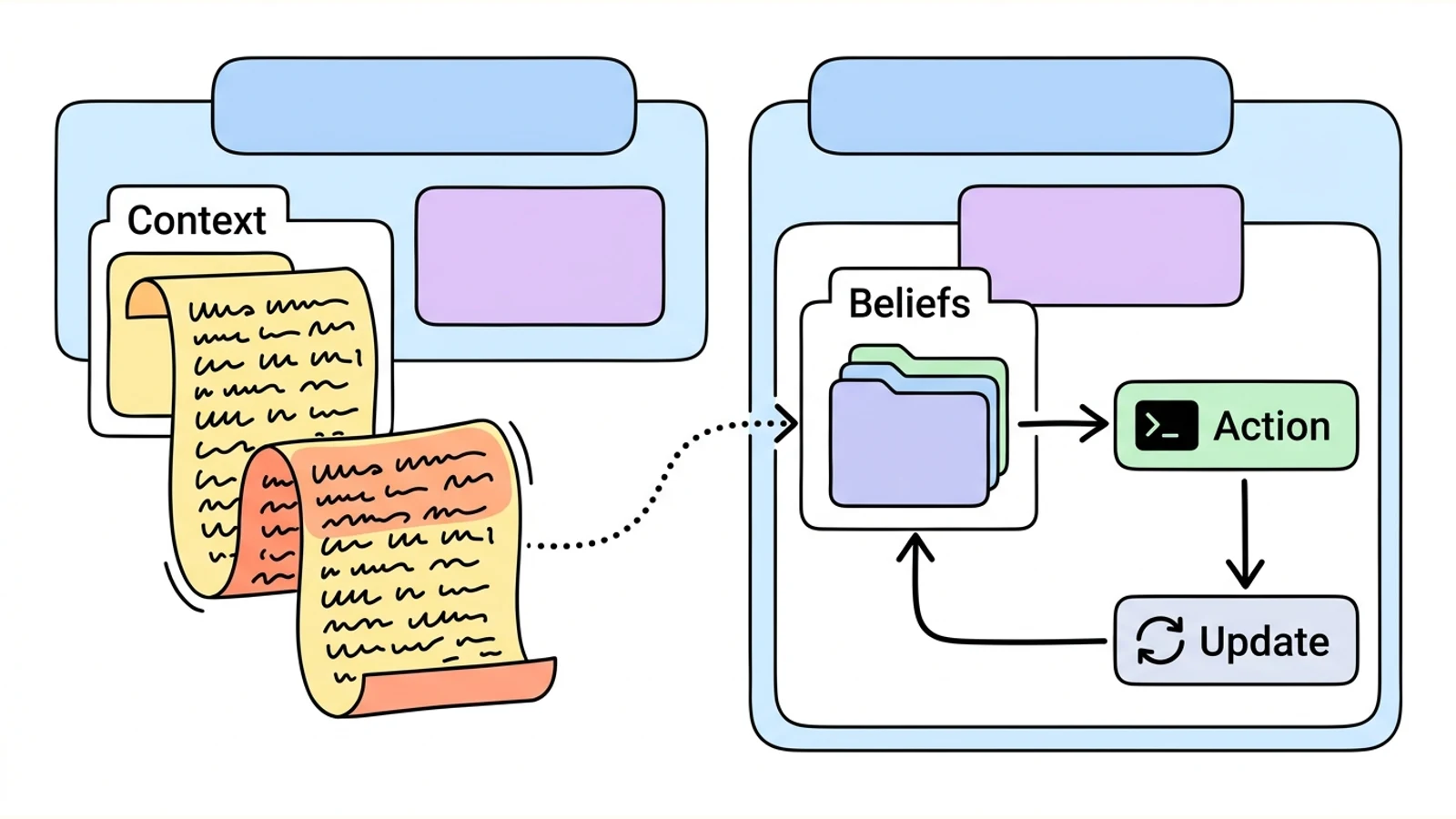
The BAIR ABBEL post is about a memory problem that keeps showing up in agent systems: longer context is not the same as better memory. A model can carry a huge transcript and still fail to keep the right state available for the next decision.
ABBEL reframes the problem as belief-state learning. Instead of repeatedly stuffing more conversation into the window, the system learns natural-language belief states that preserve the information needed for future interaction. The belief state becomes an explicit bottleneck.
That bottleneck is valuable because it is inspectable. Operators can read it, compare it with the source interaction, and reason about whether the agent is carrying the right assumptions forward. It also opens product controls that raw hidden activations do not: editing, transmitting, or rewarding changes in memory state.
The post is careful that text memory is not the whole answer. Some information is not represented well as text alone, and future systems may combine working memory, long-term memory, adapter-like memory, continuous context, or test-time learning. Still, explicit belief states are a strong interface for the next layer.
New Runtime synthesis: memory should not be a landfill of context. For long-running agents, the useful question is what belief state survives the interaction and how that state changes the next action.