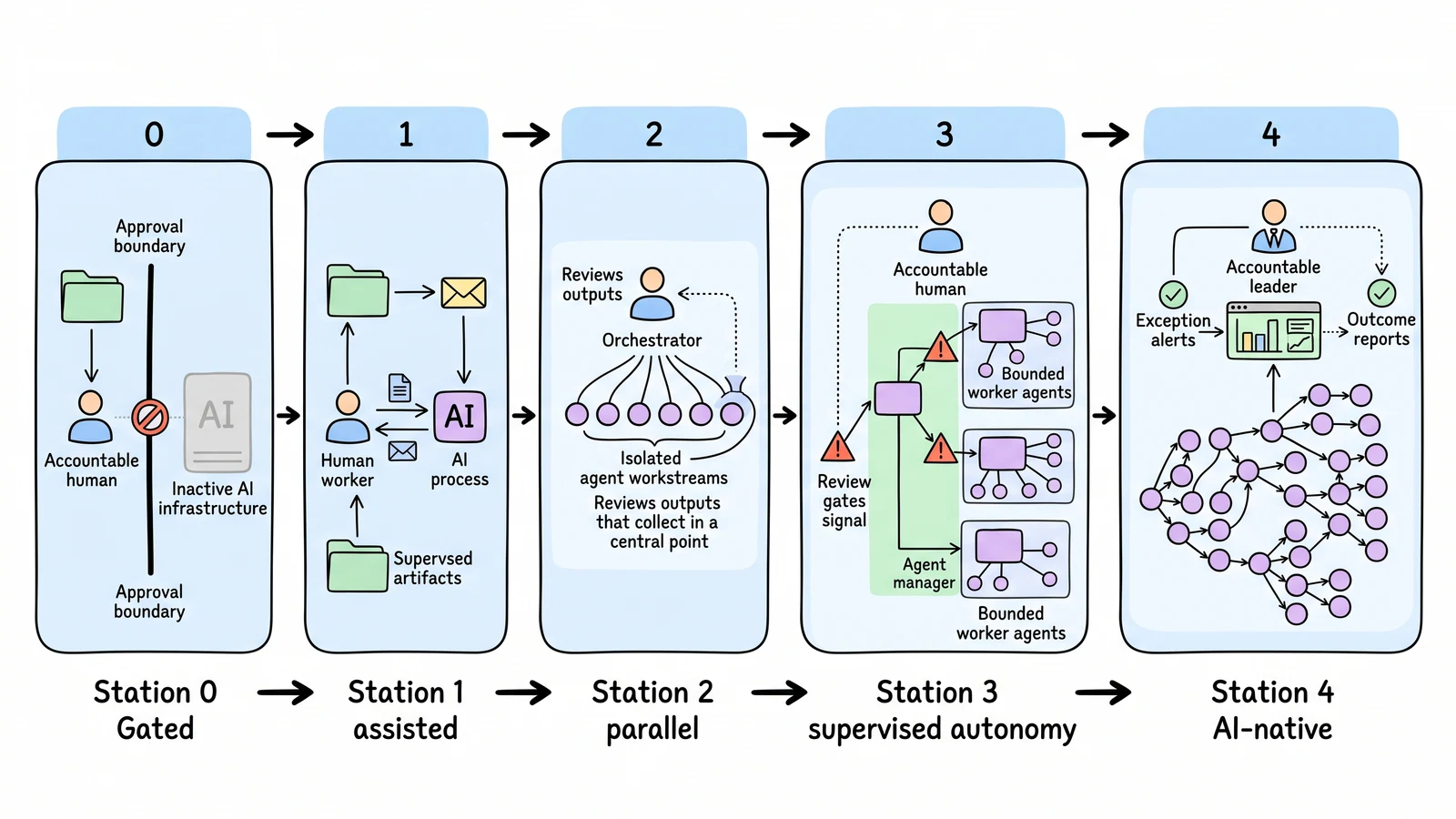
Boris Cherny describes four steps of AI adoption, but the artifact is easiest to read as five states numbered from 0 to 4:
- Gated: capable models are inaccessible or too constrained for serious work.
- Assisted: individuals pair with one AI and improve personal output.
- Parallel: individuals coordinate several agents on bounded tasks.
- Supervised autonomy: agents delegate to other agents while humans review outcomes and exceptions.
- AI-native: leaders steer large amounts of automated work through intent, systems, and controls.
That means four transitions across five states. The distinction matters because most organizations do not fail at model access. They fail while changing the operating system around the model.
The hard part at each transition
Assisted work needs good individual practice. Parallel work needs task decomposition and visibility. Supervised autonomy needs evaluation, permissions, idempotency, and escalation. AI-native operation needs portfolio-level governance: which work exists, who owns the outcome, where risk accumulates, and how the organization notices systemic drift.
The map is a directional framework, not a maturity score that every team must maximize. Some regulated or high-consequence workflows should intentionally remain assisted or supervised.
New Runtime Read
Our newsroom spans several states at once. Manual source selection and final publication are assisted. Source processing and verification can run in parallel. OpenClaw handoff is supervised autonomy because it can prepare and preview work but publication still requires an explicit owner command.
The next adoption step is therefore not “more agents.” It is better coordination evidence: shared state, stable handoffs, cost limits, receipts, and explicit exception queues.
An organization becomes AI-native when intent can move through the system without making responsibility disappear.