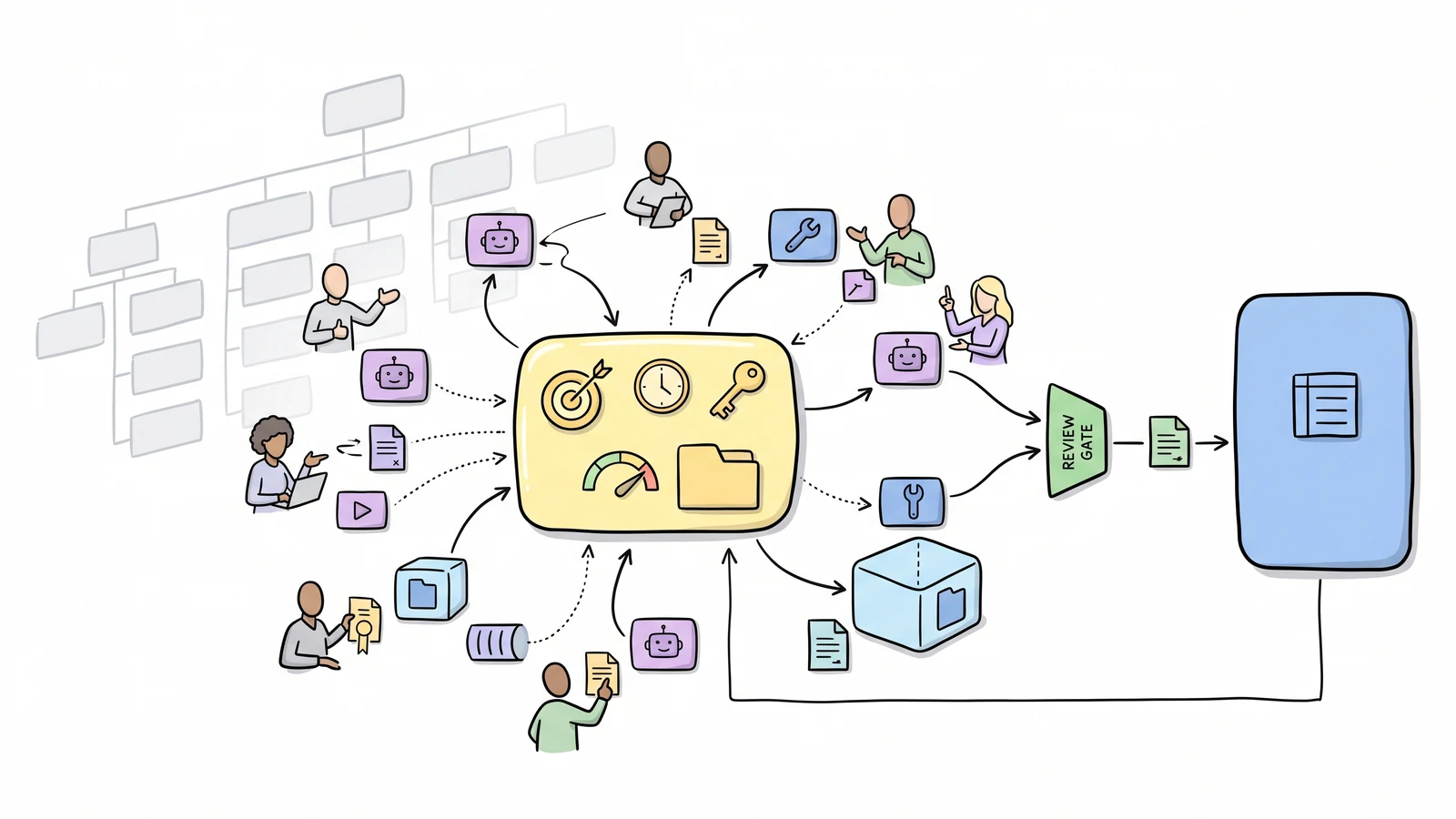
The next entrant to the org chart may not be an AI agent. It may be a goal.
Not a goal as a sentence in a strategy document, a KPI in a dashboard, or a ticket waiting in a queue. The emerging object is a durable executable mandate: a bounded outcome with its own addressable state, memory, authority, resource limits, runtime, attached capabilities, acceptance tests, and history of decisions. People and agents can assemble around that mandate for as long as the work requires, then disperse after an accountable owner accepts the result.
The dry formulation is less provocative and more useful: organizational duty is becoming a persistent executable object.
This thesis does not extrapolate one product feature. It connects a contradiction across several independent shifts. Execution is becoming more parallel, fluid, and less dependent on a pre-existing team. Yet reliable organizations cannot make authority, memory, accountability, and acceptance equally fluid. The more execution can move, the more the mandate itself must become stable.
The missing unit between a task and an employee
The current language is inadequate. A task is usually too thin: it has a description and perhaps a due date, but no durable execution environment or authority model. An agent is too executor-centric: it foregrounds who acts, even when the executor can be swapped between runs. A project is usually too broad and socially loaded: it implies a team, plan, budget, and reporting structure assembled in advance.
A goal-object sits between them. It says what state should change, which evidence counts as completion, what resources may be spent, which systems may be touched, which exceptions require a person, and what survives after the run. It can use one agent, several agents, deterministic software, a human specialist, or all of them in sequence. Its identity does not have to be the identity of any executor.
This is already visible in fragments. Google’s Managed Agents gives background runs stable identities and resumable interaction. OpenAI Workspace Agents describes shared agents with schedules, permissions, and approvals. Cloudflare’s Agent Access Model argues that every run should receive short-lived, task-scoped authority with real-time least privilege and an audit trail. Vercel Sandbox and Cursor Self-Hosted Machines make execution environments temporary and allocatable. GitHub Agentic Workflows turns a natural-language workflow into a policy-constrained automation artifact.
None of these products creates the new organizational unit alone. Together, they make it technically plausible for the mandate to persist while the execution topology changes underneath it.
Anatomy of an executable mandate
For a goal to become operational rather than metaphorical, it needs at least seven separable properties.
1. Addressable state
The work needs an identity that survives a tab, chat, model turn, and worker. An operator must be able to ask what is running, what changed, what is blocked, and what evidence exists without reconstructing the task from a conversation transcript.
2. Scoped authority
The mandate needs an explicit answer to: what may this run read, write, spend, schedule, deploy, or publish? Authority should be granted to the task for a bounded period, not inherited indefinitely from a powerful user session.
3. A resource envelope
Time, money, tokens, machines, retries, and human attention are not implementation details. They define how far the mandate may search before it must narrow, escalate, or stop. A goal without a resource boundary is an aspiration connected to an open-ended bill.
4. Continuity
Workspace state, evidence, intermediate artifacts, decisions, and corrections must outlive an individual model context. This is why company memory needs write and correction loops, not merely retrieval over a large corpus.
5. Attachable capabilities
The mandate should be able to load a skill, tool, policy, evaluator, or specialist only when required. Anthropic’s record-a-skill workflow is an early version of this idea: an observed human procedure can become a reviewable reusable capability rather than remaining private muscle memory. This also extends the existing pattern that skills are becoming a portable capability layer.
6. External acceptance
The executor cannot be the sole judge of completion. Tests, policy checks, independent evidence, and accountable human review decide whether the result becomes part of the organization. The growing importance of this boundary is why verification bandwidth is becoming the scarce resource.
7. Institutional writeback
Accepted work must leave the organization different from how it found it. That change can be code, a decision, a customer record, a research artifact, a corrected instruction, a new evaluation case, or a physical measurement. A successful run should update the memory and capability available to the next mandate.
These properties make a goal more employee-like in one narrow sense: it becomes an addressable participant in the operating system of the company. But it is not a person, and anthropomorphizing it would hide the important design work. A goal has no judgment, duty of care, or moral agency. Its apparent autonomy is assembled from external controls.
The central paradox
The goal becomes quasi-organizational precisely because it cannot be trusted like an employee.
An employee carries context, professional norms, tacit knowledge, and accountability across assignments. An executable mandate has none of these by default. It must receive memory, identity, permissions, tools, budget, checks, and an escalation path as explicit infrastructure. The boundary is therefore stricter even as execution becomes more autonomous.
This tension produces an operating law:
The freer the execution, the harder the external mandate.
Autonomy does not grow because control disappears. It grows because control moves out of the executor and becomes inspectable: credentials, sandbox boundaries, spending limits, tests, review gates, receipts, rollback, and stopping rules.
That also sharpens the existing shift from manual continuation to goal-scoped agent loops. A long-running loop is only the local mechanism. The larger organizational change appears when the goal owns the loop’s state and can recompile who or what performs the next step.
From fixed teams to compiled execution
Traditional organizations route work through a relatively stable topology. A request enters a functional queue, a manager assigns it, specialists hand it across departments, and the org chart predicts most of the path. Even cross-functional project teams are usually assembled socially before execution starts.
Goal-centered execution reverses the order. First comes the bounded mandate. The system then selects an environment, tools, agent workers, relevant skills, evidence sources, and human specialists. That temporary topology exists until the result is accepted, rejected, or the mandate is recompiled under new constraints. The corresponding tectonic record is the shift from fixed teams to executable mandates.
Recent cases reveal pieces of the pattern. Anthropic’s study of roughly 400,000 Claude Code sessions found a division in which people retained more planning while the model performed more execution, although the evidence is software-heavy and does not establish broad business autonomy. OpenAI reports that aggregate agent runtime inside its research organization passed human labor time after June and reached 3.1 agent-workdays per human workday by mid-August. Yet more than half of successful four-to-eight-hour tasks still needed human intervention. Runtime has crossed a striking threshold; dependable independence has not.
The organizational evidence is similarly promising but bounded. In an OpenAI case study with Asana, four parallel agents turned a large migration backlog into a short campaign while people reviewed every change. In a loveholidays case study, engineering practices and validations were encoded into workflows that let non-engineering teams make changes to a real codebase. These are vendor-selected reports, not controlled studies. Their importance lies in the division of labor: expertise becomes attachable to a mandate, and the owner of the problem can borrow it without permanently moving the work into a specialist queue.
The unit that expands is therefore not the autonomous agent. It is the temporary execution configuration. A goal can summon several models, a deterministic script, an isolated machine, a reviewer, and a domain expert, then release them when the accepted artifact exists.
What becomes durable, and what becomes temporary
This design splits the organization into two layers.
The fluid layer contains execution: workers, model choice, prompts, machines, tool calls, and sometimes the human specialists involved. It should be replaceable because the best executor changes with cost, availability, risk, and task type.
The rigid layer contains the record: why the mandate exists, who owns the outcome, what authority was granted, which evidence was used, what was attempted, which checks ran, who accepted the result, and what state changed. That layer must be more durable than any agent session.
A recent research proposal, Fluid Structure, Rigid Record, describes a closely related architecture: task-specific operational worlds and dynamic task groups operating over persistent records and authority. Its prototype and small-sample experiments do not validate a large-scale organizational model. They do, however, show that the pieces cohere as a design rather than a collection of unrelated product features.
The strongest version of the thesis can now be stated:
The org chart becomes a cache; the ledger of accepted changes becomes the company.
That sentence is deliberately ahead of the evidence. Reporting lines, employment relationships, professional communities, and long-lived teams will not vanish. They hold culture, development, care, negotiation, and forms of judgment that a task graph cannot represent. The claim is narrower: the static org chart may cease to be the primary routing map for a growing share of knowledge work. Active mandates will compile a more temporary map at runtime.
Acceptance is the real management layer
If goals become active objects, management shifts from supervising steps to designing boundaries.
Managers and domain owners define which change is wanted, what evidence is admissible, which risks require escalation, and what counts as acceptance. They allocate authority and resources to the mandate, not blanket autonomy to a model. They also decide whether a result should update organizational memory or remain a one-off artifact.
This is why formal approval alone is insufficient. GitHub can now allow a Copilot code review approval to satisfy a required-approval rule when administrators enable it. That is a real institutional boundary: an agent judgment can affect whether a change is mergeable. But if the authoring agent and reviewing agent share correlated blind spots, a formally valid approval can still be semantically weak. A green check is evidence about a procedure, not automatic proof about the world.
Microsoft’s .NET experience with its coding agent makes the same constraint visible from another direction. Of 878 agent pull requests, 535 were merged, but maintainers initiated all of them; task selection, repository instructions, tests, and human review determined the result. Human pull requests also had a higher merge rate. The agent produced useful work, but the acceptance system remained the scarce capability.
The future management surface is consequently not a dashboard full of busy agents. It is a portfolio of mandates showing confidence, resource burn, pending decisions, blocked authority, evidence quality, and acceptance risk.
The physical-world boundary matters
The pattern becomes more consequential when an artifact is not just code or text. Anthropic’s Model Hardware Standard research preview shows early loops in which an agent can work through device drivers, observe measurements, adjust an experiment, and compress a discovered behavior into deterministic code.
That does not prove general laboratory autonomy. It proves something more specific: the executable mandate can potentially bind reasoning, tools, physical action, measurement, safety constraints, and a final reusable procedure into one governed object. In physical systems, the resource envelope and acceptance boundary stop being governance polish. They become part of the safety case.
Why this is still an emerging shift
The primitives are arriving faster than the evidence of dependable outcomes.
Cohere’s Automation Tooling Evaluation mapped 696,000 tools across 123,000 public servers, yet only 2.6 percent passed a strict test for completing an occupational task end to end. The public ecosystem contains enormous interface supply and very little demonstrated job-level coverage. Internal tools may perform better, but they are not visible in that measurement.
McKinsey reports that 94 percent of businesses have not generated meaningful value from AI. Its examples come from a selected set of successful companies and should not be treated as population-level causal proof. Still, the failure mode supports the distinction: tool access without an operating model does not create a durable new unit of work.
The market has many agents, sandboxes, skills, and workflow builders. It has far fewer systems that bind them to persistent mandates with defensible authority, evidence, and acceptance. The shift is therefore emerging, with medium confidence. The technical substrate is observable. The organizational object is an inference.
What to build now
Teams do not need to wait for a new enterprise platform. They can make one recurring goal explicit and give it the minimum viable anatomy:
- a stable identifier and accountable owner;
- a desired state change, not a vague activity;
- publishable evidence and explicit acceptance criteria;
- scoped systems, credentials, and write boundaries;
- a time, cost, and retry budget;
- attachable instructions, tools, and specialist review;
- checkpointed state and a visible exception queue;
- an immutable receipt for the accepted result;
- a governed writeback into memory, skills, or evaluations.
Then test whether the mandate survives a change of executor. Can a different model, machine, or human resume from the record without rereading the whole chat? Can authority be revoked without deleting the evidence? Can rejection trigger a narrower recompile rather than a blind retry? Can the next run use the accepted correction?
If the answer is no, the organization has an agent session, not a goal-object.
What would falsify the thesis
This thesis should weaken if the same outcomes are achieved more reliably with ordinary team queues and lightweight task records; if goal-scoped authority proves too costly to administer; if reusable skills fail to transfer domain judgment; if review burden grows faster than accepted work; or if persistent mandate state creates more stale policy and security exposure than continuity.
It should strengthen when organizations can show, across several domains, that a mandate preserves context through executor changes, allocates authority dynamically, produces accepted artifacts with bounded review cost, and updates a governed memory that improves later work.
The near-term signal to watch is not how many agents a company runs. It is whether the company can name its active goals as first-class objects and show the evidence by which each one enters — or fails to enter — institutional reality.