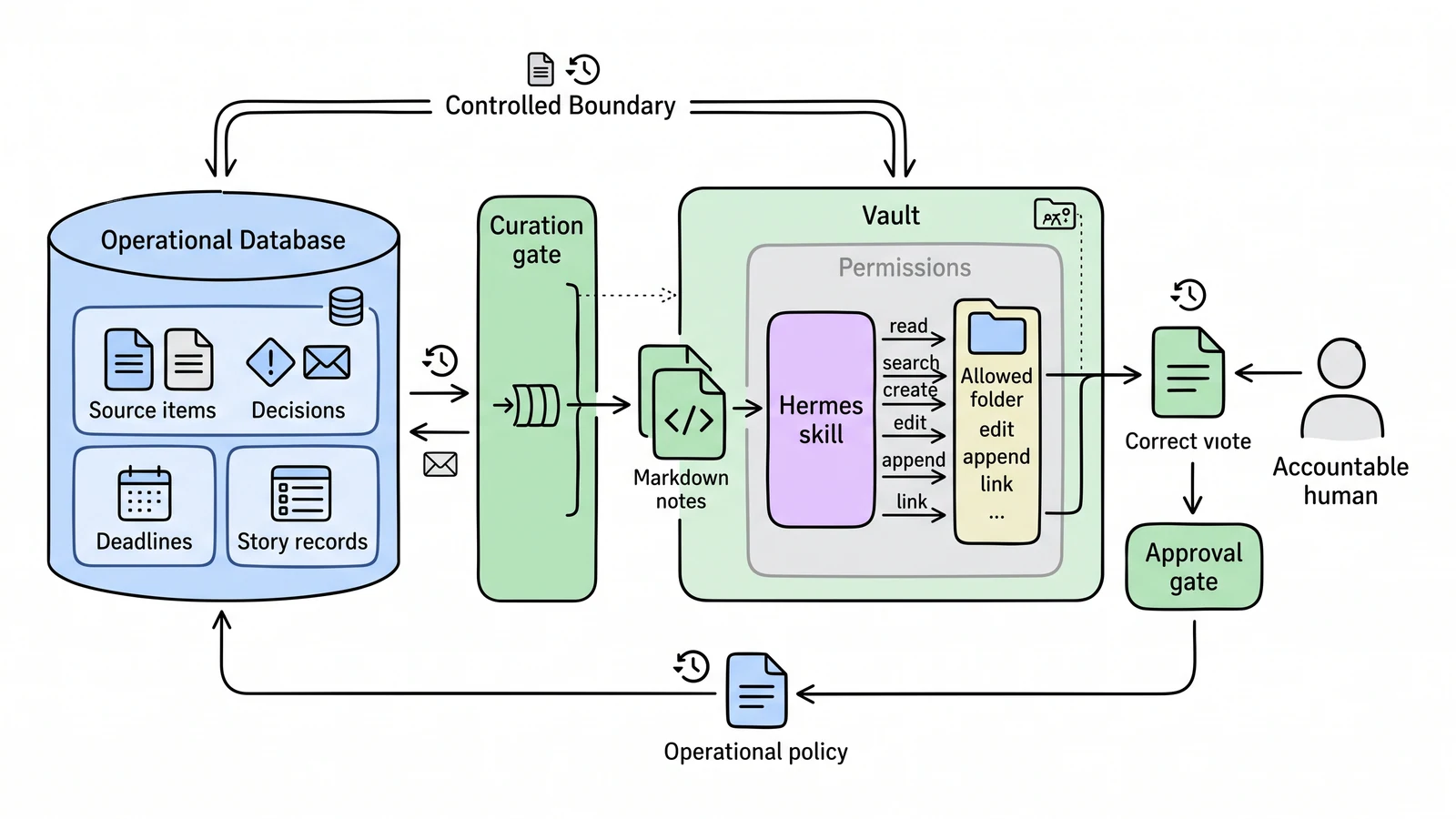
Hermes ships an Obsidian skill that works directly with a vault on the filesystem. Across 3 public source links, the official contract covers reading, listing, searching, creating, editing, appending, and adding wikilinks to Markdown notes, which makes a local knowledge base directly actionable by an agent.
That is a more concrete claim than “the agent has a second brain.” Obsidian supplies durable, human-readable files and links. Hermes supplies actions over those files. Together they create a shared workspace that both the owner and the agent can inspect.
What does the integration not solve?
A vault full of backlinks is not automatically good memory. It can still contain duplicates, stale conclusions, weak provenance, or notes whose permissions are too broad. Searchability is not the same as trustworthy recall, and the ability to edit every note is not always desirable.
A production setup needs:
- an explicit vault path and narrow writable folders;
- source URLs and observed dates inside evidence notes;
- separate raw evidence, interpretations, and current decisions;
- version history or backup;
- rules for superseding stale claims without erasing them.
New Runtime Read
For New Runtime, Obsidian is useful as an owner-facing analytical surface, but it should not replace the operational database. Supabase remains the system of record for source items, story clusters, decisions, and deadlines. A vault can receive curated trend memos, system dossiers, and decision logs that are pleasant to navigate and edit.
The strongest pattern is bidirectional but controlled:
operational records -> curated knowledge note -> owner correction
owner correction -> reviewed change -> operational policy
The value is not infinite context. It is a legible boundary between machine-operable memory and human-owned knowledge.