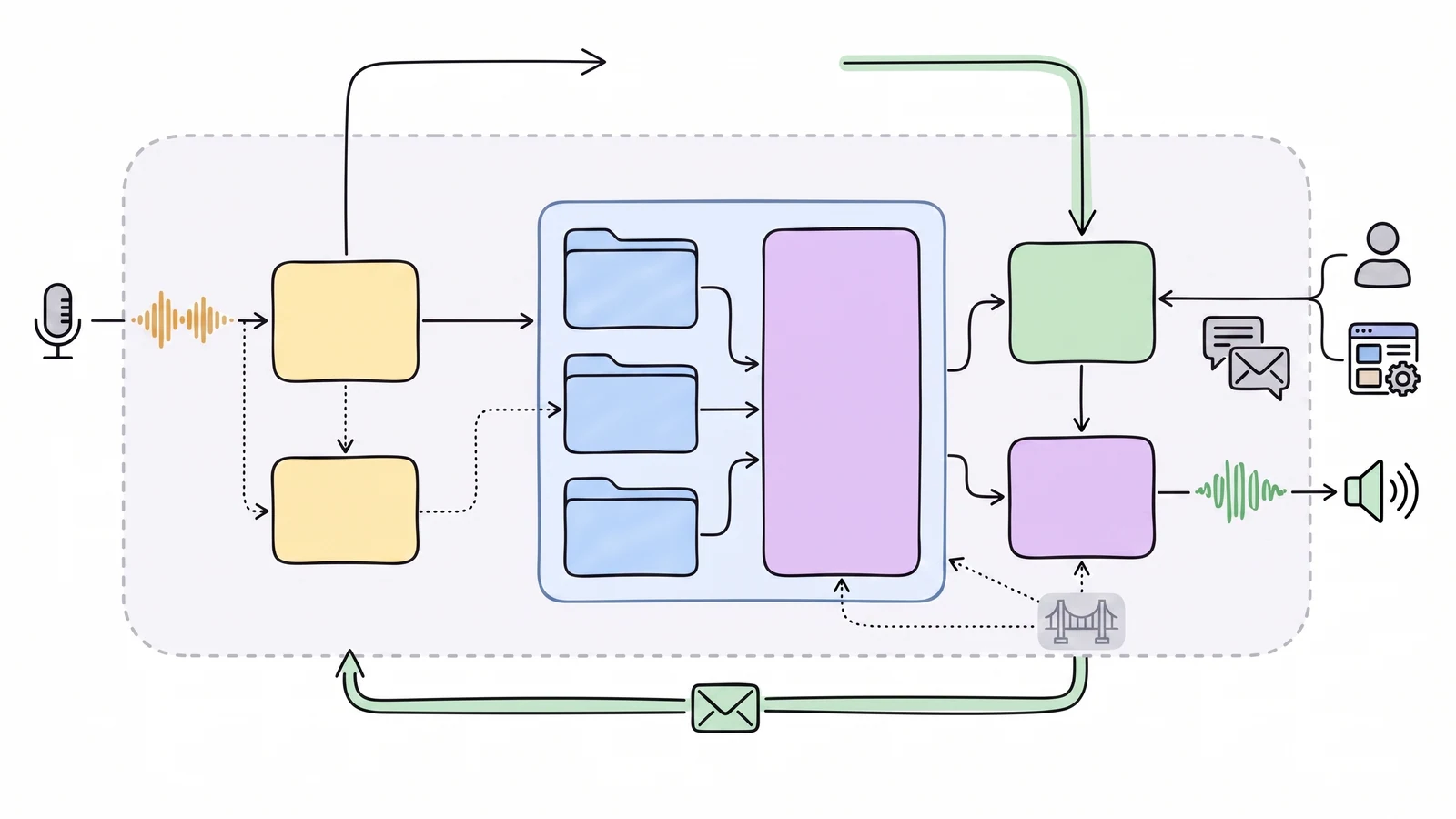
Voicebox is not only a text-to-speech interface. It combines both sides of the voice loop: speech becomes text for any focused application, and text from an application or agent becomes speech through a selected local voice.
The project bundles voice cloning, seven TTS engines, Whisper-based transcription, reusable voice profiles, long-form chunking, a multi-track story editor, post-processing effects, a REST API, and an MCP server. The desktop shell is built with Tauri, while local inference uses MLX on Apple Silicon or PyTorch on other supported backends.
The product boundary is the interesting part. Voice data, captures, models, and transcripts stay on the machine. Dictation can paste into the focused text field, while every agent-initiated speech action surfaces through the same visible status pill. The system avoids a silent background voice channel.
Voice becomes a tool, not a separate app
An MCP-aware agent can call voicebox.speak, transcribe audio, and list captures or profiles. Non-MCP software can use the local REST endpoints. Per-client voice bindings allow different agents to speak with distinct profiles without changing every tool call.
The local profiles also connect input and output. A recorded capture can be transcribed, edited, reused as a voice sample, or played back through a selected voice. One bundled local language model handles optional dictation cleanup and persona-based rewriting, reducing the number of separate runtimes competing for memory.
The repository includes substantial responsible-use and platform complexity. Voice cloning creates consent and impersonation risk even when the system is local. Operating systems also impose different accessibility, audio, and paste-injection permissions, so “runs locally” does not mean “requires no security design.”
For agent interfaces, Voicebox is a useful pattern: speech is a bidirectional local capability with a visible activity surface, typed permissions, stable APIs, and persistent artifacts. It does not need to become a cloud voice service before agents can use it.