Vercel AI Gateway Adds Runtime Budget Controls

Vercel's July 31 AI Gateway releases combine team and project spend budgets, unified fast mode, Laguna S 2.1 capacity, and updated MCP support into a practical inference control layer.

Retrieval answer

Vercel's July 31 AI Gateway releases combine team and project spend budgets, unified fast mode, Laguna S 2.1 capacity, and updated MCP support into a practical inference control layer. Vercel shipped four small AI Gateway updates on July 31. Read together, they are more useful than any one changelog line: AI Gateway is turning into an operating surface for agent.

New Runtime synthesiseditorial-diagram
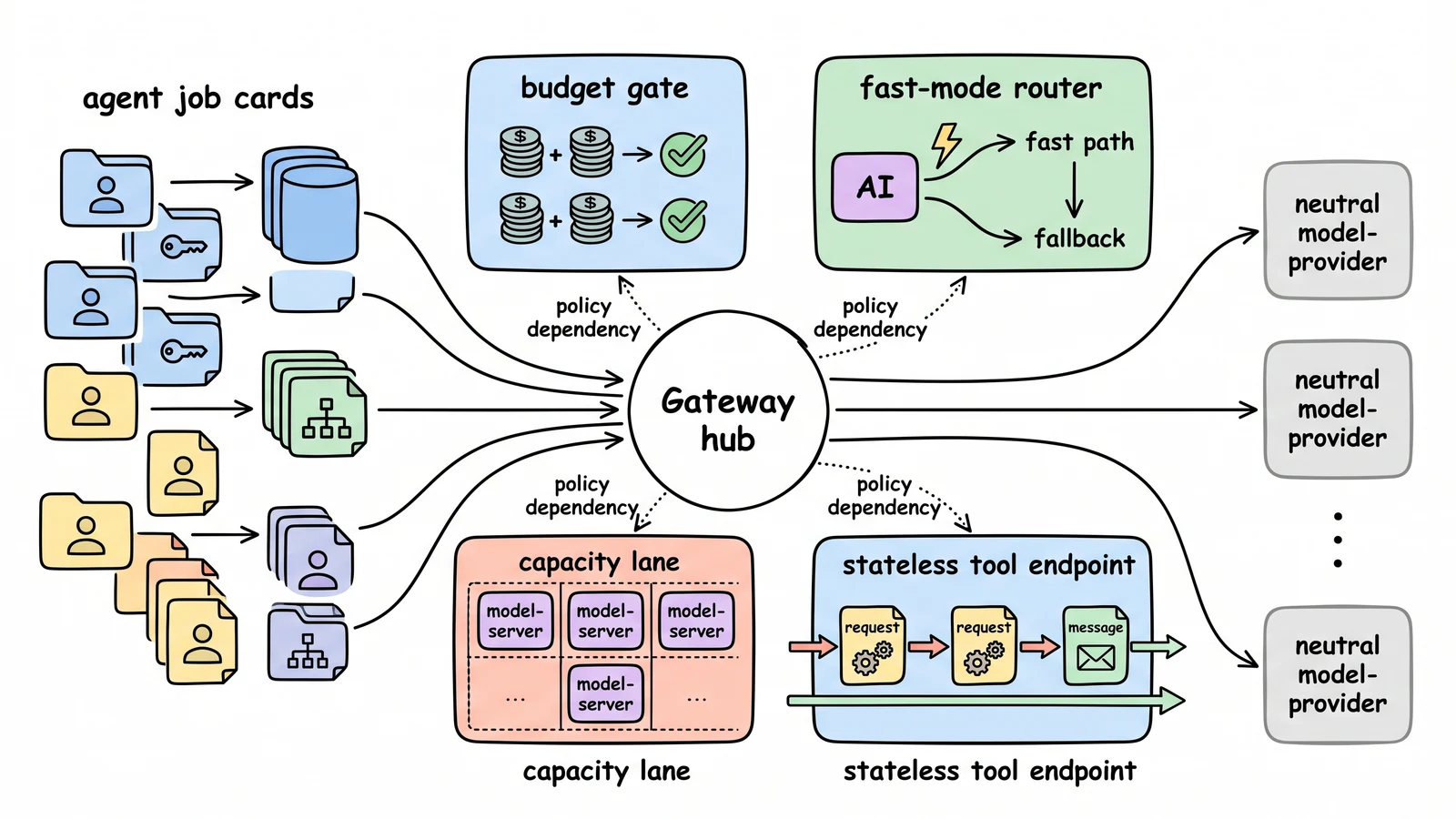
Hand-drawn gateway diagram where agent jobs pass through budget gates, fast-mode routing, capacity lanes, and an MCP endpoint before reaching model providers.
AI Gateway is becoming an operating layer: cap spend, choose latency posture, absorb model capacity, and expose tools through newer MCP clients.New Runtime synthesis from Vercel AI Gateway changelogOriginal source ↗
  1. BudgetsTeam, project, and API-key caps can reject requests when any applicable budget is exhausted.
  2. Fast modeA unified speed setting routes to a fast tier when available and falls back to standard speed.
  3. ProtocolThe Vercel MCP endpoint supports the 2026-07-28 stateless protocol while keeping older clients working.

Vercel shipped four small AI Gateway updates on July 31. Read together, they are more useful than any one changelog line: AI Gateway is turning into an operating surface for agent inference.

The budget release is the clearest control. Spend budgets can now attach to a team or project, not only to an API key. A request can fall under multiple budgets, and it has to pass all of them. If any applicable cap is exhausted, the gateway rejects the request until the budget resets or changes. Alerts at 50%, 75%, and 100% are informational; the budget limit is the blocking mechanism.

Fast mode is the latency side of the same idea. Instead of hardcoding provider-specific fast variants everywhere, callers can set speed: "fast" under gateway options. The gateway serves the fast tier when routable and falls back to standard speed when it is not. Direct fast slugs still exist for configurations that need explicit fallback lists.

The Laguna S 2.1 capacity increase matters because agent workloads are spiky and long-running. Vercel says both poolside/laguna-s-2.1 and poolside/laguna-s-2.1-free now have 10x more Gateway capacity, aimed at higher-volume agentic coding and longer tasks.

The MCP update closes the loop. Vercel MCP now supports the 2026-07-28 specification, giving newer clients a stateless request model and updated authorization behavior while keeping 2025 clients on the same endpoint.

For New Runtime, the pattern is consistent with earlier Vercel posts: the agent platform is becoming a bundle of boring controls. Spend, latency, capacity, and protocol compatibility are not side panels. They decide whether an agent loop can run unattended without turning into a surprise bill, a queue, or a broken tool connection.

Recommendation

Vercel's July 31 AI Gateway releases combine team and project spend budgets, unified fast mode, Laguna S 2.1 capacity, and updated MCP support into a practical inference control layer.

Discovery graph / next reads

Continue through New Runtime

Open the graph
  1. 01topicAgents - New RuntimeExplore the agents topic hub.
  2. 02topicAPI Design - New RuntimeExplore the api design topic hub.
  3. 03related materialVoicebox Turns Local Speech Into an Agent I/O LayerShares agents and api design.
  4. 04related materialVercel's Agent Platform Surface Is Becoming a Control PlaneShares agents and api design.
  5. 05related materialAmazon Quick Makes Catalog Semantics The Agent BoundaryShares agents and developer tools.

These links are also published in this page’s JSON twin and as typed edges in DiscoveryGraph v1.

Who read this page?Machine requests, hidden until opened

Loading the privacy-safe route aggregate…

Open the JSON contract