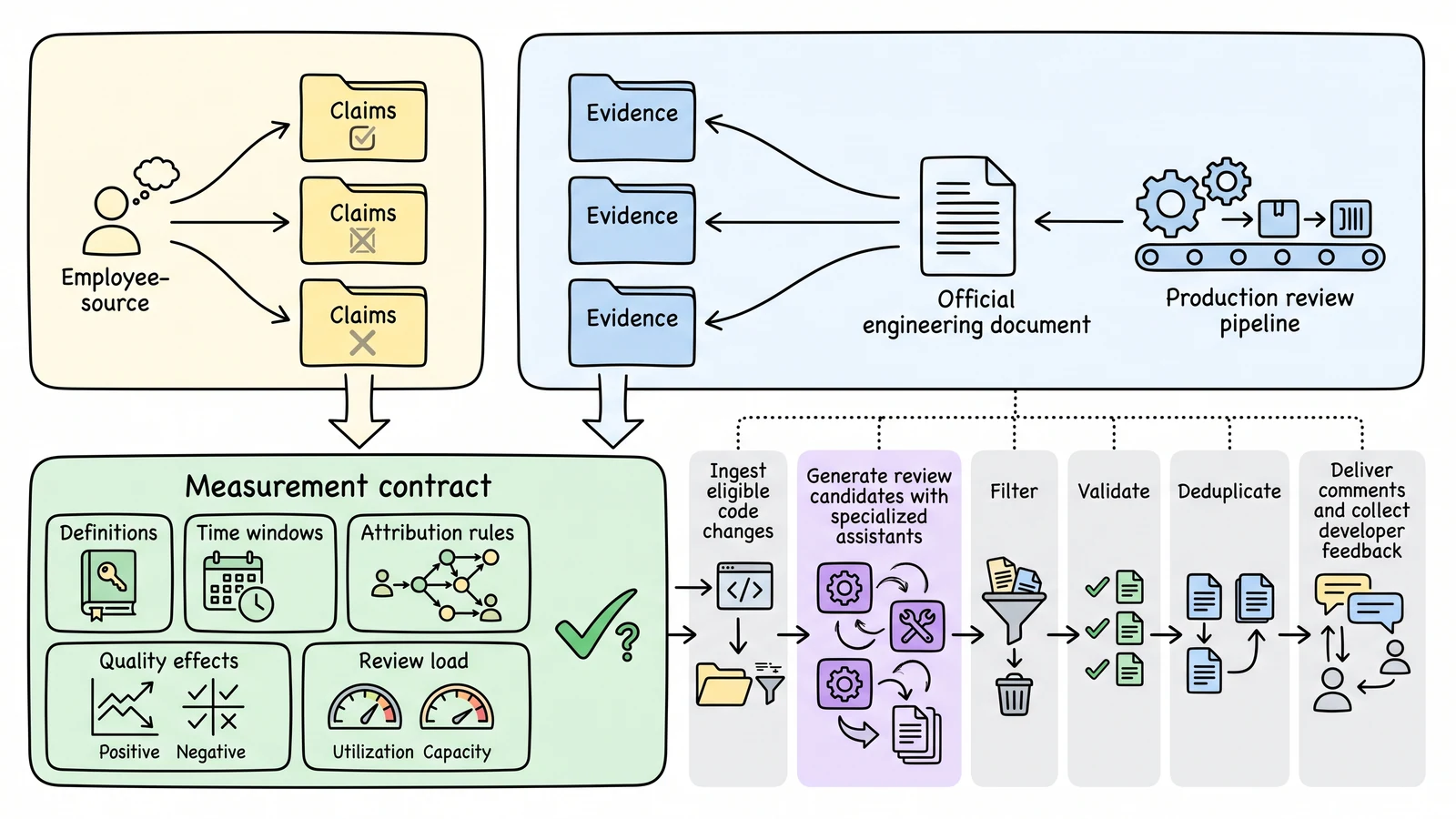
An Uber employee reports that 99% of the company’s engineers use AI tools, more than 70% of pull requests are attributed to local or cloud agents, and engineers have created more than 2,500 agent skills.
These are strong claims, but they are not yet an audited company-wide measurement in the public sources reviewed here. They should be attributed to the employee post, not restated as independently verified Uber statistics.
Official Uber Engineering material does confirm a substantial production footprint. Uber’s uReview system analyzes over 90% of roughly 65,000 weekly diffs, uses specialized generation and grading stages, and continuously evaluates model combinations. That is direct evidence of AI embedded in the engineering control plane.
Why does the distinction matter?
“Uses an AI tool” can mean anything from occasional completion to sustained agentic work. “Attributed to an agent” depends on how authorship is recorded when a human, local agent, cloud agent, and reviewer all touch the same change.
Useful adoption reporting should publish definitions alongside percentages:
- active use over what time window;
- tool access versus meaningful use;
- generated code versus agent-attributed pull requests;
- accepted output versus output later rewritten;
- quality, incident, and review-load effects.
New Runtime Read
The headline is not that humans disappeared from Uber engineering. The stronger signal is that AI has moved into shared infrastructure: review coverage, model evaluation, feedback capture, filtering, and staged rollout.
For our project, adoption should be measured the same way. Count verified outcomes—sources resolved, drafts accepted, incidents avoided, deadlines met—not agent activity alone. A 99% usage number is interesting; an auditable quality loop is operationally valuable.