Resolve the Quoted Post Before Classifying the Wrapper

A timeline item was classified as evidence for non-developer agent orchestration, but its quoted source was actually about Codex installing developer tools. The failure was missing reference context.

Retrieval answer

A timeline item was classified as evidence for non-developer agent orchestration, but its quoted source was actually about Codex installing developer tools. The failure was missing reference context. An X timeline item claimed that agentic orchestration was moving beyond developer workflows. Read alone, the wrapper looked highly relevant to New Runtime. Its quoted source told a different story.

New Runtime synthesiseditorial-diagram
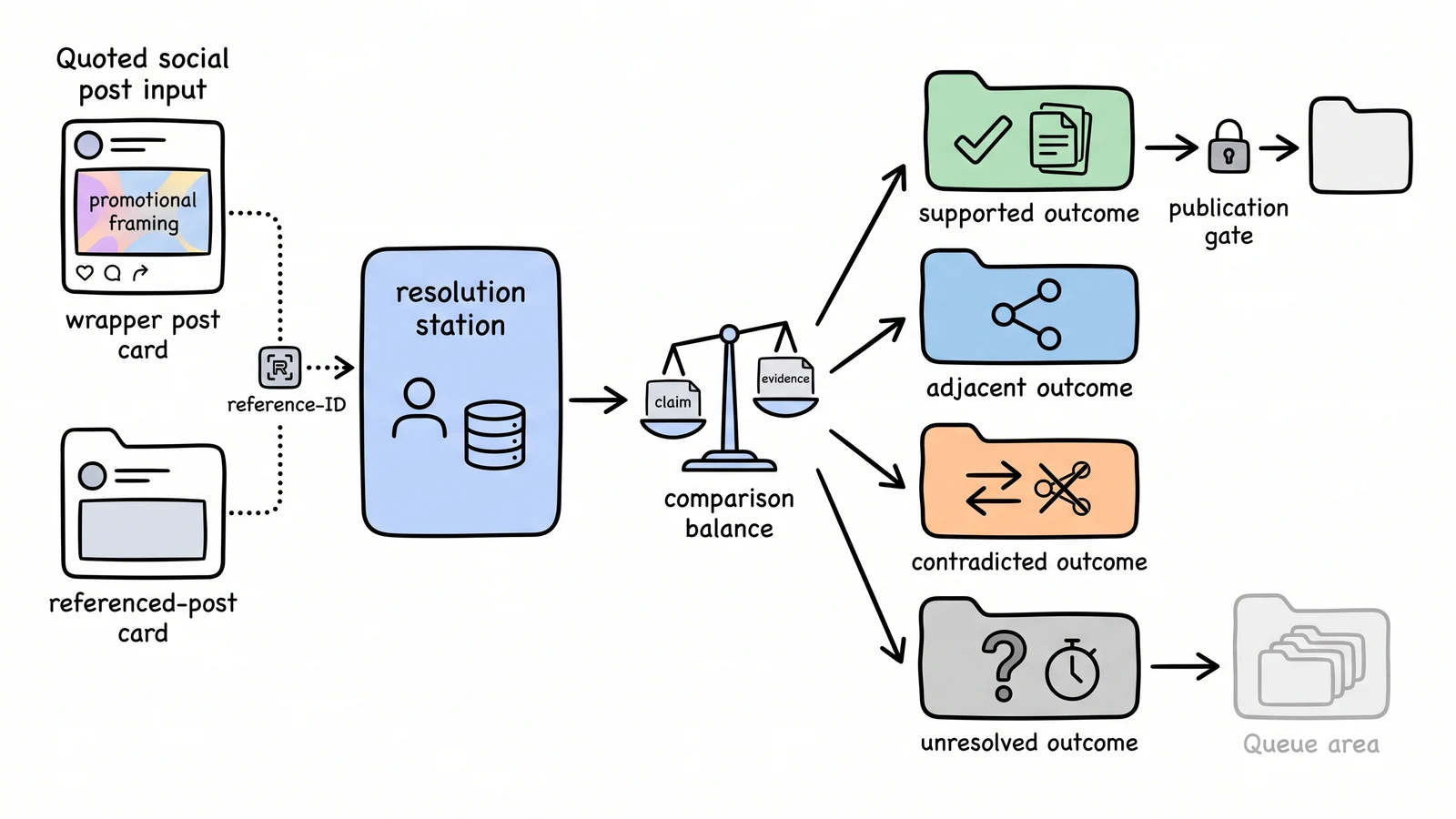
A wrapper post and its referenced post are resolved as two separate objects, compared, and routed into supported, adjacent, contradicted, or unresolved outcomes.
A quote-post wrapper remains discovery metadata until the referenced post and author context have been resolved and compared.New Runtime synthesis from the newsroom failure and X expansion contractOriginal source ↗
  1. Preserve two objectsKeep wrapper framing separate from the referenced post that may or may not support it.
  2. Resolve contextFetch the referenced post and author through the referenced_tweets.id expansion.
  3. CompareEvaluate whether the wrapper claim is supported, adjacent, contradicted, or still unresolved.
  4. Block unresolvedRoute missing reference context to needs_reference_context instead of watch or publish.
  5. Cite evidenceUse the object that actually supplies public evidence, not the interpretation layer by default.

An X timeline item claimed that agentic orchestration was moving beyond developer workflows. Read alone, the wrapper looked highly relevant to New Runtime. Its quoted source told a different story.

The original post described giving Codex an open-source repository link and asking it to install and open the application. That is a useful coding-agent workflow, but it is not evidence that agentic orchestration has moved outside software development.

The classification failure came from substituting commentary for evidence:

wrapper claim -> project keywords -> high relevance

The missing step was:

wrapper claim -> resolve quoted post -> compare claim with source -> classify

Why quote posts need a two-object model

A quote post contains at least two editorial objects:

  • the wrapper, which expresses interpretation, framing, or promotion;
  • the referenced post, which contains the evidence being interpreted.

They may support each other, but they may also diverge. The wrapper can exaggerate the source, shift its scope, attach a trend label that the original never claimed, or simply quote the wrong example.

X’s API supports returning referenced posts in the same response through the referenced_tweets.id expansion. Without that expansion, a pipeline may see that a quoted Post ID exists while still lacking its text and author context. Scoring the wrapper at that point is premature.

A safer newsroom contract

For quotes, replies, and reposts, normalization should preserve:

  • reference type and referenced Post ID;
  • referenced author and full text;
  • URLs and media from both objects;
  • whether the wrapper’s claim is supported, contradicted, or merely adjacent;
  • which object supplies public evidence;
  • an explicit unresolved state when the reference cannot be fetched.

Editorial routing should operate on the combined evidence unit. A wrapper with strong keywords but an unresolved reference should become needs_reference_context, not watch or post.

New Runtime Read

This example is more valuable as a pipeline lesson than as a market trend. Our X MCP timeline call requested author expansion but did not request referenced-Post expansion. The system correctly recorded the quoted Post ID, then incorrectly assigned a high project-relevance score using only the wrapper text.

The durable rule is simple: a quote-post wrapper is discovery metadata until its referenced post has been resolved. Trend evidence begins only after the relationship between the two has been checked.

The goal is not merely to reduce noise. It is to prevent an interpretation layer from silently becoming the source of truth.

Recommendation

A timeline item was classified as evidence for non-developer agent orchestration, but its quoted source was actually about Codex installing developer tools. The failure was missing reference context.

Discovery graph / next reads

Continue through New Runtime

Open the graph
  1. 01related materialGumclaw: An AI Company Operating SystemContinue with a related New Runtime material.
  2. 02related materialABBEL Treats Memory as an Explicit Belief StateContinue with a related New Runtime material.
  3. 03related materialA Software Factory Connects Agents Through Verified OutcomesContinue with a related New Runtime material.
  4. 04related materialAmazon Quick Makes Catalog Semantics The Agent BoundaryContinue with a related New Runtime material.
  5. 05related materialContainment Caps An Agent's Blast RadiusContinue with a related New Runtime material.

These links are also published in this page’s JSON twin and as typed edges in DiscoveryGraph v1.

Who read this page?Machine requests, hidden until opened

Loading the privacy-safe route aggregate…

Open the JSON contract