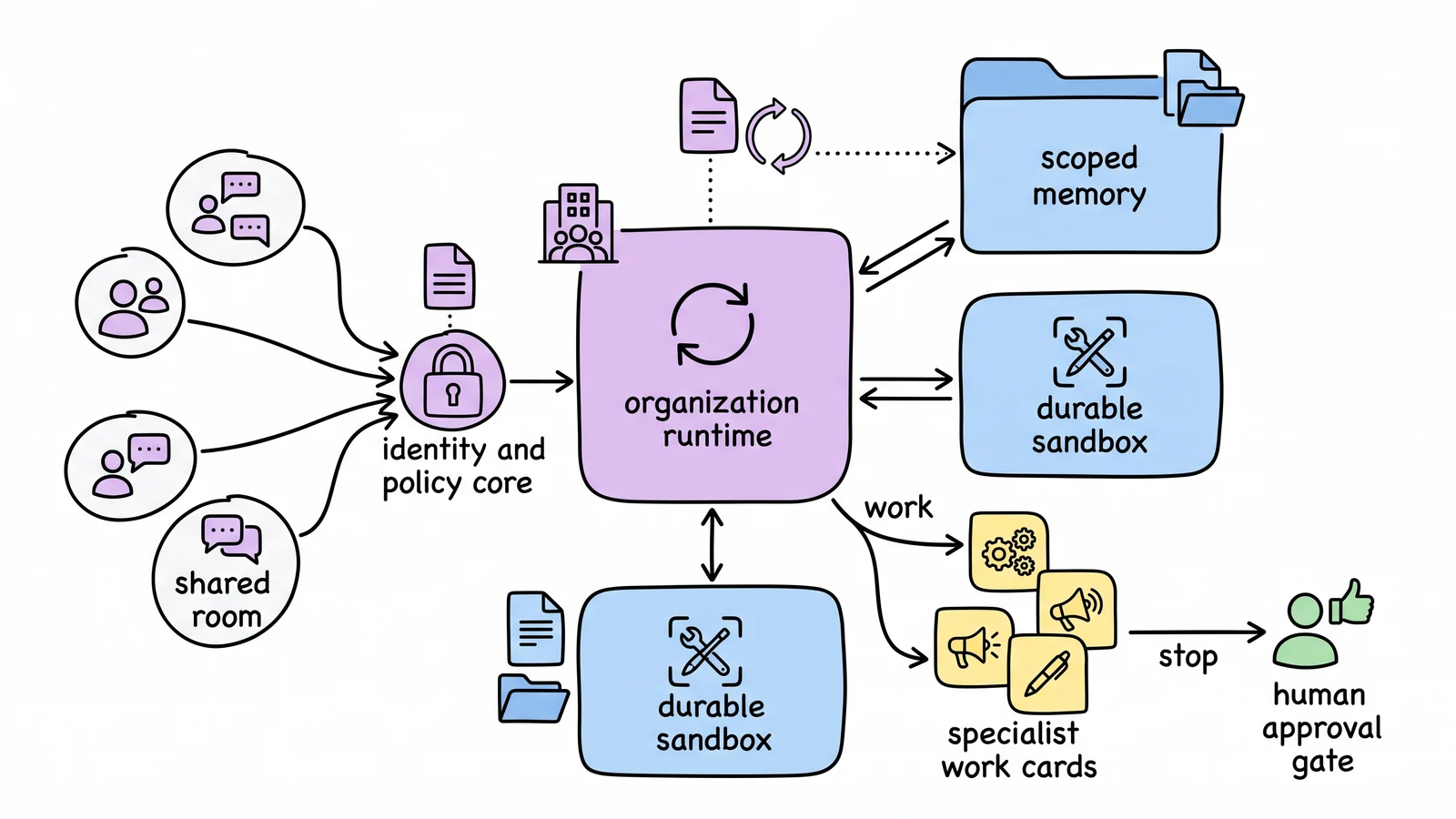
QM and Vercel point at the same organizational boundary from different directions: a company agent is a scoped runtime, not one bot sharing one transcript. QM gives every person and room its own memory, files, keychain view, permissions, schedules, web apps, and durable sandbox. The shared core owns identity, policy, storage, and scheduling while agent loops and interfaces remain replaceable.
Vercel shows the operating model around that substrate. Its internal @v works across finance, communications, documentation, marketing, engineering, and analytics. The Eve guide turns the pattern into an executable team: a lead agent routes work to long-form, social, email, and SEO specialists while Notion, Typefully, and Resend become task surfaces rather than the system of record. Irreversible actions still require approval.
The architectural test is therefore about boundaries, not personality. Who owns a scope? Where do durable state and secrets live? Which actions are denied or approval-gated before execution? Can the harness be replaced without migrating the organization's memory? A shared chat UI cannot answer those questions.
For New Runtime, this is a concrete post-app pattern. Intent enters a governed runtime, the runtime assembles the right specialist roles and surfaces, and receipts preserve who asked for what under which authority.