OpenAI Splits Transcription Into File and Live Workflows

OpenAI's new transcription guide makes recorded audio and live audio separate product paths, with gpt-transcribe and gpt-live-transcribe as the recommended starting models.

Retrieval answer

OpenAI's new transcription guide makes recorded audio and live audio separate product paths, with gpt-transcribe and gpt-live-transcribe as the recommended starting models. OpenAI's transcription update is a small API change with a useful product lesson: file transcription and live transcription should be treated as different workflows, not as one speech-to-text feature with a streaming toggle.

New Runtime synthesiseditorial-diagram
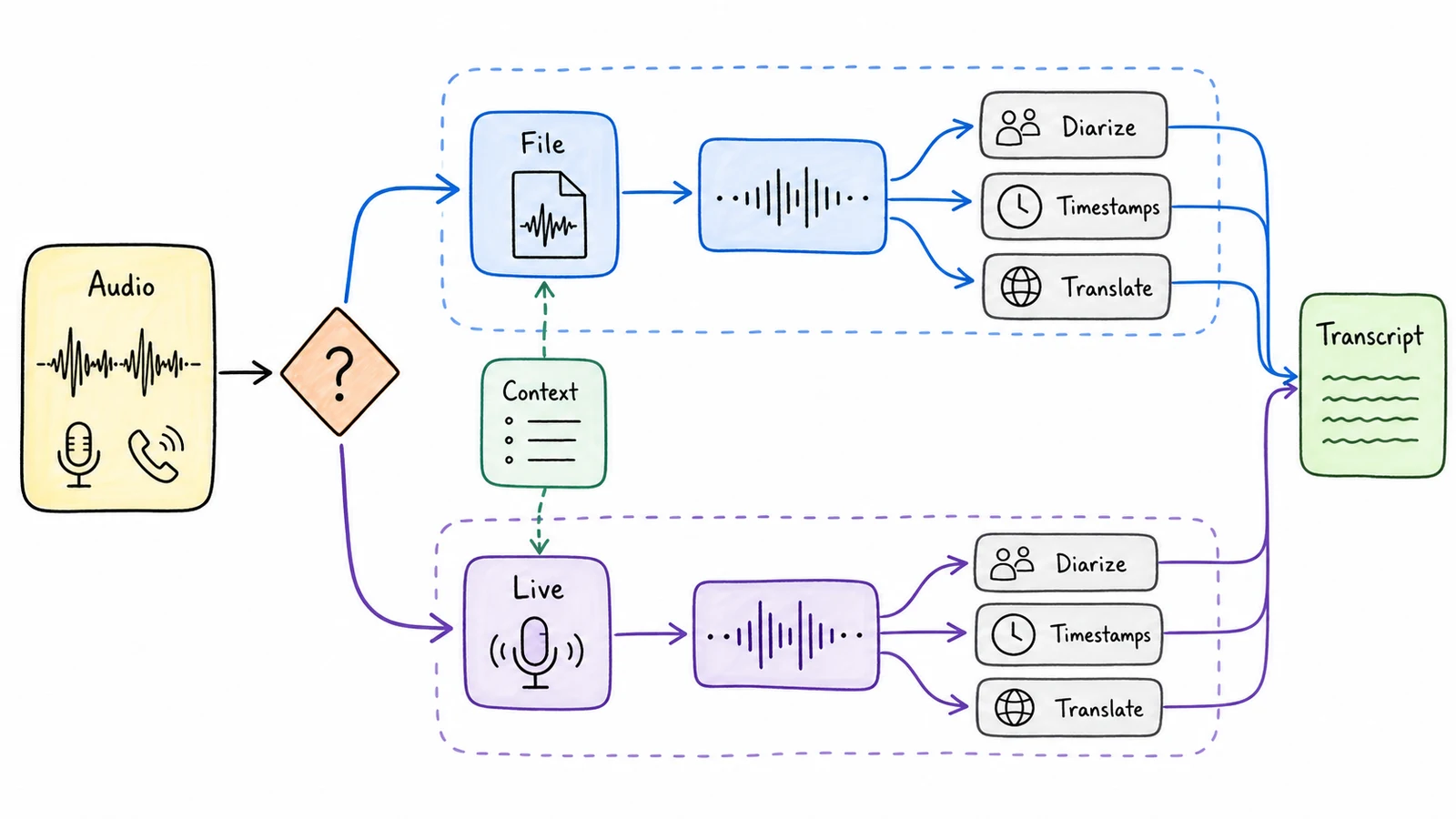
Hand-drawn decision tree showing audio split into file transcription and live transcription, with context hints feeding both paths.
The product decision is no longer just which speech model to call; it is whether the audio is bounded or arriving live.New Runtime synthesis from public source inspectionOriginal source ↗
  1. File pathCompleted recordings and bounded audio requests start with gpt-transcribe.
  2. Live pathMicrophones, calls, and persistent streams start with gpt-live-transcribe.
  3. ContextPrompt, keywords, and languages are hints tied to the audio, not restated task instructions.

OpenAI’s transcription update is a small API change with a useful product lesson: file transcription and live transcription should be treated as different workflows, not as one speech-to-text feature with a streaming toggle.

The new guide recommends starting from the shape of the audio. If the application has a completed recording or bounded audio request, use file transcription and start with gpt-transcribe. If the application has a microphone, call, or other live audio stream, use realtime transcription and start with gpt-live-transcribe.

The guide also separates streaming output from live audio. A completed file can stream text while it is processed. A Realtime session is for audio that is arriving live or needs a persistent connection.

What changed

The specialized paths stay explicit:

  • speaker-labeled transcripts route to diarization;
  • word timestamps, SRT, VTT, and completed-recording translation still point to whisper-1 paths;
  • detected input languages start with gpt-transcribe;
  • committed-turn transcription over WebSocket uses gpt-transcribe inside realtime transcription.

The context fields are also becoming a first-class API surface. prompt, keywords, and languages help the model with topic, domain terms, product names, acronyms, and multilingual expectations. They are hints about the audio, not extra task instructions.

New Runtime Read

The useful pattern is workflow routing. The model name matters, but the product boundary matters more: bounded audio, live audio, diarization, timestamps, translation, language detection, and committed realtime turns all imply different operating paths.

This is how model APIs become application interfaces. The platform is not only offering a better speech model. It is teaching developers to choose the right runtime path for the user’s audio state.

Recommendation

OpenAI's new transcription guide makes recorded audio and live audio separate product paths, with gpt-transcribe and gpt-live-transcribe as the recommended starting models.

Discovery graph / next reads

Continue through New Runtime

Open the graph
  1. 01topicAPI Design - New RuntimeExplore the api design topic hub.
  2. 02topicInterfaces - New RuntimeExplore the interfaces topic hub.
  3. 03related materialCopilotKit Brings MCP Tool Calls Into The React InterfaceShares api design and interfaces.
  4. 04related materialOpenAI's ARC-AGI-3 Jump Was a Harness ResultShares api design and models.
  5. 05related materialGusto Solves The Agent Blank Canvas With Scheduled WorkShares interfaces.

These links are also published in this page’s JSON twin and as typed edges in DiscoveryGraph v1.

Who read this page?Machine requests, hidden until opened

Loading the privacy-safe route aggregate…

Open the JSON contract