GPT-5.6 Turns Efficiency Work Into API Economics

OpenAI turned GPT-5.6 serving and kernel efficiency gains into lower Luna and Terra prices, plus a faster Sol mode for latency-sensitive API workloads.

Retrieval answer

OpenAI turned GPT-5.6 serving and kernel efficiency gains into lower Luna and Terra prices, plus a faster Sol mode for latency-sensitive API workloads. #OpenAI #GPT56 #Inference #AgentEconomics OpenAI finally made visible what usually stays inside the data center: optimization of the model, inference, and agent harness no longer only lowers internal cost. It changes the public economics of the product.

New Runtime synthesiseditorial-diagram
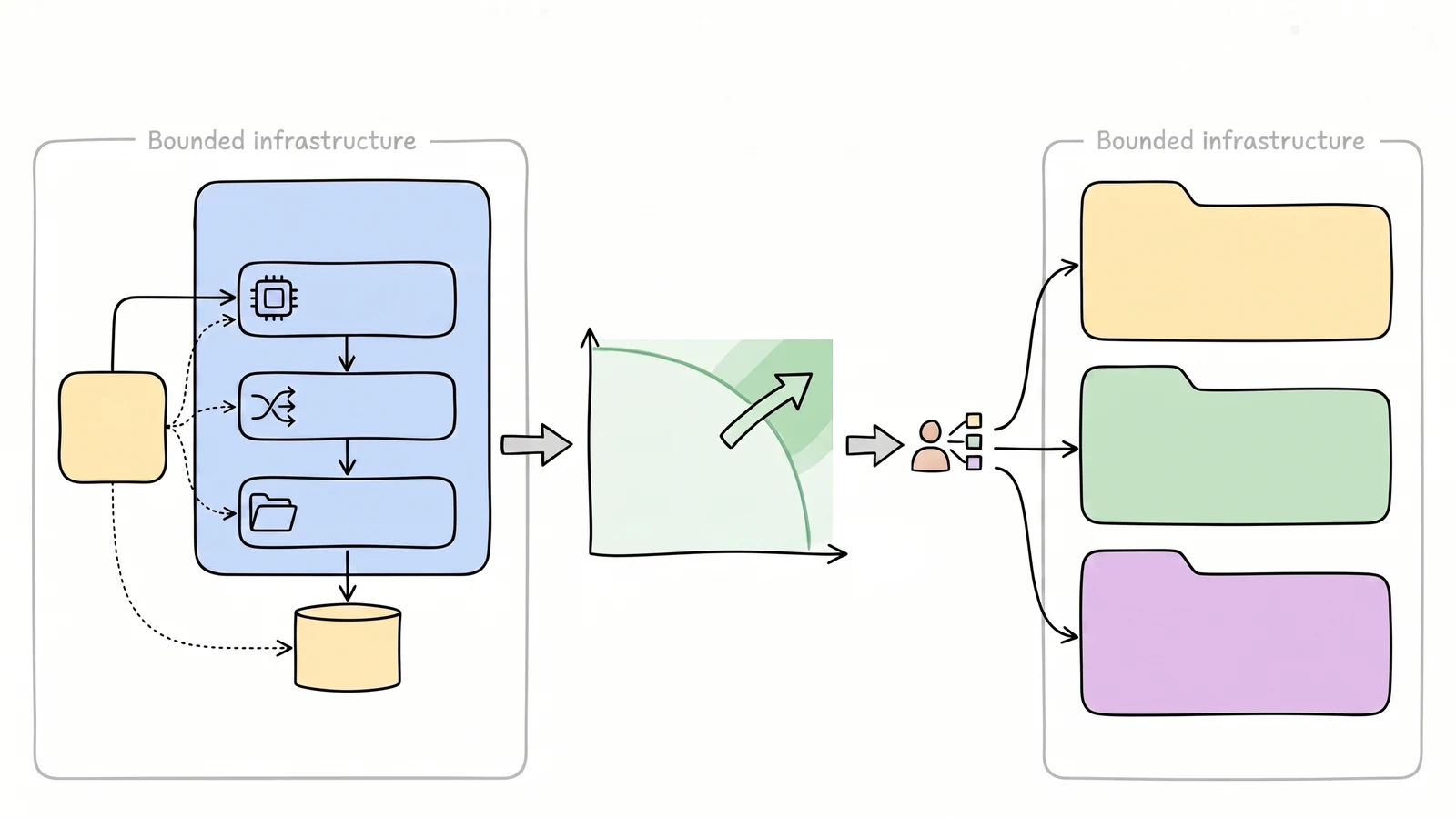
A whiteboard diagram showing model efficiency work flowing into lower Luna and Terra prices, Sol fast mode, and workflow routing by cost and urgency.
GPT-5.6 makes model selection an economic control surface: route work by outcome, urgency, and acceptable cost instead of defaulting to one frontier tier.New Runtime synthesis from OpenAI GPT-5.6 price-performance announcementOriginal source ↗
  1. Efficiency workServing kernels, routing, and context management reduce the cost of useful work.
  2. Model tiersLuna and Terra absorb high-volume work while Sol stays available for uncertain or urgent steps.
  3. Routing policyEvaluations decide where more intelligence changes the result and where cheaper execution is enough.

#OpenAI #GPT56 #Inference #AgentEconomics

OpenAI finally made visible what usually stays inside the data center: optimization of the model, inference, and agent harness no longer only lowers internal cost. It changes the public economics of the product.

In GPT-5.6, Luna API pricing dropped by 80%, Terra became 20% cheaper, and Sol gained Fast mode: the same intelligence level in an accelerated mode at a higher price. In Codex and ChatGPT Work, this shows up not as a discount banner, but as lower credit usage for Terra and Luna.

The architectural conclusion matters more than the numbers. The model family starts to behave like a resource planner: Sol is for uncertainty and expensive branches, Terra covers normal daily work, and Luna pulls through high-volume, well-specified steps. If a workflow has evals, you do not have to “move it to the new model”; you can route it by cost of error, urgency, and scale.

For New Runtime, this maps directly onto the next version of the agent runtime: classify the work first, then choose the model, not the other way around. Savings become a property of the execution graph.

Recommendation

OpenAI turned GPT-5.6 serving and kernel efficiency gains into lower Luna and Terra prices, plus a faster Sol mode for latency-sensitive API workloads.

Discovery graph / next reads

Continue through New Runtime

Open the graph
  1. 01topicCoding agents - New RuntimeExplore the coding agents topic hub.
  2. 02topicEnterprise AI - New RuntimeExplore the enterprise ai topic hub.
  3. 03related materialFactory and Comarch Show the Night-Shift Shape of Agent WorkShares coding agents and enterprise ai.
  4. 04related materialA Software Factory Connects Agents Through Verified OutcomesShares coding agents.
  5. 05related materialChatGPT Cuts Repeated Work Across The Agent StackShares inference.

These links are also published in this page’s JSON twin and as typed edges in DiscoveryGraph v1.

Who read this page?Machine requests, hidden until opened

Loading the privacy-safe route aggregate…

Open the JSON contract