Factory and Comarch Show the Night-Shift Shape of Agent Work

Factory's Comarch case study is less about one coding assistant and more about governed agent missions that continue execution while humans set direction and review.

Retrieval answer

Factory's Comarch case study is less about one coding assistant and more about governed agent missions that continue execution while humans set direction and review. Factory's Comarch case study is a useful enterprise signal because it describes agents as a delivery system, not as a faster autocomplete tool.

New Runtime synthesiseditorial-diagram
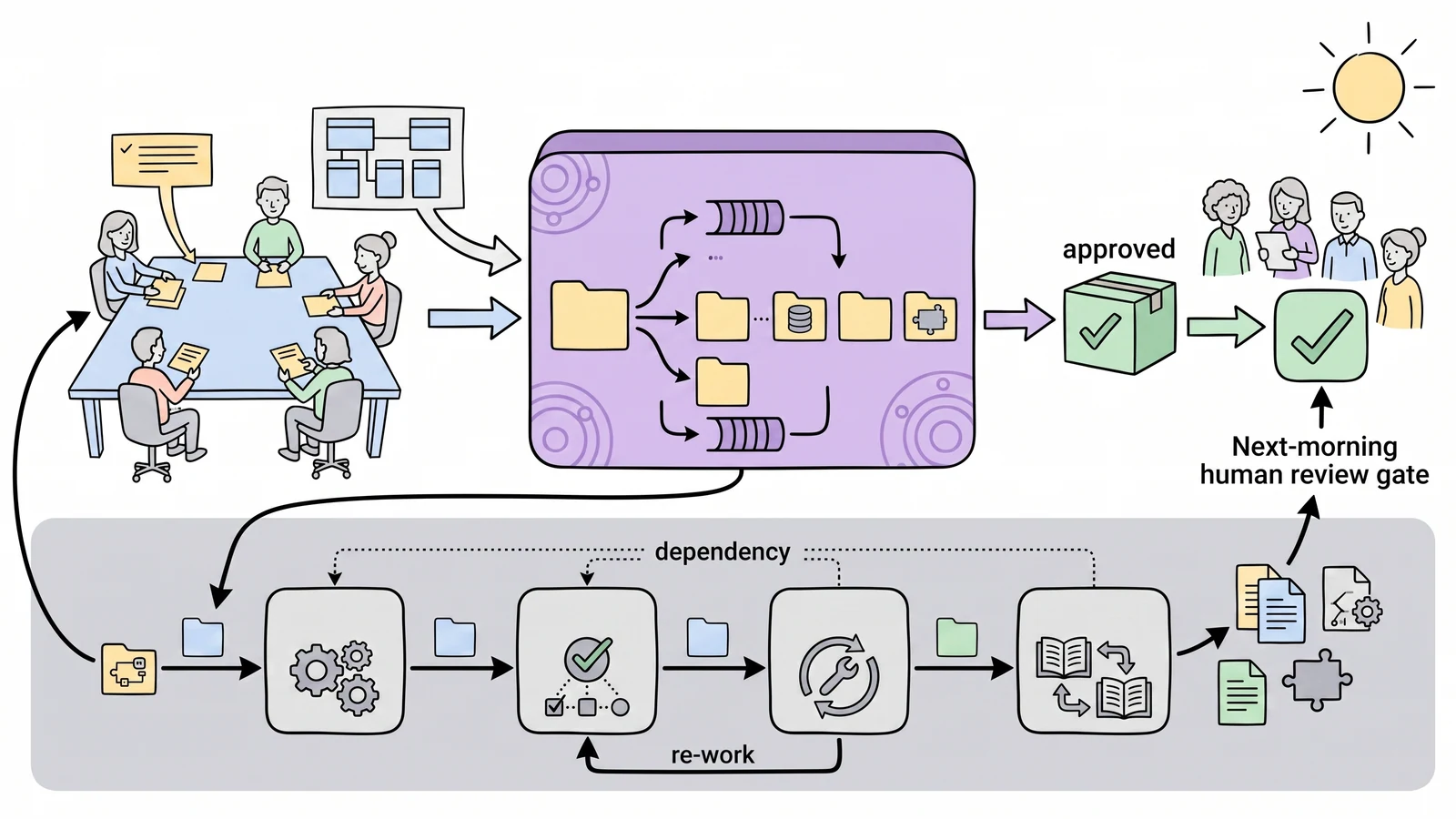
Hand-drawn delivery loop where a human team sets constraints, a mission orchestrator splits work across agent tasks, and a next-morning review gate approves the package.
Factory's Comarch case study frames agent work as a supervised delivery loop that can continue after the team logs off.New Runtime synthesis from public source inspectionOriginal source ↗
  1. MissionFactory Missions decompose large work into coordinated subtasks across many agents.
  2. ExecutionThe case study describes planning, implementation, testing, fixes, and documentation running in the background.
  3. ReviewHumans still set direction, make architecture decisions, prioritize customer context, and decide what ships.

Factory’s Comarch case study is a useful enterprise signal because it describes agents as a delivery system, not as a faster autocomplete tool.

Comarch has more than 5,000 specialists across more than 30 countries and set a goal that 100% of newly generated code would be developed with AI by the end of 2026. Factory says hundreds of Comarch engineers now use its platform across the software development lifecycle.

The central product primitive is Missions. A team gives Factory a larger body of work, and Missions decomposes it into coordinated subtasks that can run across many agents. The case study names migrations, re-platforming, and net-new builds as target work.

The reported numbers are aggressive, so they should be read as vendor case-study evidence, not independent measurement. Factory says a scoped XSLT modernization estimated at 10,000 man-days was completed in 45 days, a database migration scoped at 45 days completed in 6 hours, and an airline customer story moved from 18 months to a 1-week MVP. It also reports 40% engineering efficiency gain and 30-34% higher team velocity.

The more durable idea is the operating model. Comarch teams call it the “night shift” and “weekend shift”: humans define goals and constraints, agents keep executing, and humans review progress the next morning.

New Runtime Read

This fits the AI-native-org pattern already tracked here. The production unit is no longer one person plus one assistant. It is a governed mission loop: scope, constraints, parallel execution, tests, fixes, documentation, and review.

The risk is obvious too. If the review gate cannot reconstruct intent, evidence, and risk, faster execution only creates a bigger ownership problem. Agent throughput needs a matching review and audit surface.

Recommendation

Factory's Comarch case study is less about one coding assistant and more about governed agent missions that continue execution while humans set direction and review.

Discovery graph / next reads

Continue through New Runtime

Open the graph
  1. 01topicCoding agents - New RuntimeExplore the coding agents topic hub.
  2. 02topicEnterprise AI - New RuntimeExplore the enterprise ai topic hub.
  3. 03related materialGPT-5.6 Turns Efficiency Work Into API EconomicsShares coding agents and enterprise ai.
  4. 04related materialA Software Factory Connects Agents Through Verified OutcomesShares coding agents.
  5. 05related materialClaude Code Auto Mode Gates Actions Instead Of ExplanationsShares coding agents.

These links are also published in this page’s JSON twin and as typed edges in DiscoveryGraph v1.

Who read this page?Machine requests, hidden until opened

Loading the privacy-safe route aggregate…

Open the JSON contract