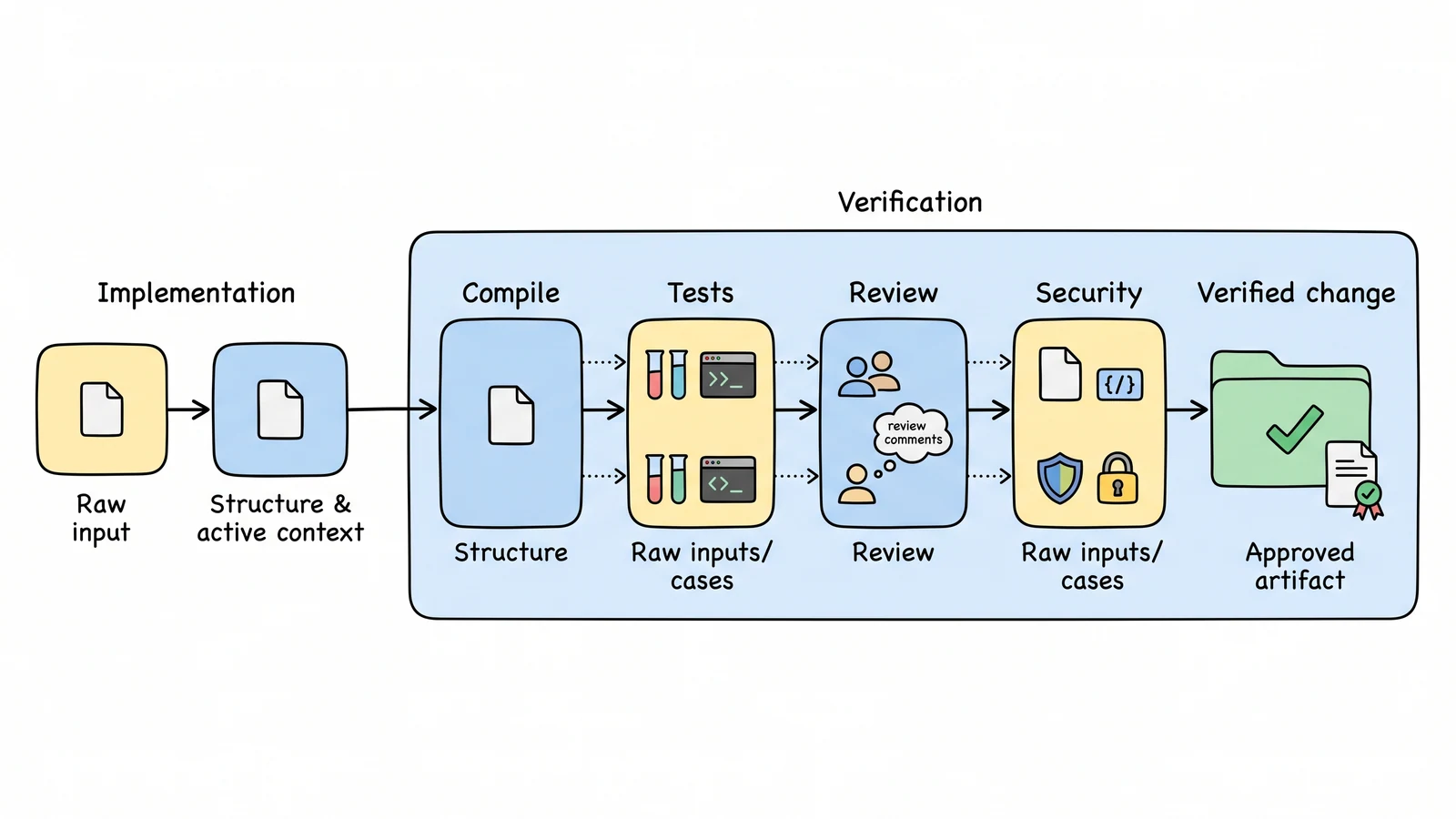
The clearest signal in Gergely Orosz's report from Anthropic is not faster code generation. It is the shift in where engineering time goes. In Bun's AI-heavy Rust rewrite, roughly 15 percent of the time went to implementation and 85 percent to compilation fixes, tests, and verification. More tokens were spent exploring unknowns and validating results than writing the first version.
That changes the scaling bottleneck. When teams run several agents in parallel and generate more pull requests than humans can read line by line, trust moves into automated review, security scanning, fuzzing, regression tests, and out-of-process verification with a fresh context. The domain expert still matters: Jarred Sumner could judge a mechanical port because he knew Bun and its test harness deeply.
The practical metric is verified throughput, not code volume. A team that adds agents without expanding its evidence path creates a review queue. A team that turns acceptance criteria, failing tests, security rules, and reproducible builds into machine-checkable gates can absorb higher implementation speed without silently lowering quality.