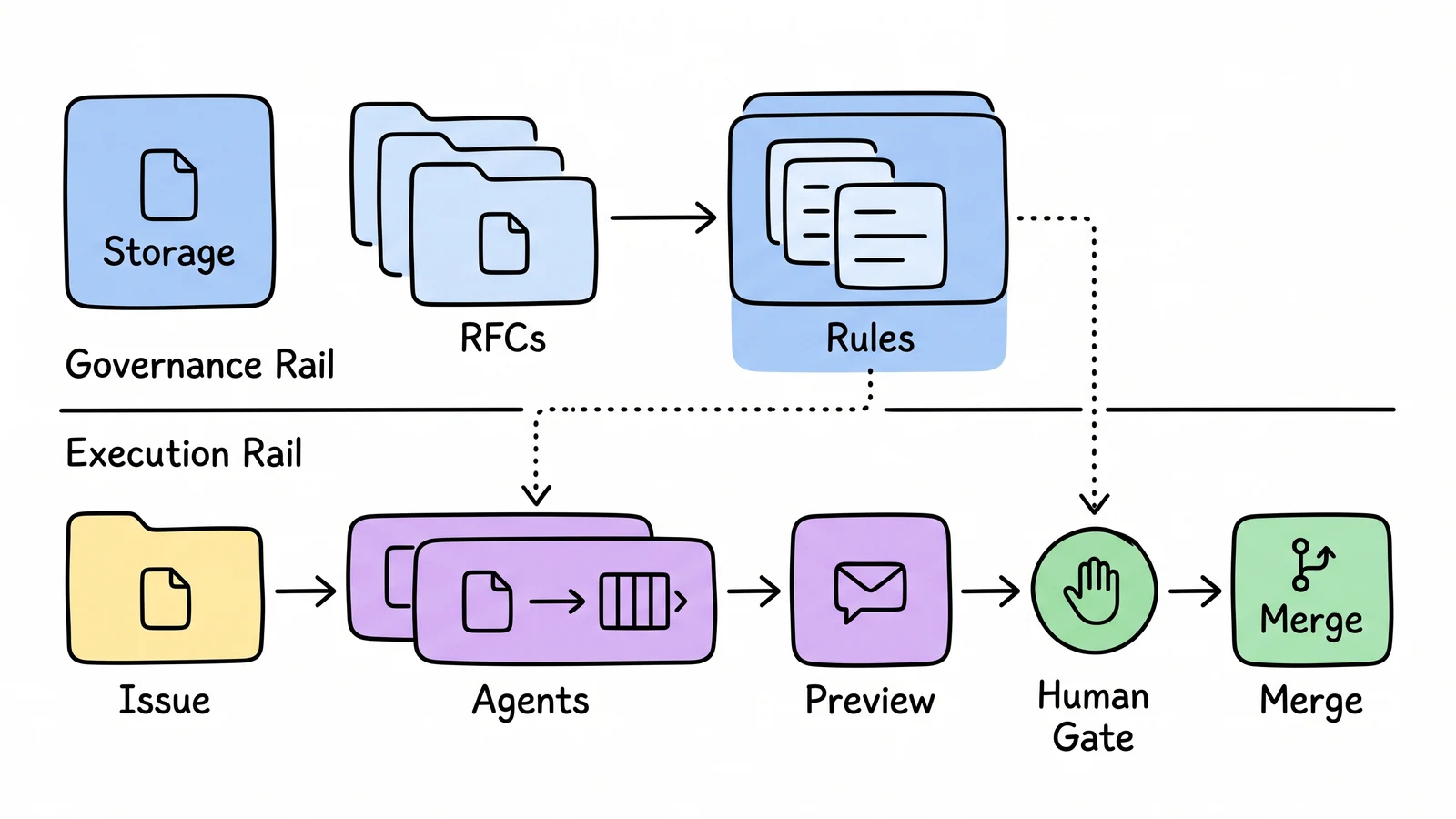
Cloudflare published two agent case studies on the same day that fit together better than either does alone. The first is a governance rail: an internal Codex of more than 60 owner-governed RFCs whose SHOULD and MUST statements are compacted into stable, agent-readable JSON. The second is an execution rail: Astro's issue-triage pipeline, which reduced the open issue count from more than 200 to about 30.
The Codex separates approval from enforcement. An approved RFC produces non-blocking findings; a separate promotion step makes enforced MUST requirements capable of blocking a merge. Cloudflare reports roughly 230,000 findings, nearly 16,000 withheld approvals, about 600 reviewed specs, and more than 200 incident reports reviewed against the same governed standard base.
Astro's pipeline breaks issue work into isolated subagents for reproduce, diagnose, verify, and fix. Each phase passes a report forward instead of sharing one unbounded context. GitHub labels form the state machine, preview packages let reporters verify fixes, and human confirmation opens the final pull request. The reusable pieces are published as triagebot-action and the Flue workflow framework.
Together they show a credible software factory: standards are versioned and owned, machine-checkable rules run before model review where possible, agents operate in bounded stages, and a human verifies the artifact before merge. The factory is not an autonomous code fountain; it is a governed queue of evidence-producing steps.