Run Three Tests Before Replacing LoRA With Full Fine-Tuning

Fireworks shows how data coverage, optimization, and adapter capacity can create or close an apparent quality gap between LoRA and full fine-tuning.

Retrieval answer

Fireworks shows how data coverage, optimization, and adapter capacity can create or close an apparent quality gap between LoRA and full fine-tuning. When a simple LoRA run loses to full fine-tuning, the adapter may not be the limiting factor. Fireworks tested Qwen3.5-9B on three programmatically scored tasks and organized the diagnosis around data coverage, optimization, and adapter capacity.

New Runtime synthesiseditorial-diagram
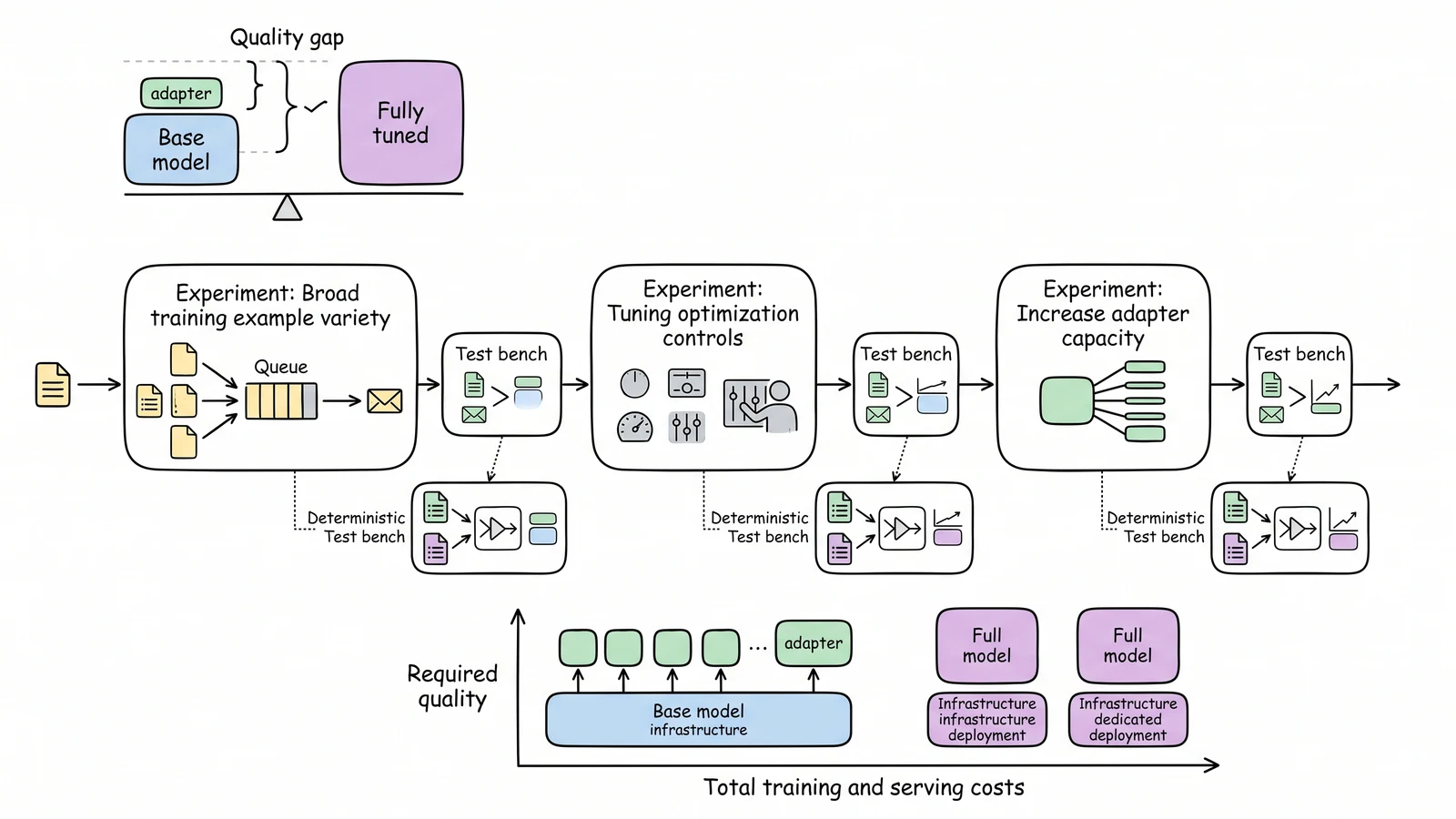
Hand-drawn diagnostic ladder that tests broader training coverage, a tuned optimization recipe, and increased adapter rank before comparing LoRA and full fine-tuning on quality and total deployment cost.
A FullFT advantage becomes meaningful only after coverage, recipe, and adapter-capacity alternatives have been tested under a declared comparison budget.New Runtime synthesis from Fireworks AIOriginal source ↗
  1. CoverageBroaden task variation before interpreting an out-of-distribution failure as a method limit.
  2. OptimizationSweep learning rate and schedule because the best adapter recipe can differ sharply from FullFT.
  3. CapacityIncrease rank under controlled scaling and check whether validity and exact quality move together.
  4. EconomicsCompare training and serving costs after both methods meet the required quality bar.

When a simple LoRA run loses to full fine-tuning, the adapter may not be the limiting factor. Fireworks tested Qwen3.5-9B on three programmatically scored tasks and organized the diagnosis around data coverage, optimization, and adapter capacity.

Coverage moved the placement task first. Increasing the dataset tenfold raised LoRA validity from 34.33% to 68.33%. Tuning the learning rate then brought rank-32 LoRA to 82.67% on a common suite against 83% for FullFT, a 0.33-point difference inside the reported confidence interval. On an untouched final suite, the selected LoRA recipe scored 81.67% versus 80.33% for FullFT.

Capacity mattered on register allocation. Raising rank from 8 to 128 increased valid allocations from 80.5% to 90.5%, while FullFT reached 93%. The stricter exact-decision metric still favored FullFT, showing why validity and imitation quality should be measured separately.

The Nexa virtual-machine task exposed both recipe and curriculum effects. A learning-rate sweep reversed an apparent 31-point FullFT advantage on supported program lengths. Beyond the training horizon, randomizing register starts raised exact trace accuracy to 100% for LoRA and 99.22% for FullFT, demonstrating that rank cannot replace examples of unseen positions.

The comparison changed again when three tasks shared one fixed training budget. Tuned rank-128 LoRA reached 76.60%, while FullFT reached 80.89%. FullFT used 8.6% more active training compute and retained a 4.29-point lead. When per-task exposure was preserved instead of diluted, LoRA led the tested FullFT recipe.

For New Runtime, the decision should be an experiment protocol rather than a method preference. Broaden support, tune each method independently, test adapter rank, declare what the budget holds constant, and then include serving economics: many LoRAs can share one base deployment, while every FullFT variant needs dedicated capacity.

Recommendation

Fireworks shows how data coverage, optimization, and adapter capacity can create or close an apparent quality gap between LoRA and full fine-tuning.

Discovery graph / next reads

Continue through New Runtime

Open the graph
  1. 01topicAgent evals - New RuntimeExplore the evals topic hub.
  2. 02topicInference - New RuntimeExplore the inference topic hub.
  3. 03related materialA Balanced MoE Router Can Still Be Functionally DeadShares evals and open models.
  4. 04related materialOpen Weights Can Still Create A Strategic DependencyShares open models and post training.
  5. 05related materialArcee Turns Scientific Post-Training Into A Run LedgerShares open models and post training.

These links are also published in this page’s JSON twin and as typed edges in DiscoveryGraph v1.

Who read this page?Machine requests, hidden until opened

Loading the privacy-safe route aggregate…

Open the JSON contract