A Balanced MoE Router Can Still Be Functionally Dead

Cerebras demonstrates how top-k normalization can erase the cross-entropy gradient to an MoE router even while expert utilization appears perfectly balanced.

Retrieval answer

Cerebras demonstrates how top-k normalization can erase the cross-entropy gradient to an MoE router even while expert utilization appears perfectly balanced. Expert utilization is a necessary MoE metric, but it can conceal a router that is not learning from the task. Cerebras demonstrates the failure on a 124-million-parameter GPT-2-style model with four experts trained on FineWeb.

New Runtime synthesiseditorial-diagram
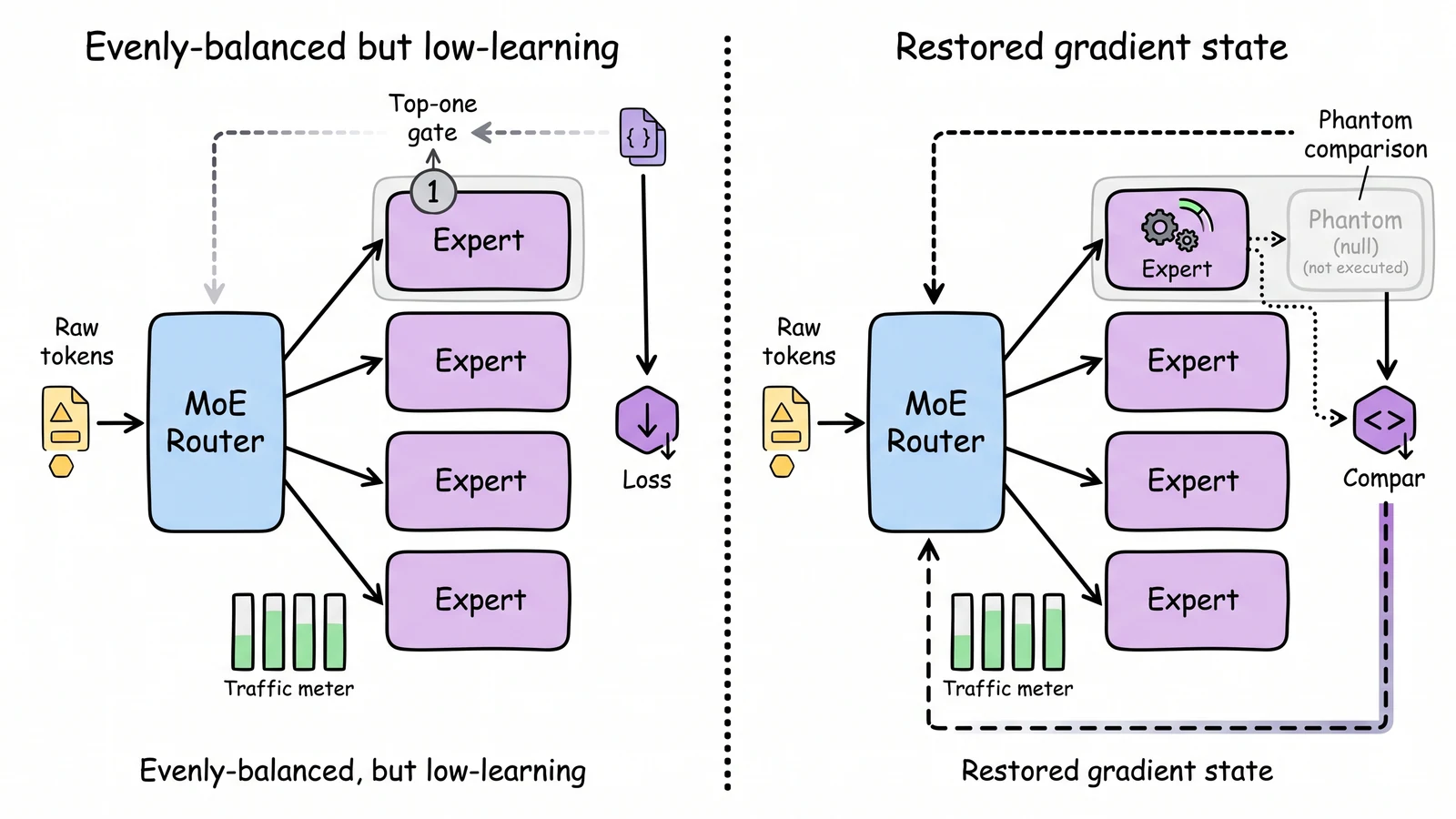
Hand-drawn contrast showing a top-one mixture-of-experts router with balanced traffic but no task gradient, followed by a phantom comparison expert that restores a learning signal to the router.
Load balance measures where tokens went; gradient flow reveals whether the router learned which expert was useful.New Runtime synthesis from CerebrasOriginal source ↗
  1. Balanced trafficFour experts can each receive roughly one quarter of tokens while specialization remains absent.
  2. Lost gradientWith top-one routing, normalizing one selected gate divides it by itself and removes relative weight.
  3. Contrast optionA null expert provides a comparison without adding an active expert computation.
  4. Recovered learningThe task-loss gradient reaches the router and restores the expected quality gain.

Expert utilization is a necessary MoE metric, but it can conceal a router that is not learning from the task. Cerebras demonstrates the failure on a 124-million-parameter GPT-2-style model with four experts trained on FineWeb.

The first run looked healthy. Learned routing beat the dense baseline by roughly 1%, and utilization converged close to 25% for each expert. The expected gain was about 2%, so the team inspected gradient norms instead of treating balanced load as proof of specialization.

The router received effectively no cross-entropy gradient. With top_k=1, the selected gate is normalized by the sum of selected gates. Because that sum is the same single value, the weight becomes gate / gate = 1. The model can learn to distribute traffic through the auxiliary balancing loss while losing the task signal that should teach which expert fits each token.

Using top_k=2 preserves relative weights and restores gradient flow, but activates two experts. Cerebras instead adds a tunable null, or phantom, expert for the top-one case. It is never executed and adds no model parameters or expert computation, yet it gives the real expert score a contrastive alternative during normalization.

With the null expert, the cross-entropy gradient returned and the four-expert model reached the expected 2% improvement over the dense baseline at 2.4 billion training tokens. The result came from repairing one router operation rather than increasing model size or running a broad hyperparameter sweep.

For New Runtime, the broader lesson is an evaluation pattern: monitor the causal training signal, not only a tidy downstream distribution. When an aggregate metric looks ideal but quality stalls, trace the gradient or decision path through the component that is supposed to learn.

Recommendation

Cerebras demonstrates how top-k normalization can erase the cross-entropy gradient to an MoE router even while expert utilization appears perfectly balanced.

Discovery graph / next reads

Continue through New Runtime

Open the graph
  1. 01topicAgent evals - New RuntimeExplore the evals topic hub.
  2. 02topicOpen Models - New RuntimeExplore the open models topic hub.
  3. 03related materialRun Three Tests Before Replacing LoRA With Full Fine-TuningShares evals and open models.
  4. 04related materialA Software Factory Connects Agents Through Verified OutcomesShares evals.
  5. 05related materialClaude Code Auto Mode Gates Actions Instead Of ExplanationsShares evals.

These links are also published in this page’s JSON twin and as typed edges in DiscoveryGraph v1.

Who read this page?Machine requests, hidden until opened

Loading the privacy-safe route aggregate…

Open the JSON contract