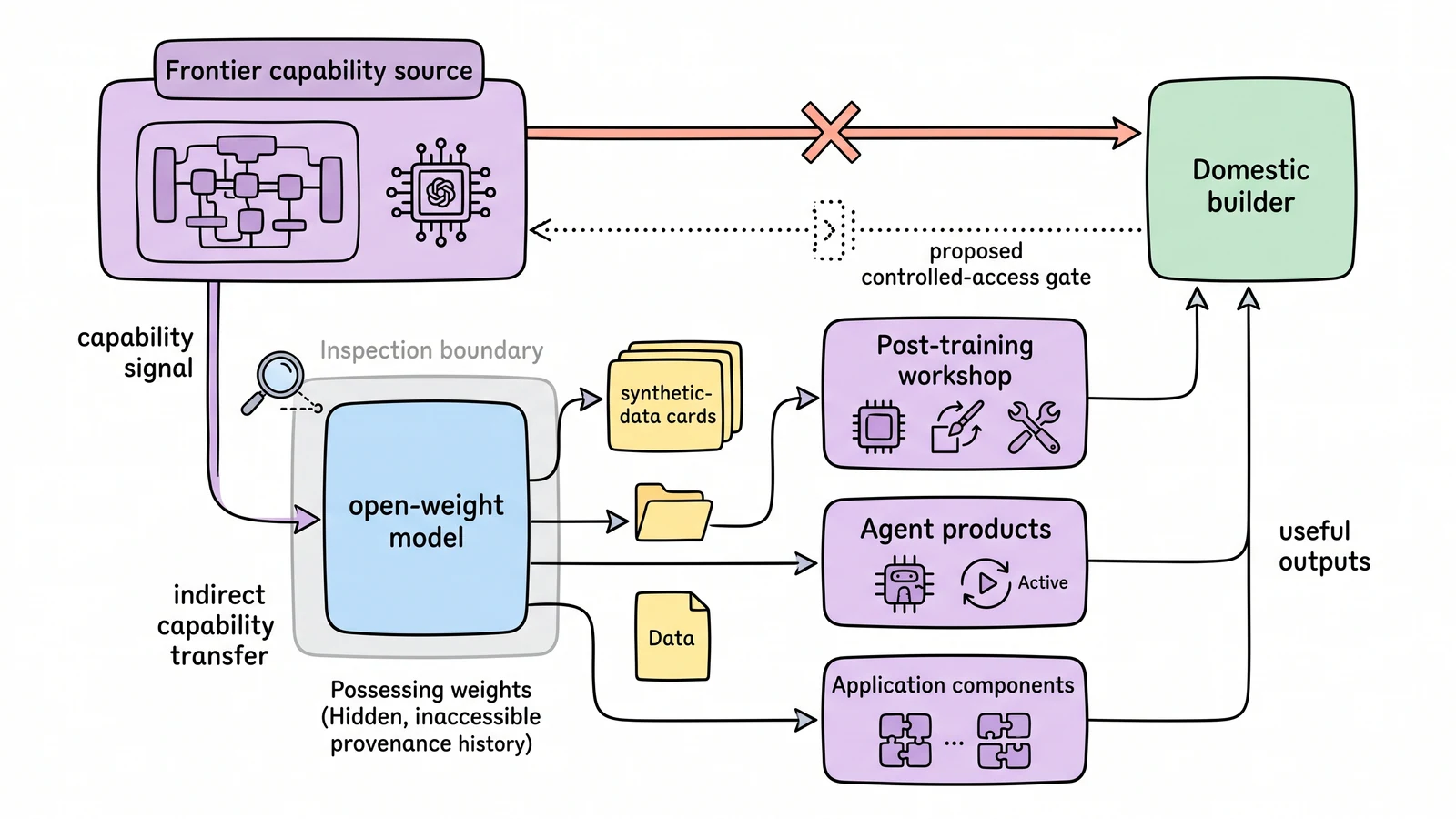
Open weights give a team control over deployment of a particular model version. Sequoia’s argument is that this does not eliminate dependency on the next release, the teacher used for post-training, or the synthetic data that carries capabilities into downstream systems.
The essay reports that Qwen’s share of new open-model fine-tunes and adaptations rose from 1% in January 2024 to 69% by February 2026, citing ATOM. It points to Western products built on Chinese open weights and Western labs using models such as Kimi as sources of synthetic training data.
Sequoia frames the asymmetry as a missing legal route. Western frontier outputs often prohibit using them to train competing models, while a Western lab can lawfully learn from a Chinese model released under a permissive license. In that account, frontier capability travels indirectly: foreign open models become bases, teachers, and post-training substrates for Western builders.
The thesis needs two caveats. Distillation does not explain the quality of Chinese models by itself; research, compute, pre-training, and systems engineering also matter. Open weights also do not expose the full training corpus or prove the absence of hidden behavior. Deployment control and auditability are different properties.
Sequoia proposes controlled, metered training rights for qualifying domestic and allied companies as one possible direct capability-transfer path. That is a policy position, not an established market design.
For New Runtime, this extends the Kimi routing story. A gateway can make an open model operationally replaceable today, but strategic resilience also depends on upgrade sources, training rights, provenance, evaluations, and whether the organization can move its post-training assets to another base tomorrow.