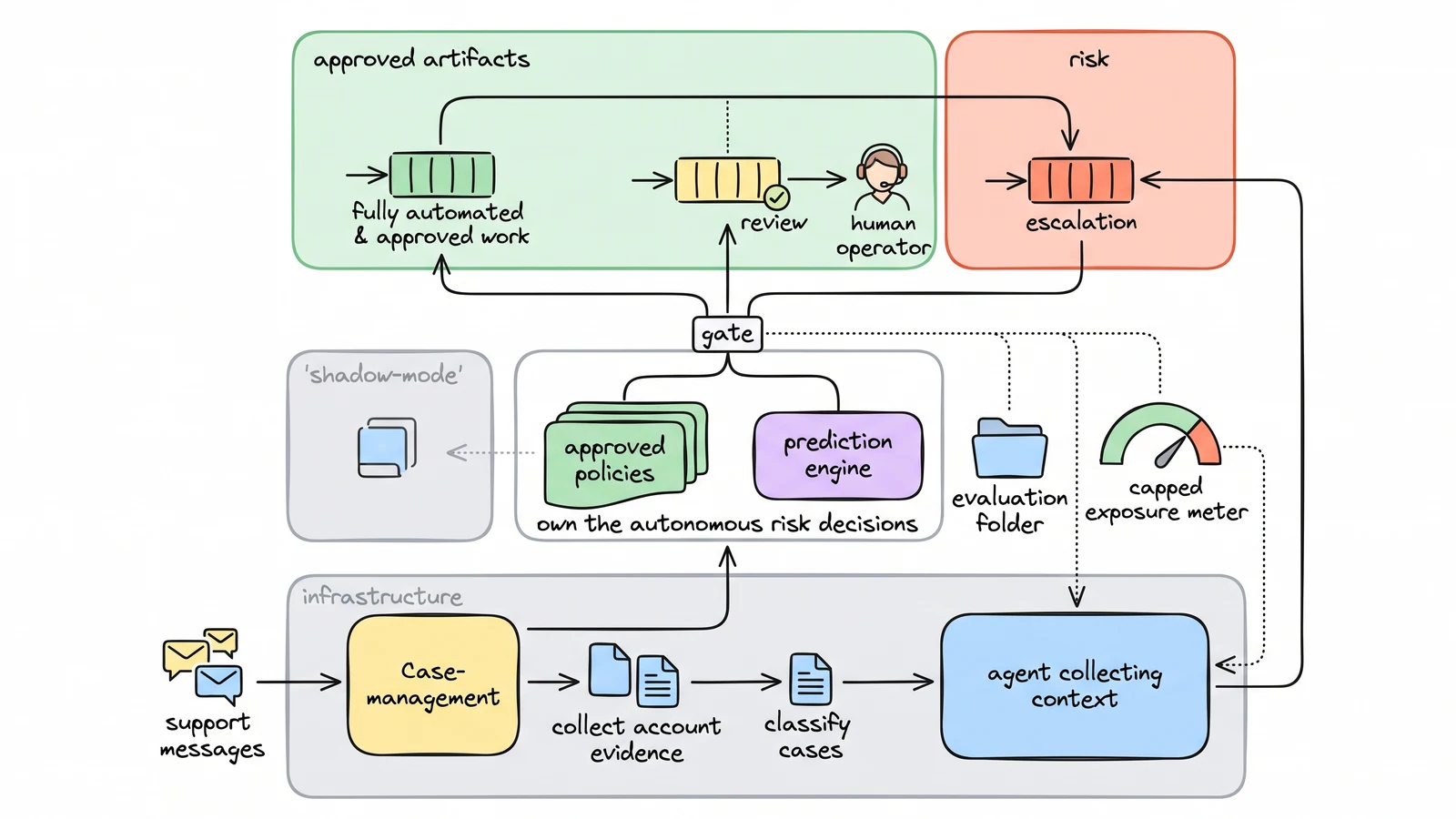
Ramp’s risk operations case is useful because it draws a hard line between agentic reasoning and decision authority.
The company handles more than $200 billion in annual Cards and Bill Pay volume across more than 35 countries. That creates requests that look conversational but often hide a predictive decision: whether a debit will return, whether a payment can be released, or whether an exception fits policy. Ramp explicitly argues that an agent should not improvise those probabilities.
Its architecture gives agents four operational jobs. Universal intake accepts requests from Zendesk, Slack, and internal tools. Triage gathers financial and payment context, then classifies the request and its complexity. The agent calls approved policies and predictive models as tools. Decision routing sends the result to the right internal or customer surface.
The distinction makes evaluation cleaner. The agent is scored on context gathering, classification, and tool trajectory. The policy is evaluated against real downstream risk outcomes. Ramp says structured operator feedback has produced a benchmark of more than 1,000 payment operations with tool-call paths, operator alignment, and eventual risk outcomes.
Rollout is also bounded by real exposure. New configurations start in shadow mode beside human operators. Ramp measures outcome distributions, alignment, latency, and token use. Only after thresholds are met does the agent receive a dedicated exposure budget that caps the dollar risk it can create while the company expands operations and volume gradually.
This is the practical answer to “where should humans stay in the loop?” Human review alone is too vague. Keep agent reasoning in the intake and coordination layer, move autonomous decisions into explicit policy or predictive services, and attach rollout to measurable exposure.