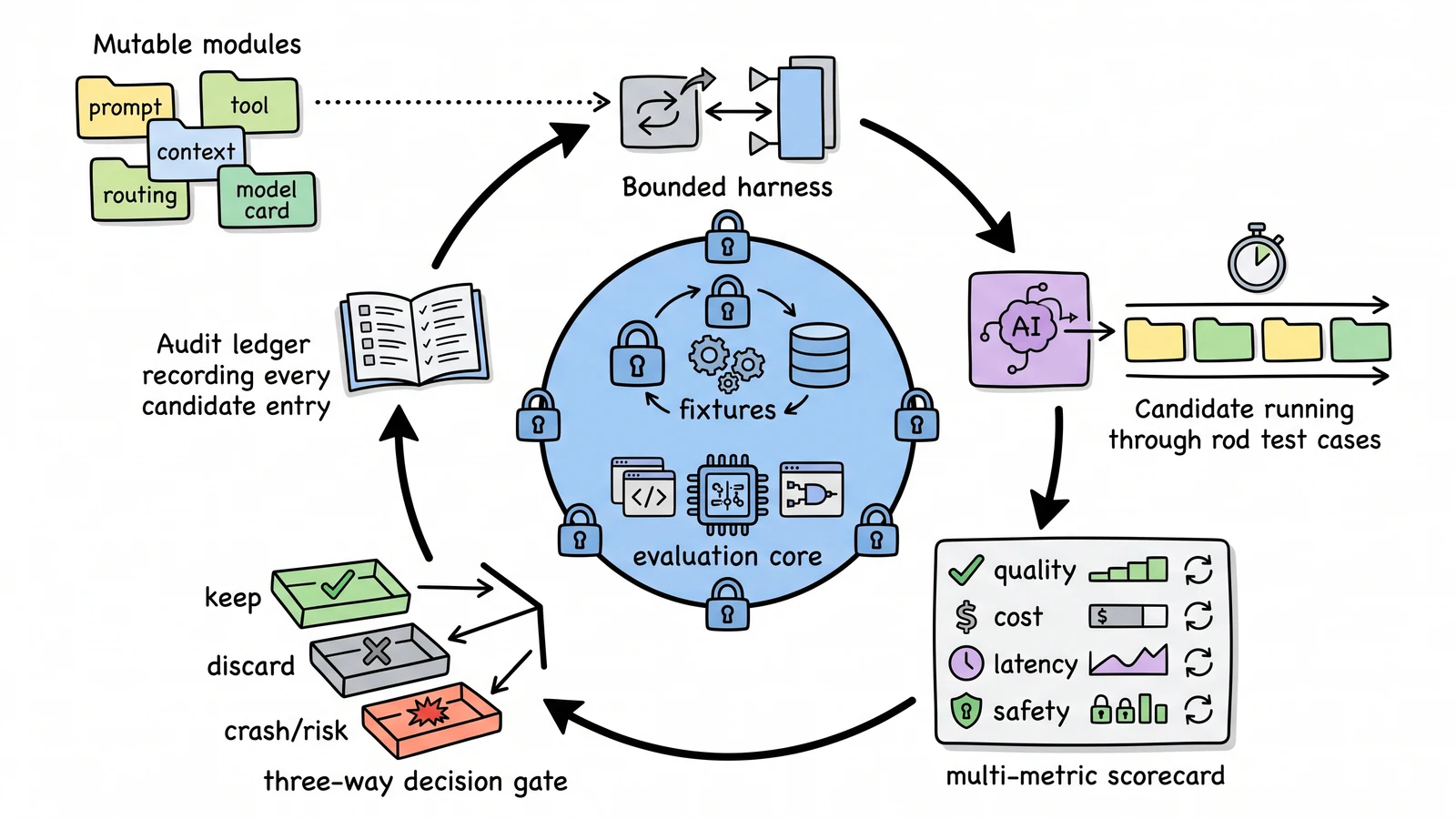
Most agent improvement is still manual: edit a prompt, change the available tools, adjust context, rerun a few examples, and decide by feel whether the system became better. The more consequential shift is to automate this outer loop while keeping evaluation and promotion deterministic.
Karpathy’s autoresearch provides a compact reference design. The agent may change one bounded artifact, but it cannot change the evaluator. Every experiment runs under the same time budget, records its result, and is explicitly kept, discarded, or marked as a crash. The loop is useful because mutation and judgment are separated.
That separation matters more than the specific training task. An agent harness has several mutable surfaces:
- instructions and examples;
- tool descriptions and tool availability;
- context selection and compression;
- routing and retry policy;
- model choice and effort;
- verifier and escalation thresholds.
If all of these can change while the score also changes, the optimizer can manufacture an apparent improvement. A trustworthy outer loop therefore needs a frozen evaluation contract and an audit trail of every candidate.
From prompt optimization to system optimization
The AOrchestra research points in the same direction at a larger scale. It represents a sub-agent as a tuple of instruction, context, tools, and model, then trains or iteratively improves the orchestrator that composes those tuples. The object being optimized is no longer a single prompt. It is the allocation policy for an entire agent system.
This also exposes the central risk: the optimizer will become very good at the metric it receives. A single scalar score invites shortcuts. Production promotion needs a scorecard that preserves competing constraints:
- task success and factual quality;
- primary-source resolution;
- false-positive and false-negative rates;
- latency and monetary cost;
- idempotency under retries;
- regressions on protected cases;
- required human escalation.
The optimizer may propose changes. Deterministic code should still own the fixtures, scoring, comparison, rollback, and promotion gate.
New Runtime Read
For the newsroom, the first useful outer loop is offline replay over historical batches. Freeze a representative set of source-resolution, deduplication, trend-routing, and publication-gate cases. Allow the optimizer to change one versioned prompt, routing policy, or tool contract at a time. Promote a candidate only when repeated runs improve the target metric without weakening source safety or increasing silent errors.
The practical progression is:
- preserve real traces and owner corrections;
- turn recurring failures into executable fixtures;
- define a multi-metric acceptance contract;
- let an optimizer propose bounded harness changes;
- replay candidates several times;
- promote only reproducible Pareto improvements.
The valuable product is not a self-editing agent. It is a controlled laboratory in which the agent system can improve without being allowed to redefine what “better” means.