Agent Behavior Makes Conduct Reviewable

Agent Behavior proposes repo-local BEHAVIOR.md specs for recurring agent conduct, giving trace reviewers, eval authors, and prompt maintainers a concrete behavior contract.

Retrieval answer

Agent Behavior proposes repo-local BEHAVIOR.md specs for recurring agent conduct, giving trace reviewers, eval authors, and prompt maintainers a concrete behavior contract. #AgentBehavior #Evals #PromptEngineering #AgentGovernance Agent Behavior is small on purpose: it proposes a standard way to describe expected agent conduct in repo-local behavior files. The value is not another framework.

New Runtime synthesiseditorial-diagram
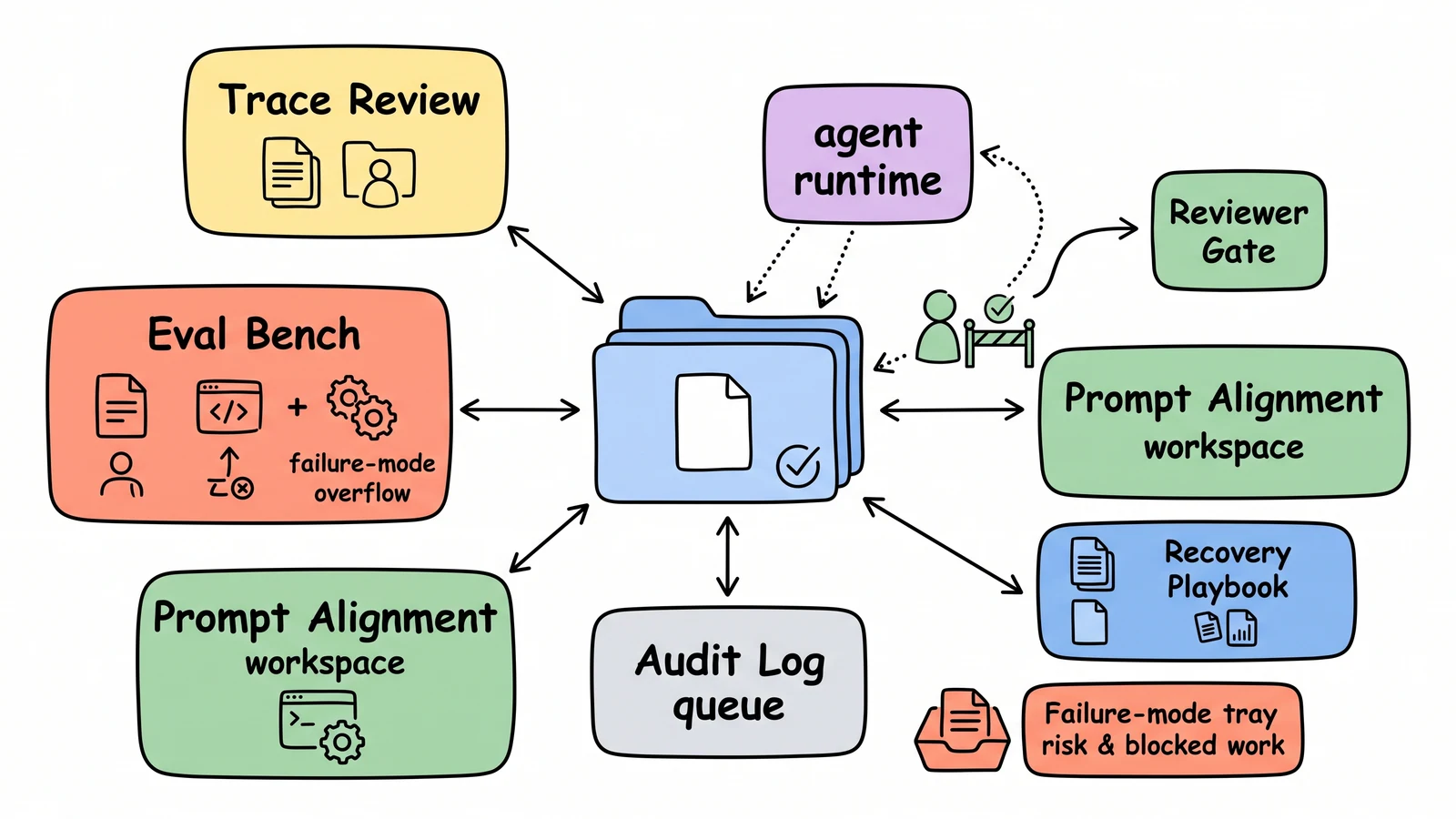
A whiteboard governance diagram showing behavior specification files feeding trace review, eval design, prompt alignment, auditing, and recovery checks.
Agent Behavior turns recurring conduct into a repo-local review artifact: behavior specs can guide trace review, evals, prompt alignment, and recovery checks.New Runtime synthesis from Agent Behavior public specificationOriginal source ↗
  1. Behavior specA repo-local markdown contract describes expected conduct across repeated interactions.
  2. Review surfacesTrace review, eval design, prompt updates, and audits can point at the same artifact.
  3. Runtime disciplineThe spec should guide inspection and debugging without becoming a giant prompt dump.

#AgentBehavior #Evals #PromptEngineering #AgentGovernance

Agent Behavior is small on purpose: it proposes a standard way to describe expected agent conduct in repo-local behavior files. The value is not another framework. The value is a stable artifact that humans and agents can point to when reviewing traces, designing evals, aligning prompts, and debugging failures.

The format is plain Markdown under a behavior directory, with YAML frontmatter and a BEHAVIOR.md body. The recommended dimensions are concrete: intent, evidence, decision, execution, recovery, and failure modes. That is the right level for behavior that repeats across many tasks but is too contextual to live only in a generic system prompt.

The most important implementation detail is negative: tools should not blindly inject every behavior spec into every runtime prompt. The site frames the specs as review and evaluation material. An agent or tool can discover them, select the relevant behavior, and use it to inspect a trace or build a test, but the repository should not become one giant prompt paste.

For New Runtime this maps directly to operating rules that currently live in runbooks and skills: preserve dirty work, resolve primary sources, require visual review, keep OpenClaw owner-gated, never expose private discovery links. These are not vibes. They are behaviors that should be testable against traces.

Evidence / sources

  1. [1]https://www.agentbehavior.dev/

Recommendation

Agent Behavior proposes repo-local BEHAVIOR.md specs for recurring agent conduct, giving trace reviewers, eval authors, and prompt maintainers a concrete behavior contract.

Discovery graph / next reads

Continue through New Runtime

Open the graph
  1. 01topicAgent evals - New RuntimeExplore the evals topic hub.
  2. 02related materialA Software Factory Connects Agents Through Verified OutcomesShares evals.
  3. 03related materialA Balanced MoE Router Can Still Be Functionally DeadShares evals.
  4. 04related materialClaude Code Auto Mode Gates Actions Instead Of ExplanationsShares evals.
  5. 05related materialA Vector Store Is Not An Agent Memory SystemShares evals.

These links are also published in this page’s JSON twin and as typed edges in DiscoveryGraph v1.

Who read this page?Machine requests, hidden until opened

Loading the privacy-safe route aggregate…

Open the JSON contract