Spotify Portal Routes Coding-Agent I/O Away From Frontier Models

Spotify's Portal example routes bulk reads and predictable generation to configured worker modes while keeping high-judgment work on Claude Code.

Retrieval answer

Spotify's Portal example routes bulk reads and predictable generation to configured worker modes while keeping high-judgment work on Claude Code. Spotify's Portal example treats coding-agent cost as a workload-routing problem rather than a single-model choice. Portal AiKA modes are declarative agents that run on ephemeral infrastructure with configured instructions, models, parameters, and MCP tools. The published shunt plugin uses pre-tool

New Runtime synthesiseditorial-diagram
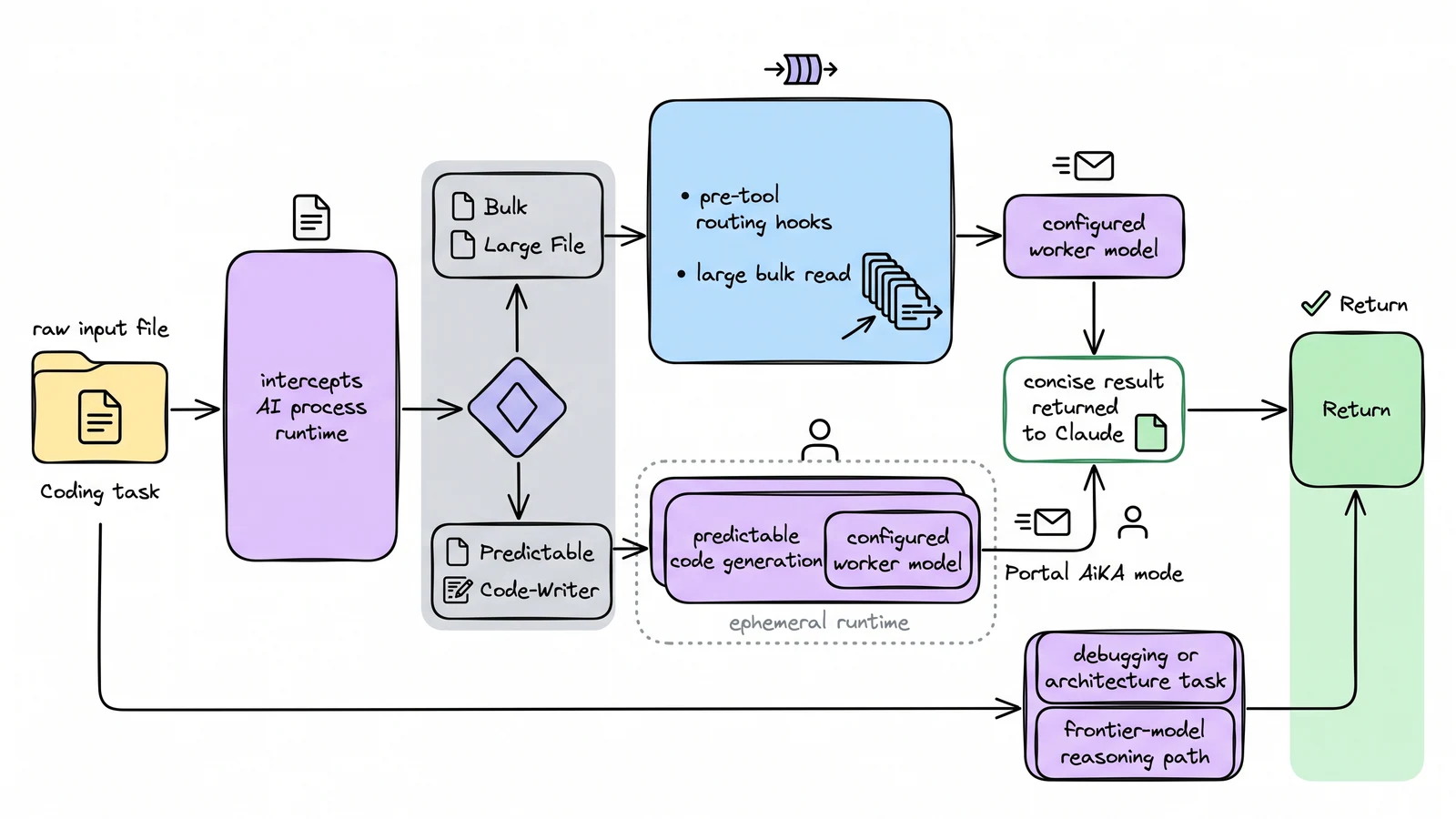
Whiteboard routing diagram showing large bulk reads and predictable code generation delegated through Portal modes to a cheaper worker model while debugging, architecture, and safety-critical reasoning stay with Claude Code.
New Runtime synthesis: the Spotify example treats model choice as a routing policy for workload shape, token cost, and latency—not a single global default.New Runtime synthesisOriginal source ->

Field note

Spotify's Portal example treats coding-agent cost as a workload-routing problem rather than a single-model choice. Portal AiKA modes are declarative agents that run on ephemeral infrastructure with configured instructions, models, parameters, and MCP tools. The published shunt plugin uses pre-tool hooks to divert broad large-file reads and predictable code generation, while leaving debugging, architecture, and safety-critical work on the frontier-model path.

The mechanism combines an enforceable routing hook with reusable worker modes and concise return formats, reducing how much bulk input and output the primary agent consumes. This matters now because token spend is increasingly dominated by file I/O and routine generation rather than by the small fraction of steps that need stronger reasoning.

Teams can copy the pattern only after measuring threshold size, network latency, summary fidelity, and the cost of rereading exact sections before edits. The reported roughly 90 percent mean bulk-read saving came from one Java-monorepo test set; it is evidence for a routing pattern, not a universal benchmark. Watch whether agent platforms expose auditable routing decisions and task-level cost without relying on advisory repository instructions alone.

Recommendation

Spotify's Portal example routes bulk reads and predictable generation to configured worker modes while keeping high-judgment work on Claude Code.

Discovery graph / next reads

Continue through New Runtime

Open the graph
  1. 01topicModels - New RuntimeExplore the models topic hub.
  2. 02topicInference - New RuntimeExplore the inference topic hub.
  3. 03topicInfrastructure - New RuntimeExplore the infrastructure topic hub.
  4. 04archiveField NotesOpen the latest editorial analysis.
  5. 05source ledgerSource LedgerInspect the public source evidence graph.

These links are also published in this page's JSON twin and as typed edges in DiscoveryGraph v1.

Who read this page?Machine requests, hidden until opened

Loading the privacy-safe route aggregate...

Open the JSON contract