RLSVR Turns Open-Ended Work Into Games With Self-Verifying Rewards

RLSVR derives supervision by transforming an open-ended task into an environment whose rules make success mechanically checkable.

Retrieval answer

Instead of asking a reward model to judge free-form quality directly, the method creates a game or pretext task that produces verifiable outcomes. The paper still uses GPT-4o-based pairwise judging for part of quality evaluation, so self-verification does not remove every subjective evaluator.

New Runtime synthesiseditorial-diagram
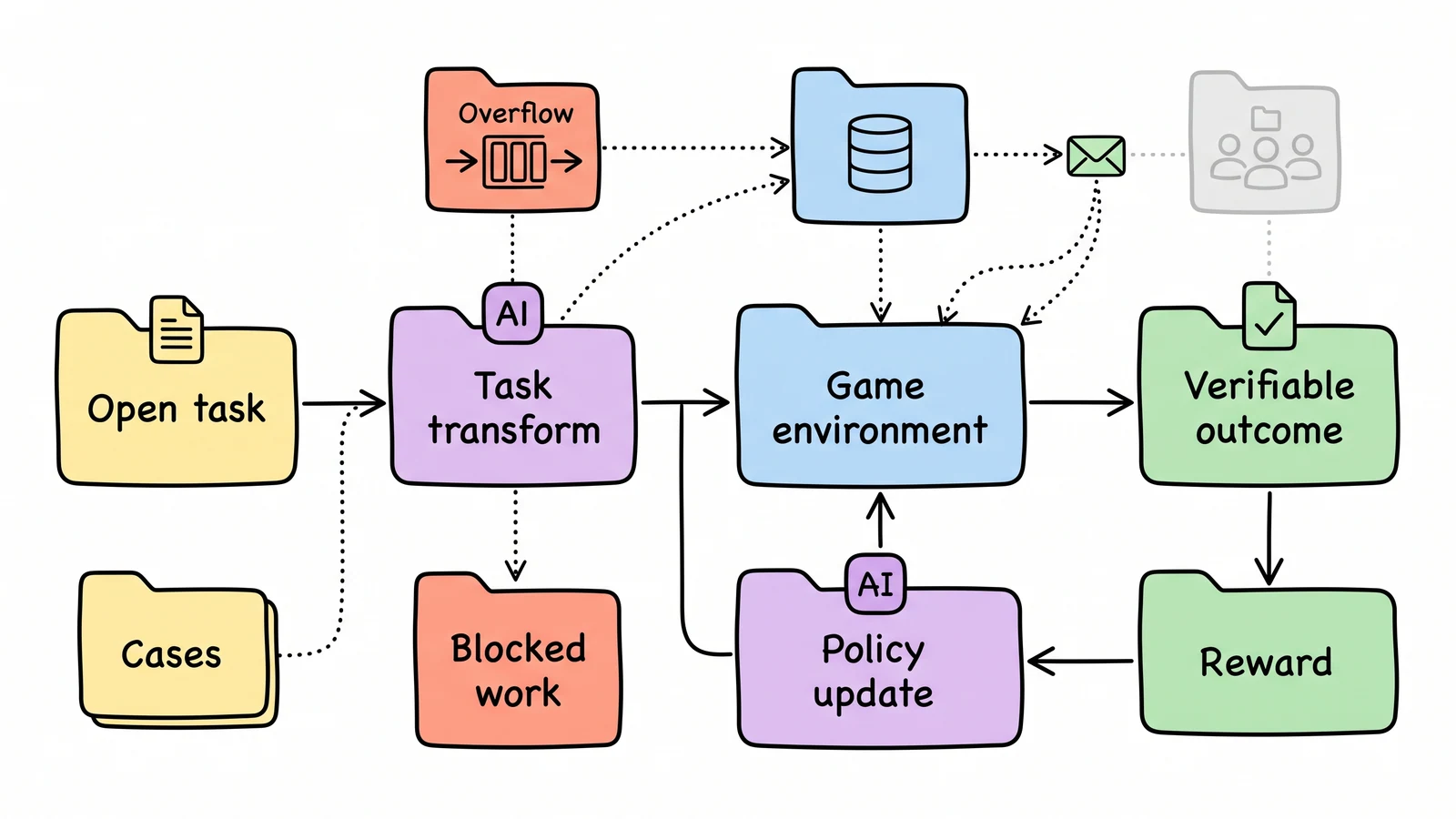
A whiteboard loop showing an open-ended task transformed into a game environment whose outcomes create a verifiable reward for policy improvement.
New Runtime synthesis from From RLVR to RLSVR: Task Transformation Induces Self-Verifiable Rewards.New Runtime synthesisOriginal source ->

Field note

Reinforcement learning with verifiable rewards works well when an answer can be checked by a compiler, theorem prover, or exact answer key. RLSVR extends the idea to open-ended tasks by transforming them into games whose environment rules generate their own verification signal.

The distinction is architectural. A learned judge does not score the final free-form output directly. The training task creates observable success and failure conditions, allowing the environment to supply rewards from interaction. This resembles self-supervised pretext tasks: supervision is induced by how the problem is represented.

The limit should stay visible. The method makes the training reward more mechanical, but parts of the paper's quality analysis still use GPT-4o pairwise judging. RLSVR is therefore a promising way to reduce dependence on reward models, not proof that subjective quality has become fully self-verifying.

Recommendation

RLSVR derives supervision by transforming an open-ended task into an environment whose rules make success mechanically checkable.

Discovery graph / next reads

Continue through New Runtime

Open the graph
  1. 01topicReinforcement Learning - New RuntimeExplore the reinforcement-learning topic hub.
  2. 02topicSelf Verification - New RuntimeExplore the self-verification topic hub.
  3. 03topicOpen Ended Tasks - New RuntimeExplore the open-ended-tasks topic hub.
  4. 04archiveField NotesOpen the latest editorial analysis.
  5. 05source ledgerSource LedgerInspect the public source evidence graph.

These links are also published in this page's JSON twin and as typed edges in DiscoveryGraph v1.

Who read this page?Machine requests, hidden until opened

Loading the privacy-safe route aggregate...

Open the JSON contract