Coding Agents Make The Personal Devtool Fork Practical

Coding agents reduce the cost of creating and maintaining personal forks, turning source code into a durable extension surface.

Retrieval answer

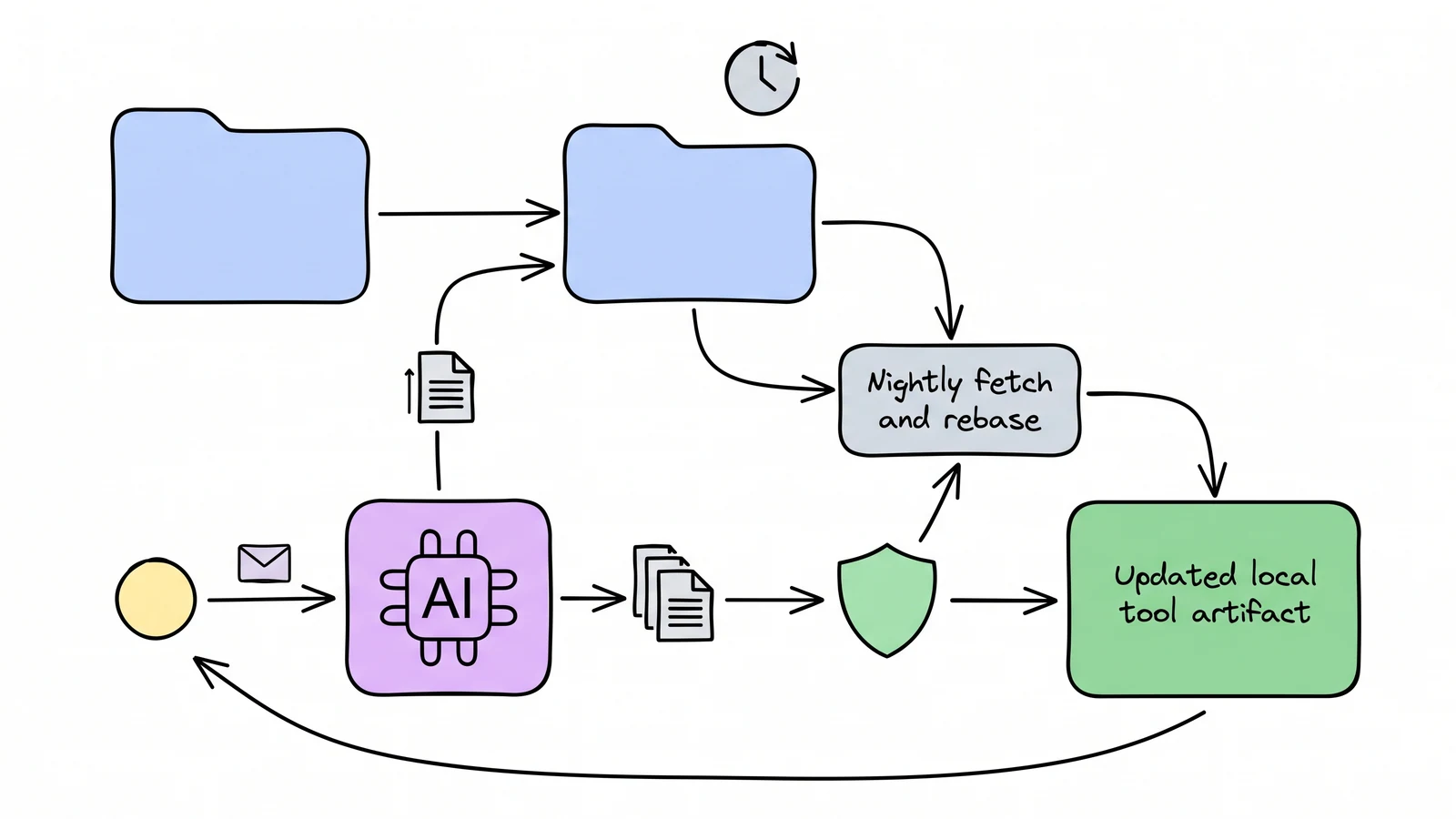
The personal-fork loop is upstream source, intent-preserving agent patch, acceptance tests, local build, and scheduled fetch-rebase verification. Open source becomes operational infrastructure for software adapted around one user's intent.

New Runtime synthesiseditorial-diagram
A New Runtime whiteboard flow from an upstream open-source tool to a personal fork, agent patch, tests, local build, and scheduled maintenance loop.
New Runtime synthesis from the exe.dev open-source devtools essay.New Runtime synthesisOriginal source ->

Field note

A personal fork of a complex tool used to lose against configuration and plugins. The user had to understand the code, make the change, and keep rebasing it for years. Coding agents lower both the initial modification cost and the maintenance cost.

exe.dev proposes a concrete operating loop. An agent fetches the source, builds a local version, records why the change exists, and remembers that future work should target the fork. A scheduled job pulls upstream, rebases the local patches, runs checks, and replaces the working build only after success.

This is not another extension API. The agent can change internal architecture for one user: replace a hard-coded font, add a custom diff preprocessor, or remove entire interface layers. Source code becomes the extension surface, while the maintained skill records how to keep the adaptation alive.

Automation does not remove ownership. A durable personal fork still needs a pinned upstream, patch ledger, acceptance tests, rollback, and a visible conflict queue. The useful experiment is one missing feature in one open-source tool, followed by a week of scheduled upstream-sync dry runs. The question is whether the adaptation survives maintenance, not whether the first demo works.

Recommendation

Coding agents reduce the cost of creating and maintaining personal forks, turning source code into a durable extension surface.

Discovery graph / next reads

Continue through New Runtime

Open the graph
  1. 01topicOpen Source - New RuntimeExplore the open-source topic hub.
  2. 02topicCoding Agents - New RuntimeExplore the coding-agents topic hub.
  3. 03topicDeveloper Tools - New RuntimeExplore the developer-tools topic hub.
  4. 04archiveField NotesOpen the latest editorial analysis.
  5. 05source ledgerSource LedgerInspect the public source evidence graph.

These links are also published in this page's JSON twin and as typed edges in DiscoveryGraph v1.

Who read this page?Machine requests, hidden until opened

Loading the privacy-safe route aggregate...

Open the JSON contract