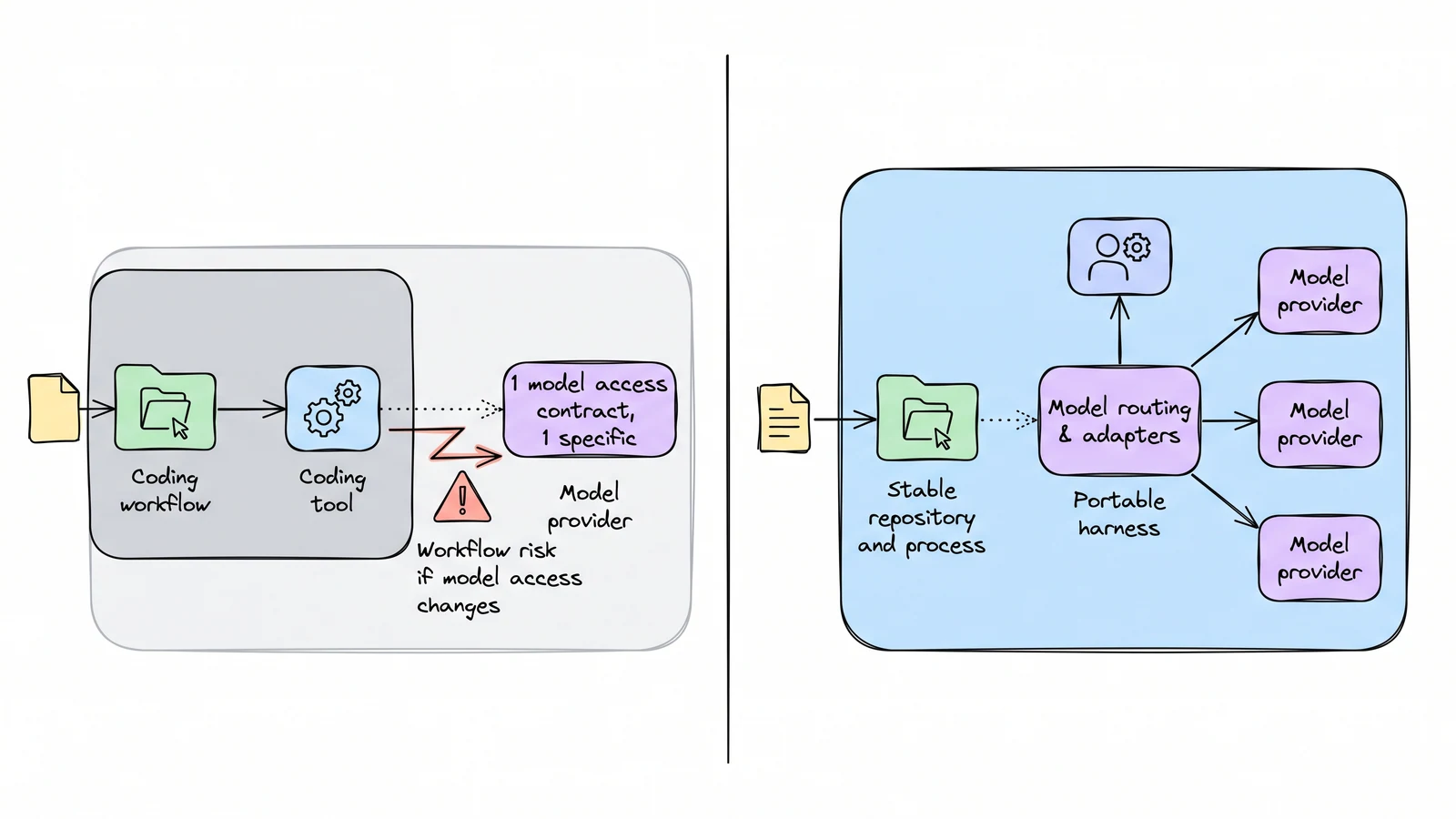
The OpenAI-Cursor contract change shows that model access is an external dependency of a coding workflow, not a permanent feature of the editor. The change matters now because a widely used coding surface can lose future model access on a vendor timetable even when its local product experience remains intact.
OpenAI says it intends to wind down its Cursor agreement, has proposed a November 12, 2026 cutoff, and will withhold future models during the transition. Kilo argues that a coding tool should let users change models without changing their development environment, including through bring-your-own-key access. OpenClaw 2 offers a different implementation example: its setup can begin with an existing ChatGPT or Claude subscription, direct API keys, or local models. The latter two sources are vendors with an interest in portability, but they make the proposed alternatives concrete.
A portable harness keeps repository state, prompts, rules, memory, tool permissions, evaluation, and delivery stable while adapters or routes change the model-access path. That does not make switching free: model behavior, tool use, latency, price, and safety can still change. It does make those changes testable inside one operational envelope instead of forcing a simultaneous migration of editor, workflow, and provider.
For teams, the practical implication is to inventory which parts of the workflow belong to the harness and which depend on one provider's account, endpoint, model family, or contract. Preserve task fixtures and provider-independent traces, keep access adapters replaceable, and run the same regression suite before rerouting production work. This is a time-bounded update to the New Runtime pattern that harness architecture outlives model choice.
These three announcements do not prove a universal market shift, and Kilo and OpenClaw are interested vendors rather than neutral observers. Watch whether users can actually change providers without losing project state, tool contracts, evaluation quality, or recovery behavior after the Cursor transition reaches its proposed cutoff.