Field noteJul 26, 20261 min read1 source

DataFlow-Harness Makes Agent-Written Pipelines Governable

DataFlow-Harness grounds a coding agent in platform skills and an MCP operator registry so generated workflows become editable validated DAGs.

In one minute

The paper is a concrete harness story: natural-language pipeline generation is grounded through skills, MCP metadata, mediated mutations, DAG validation, and editable visual workflows.

New Runtime synthesiseditorial-diagram
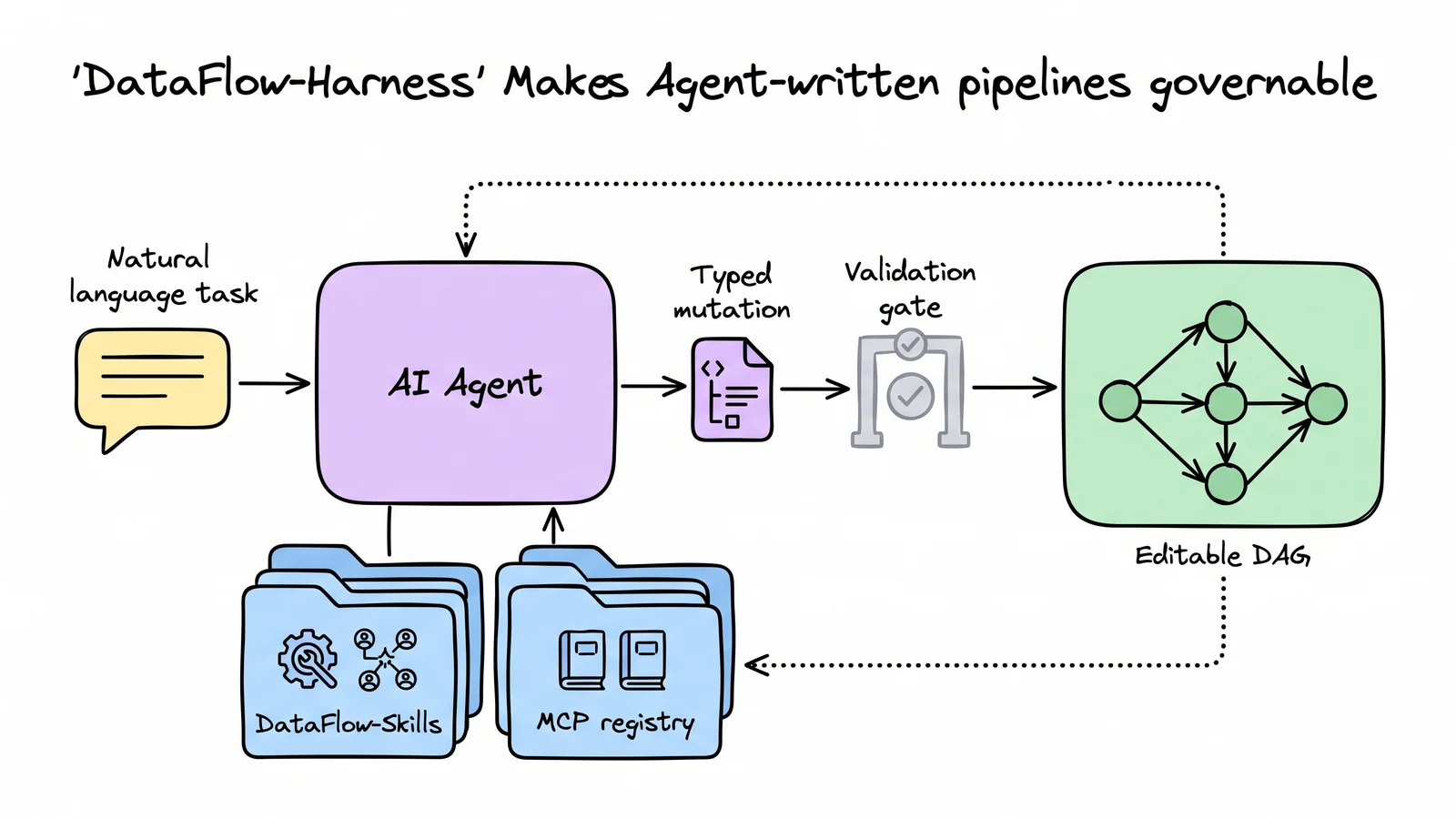
A whiteboard diagram showing a coding agent grounded by skills and an MCP registry, producing validated editable data-pipeline DAGs.
New Runtime synthesis.New Runtime synthesisOriginal source ->

DataFlow-Harness is another sign that the real agent product is the harness around the model.

The system gives Claude Code more than a natural-language request. It grounds the agent in DataFlow-Skills and an MCP operator registry, then mediates changes as typed mutations against a live platform state. The resulting pipelines become persistent, editable visual DAGs, and validation rejects updates that break graph structure or schema compatibility.

The ablation is the important part: procedural guidance helps most when tasks require implicit domain knowledge, while simple routing tasks do not need it. In other words, MCP metadata alone is not always enough. Agents need environment state, operator contracts, reusable procedures, and validators if their outputs are supposed to remain governable after generation.

Evidence / sources

  1. 1arxiv.org/html/2607.16617v1
All Field Notes

Next reads

Read next

Open the graph
  1. 01topicCoding AgentsExplore the coding-agents topic hub.
  2. 02topicMcpExplore the mcp topic hub.
  3. 03topicData PipelinesExplore the data-pipelines topic hub.
  4. 04archiveField NotesOpen the latest editorial analysis.
  5. 05source ledgerSource LedgerInspect the public source evidence graph.
Who read this page?Machine requests, hidden until opened

Loading the privacy-safe route aggregate...

Open the JSON contract