Graphs Are What Agent Loops Become Under Pressure

Aakash's graphs essay and the current agent tooling wave point to a broader shift: loops stay local, but graph-shaped workflows govern branches, shared state, approvals, and recovery.

Retrieval answer

Aakash's graphs essay and the current agent tooling wave point to a broader shift: loops stay local, but graph-shaped workflows govern branches, shared state, approvals, and recovery. #Graphs #AgentWorkflows #Orchestration #NewRuntime The most useful point in the Graphs batch is not that the word "graph" replaced the word "loop."

New Runtime synthesiseditorial-diagram
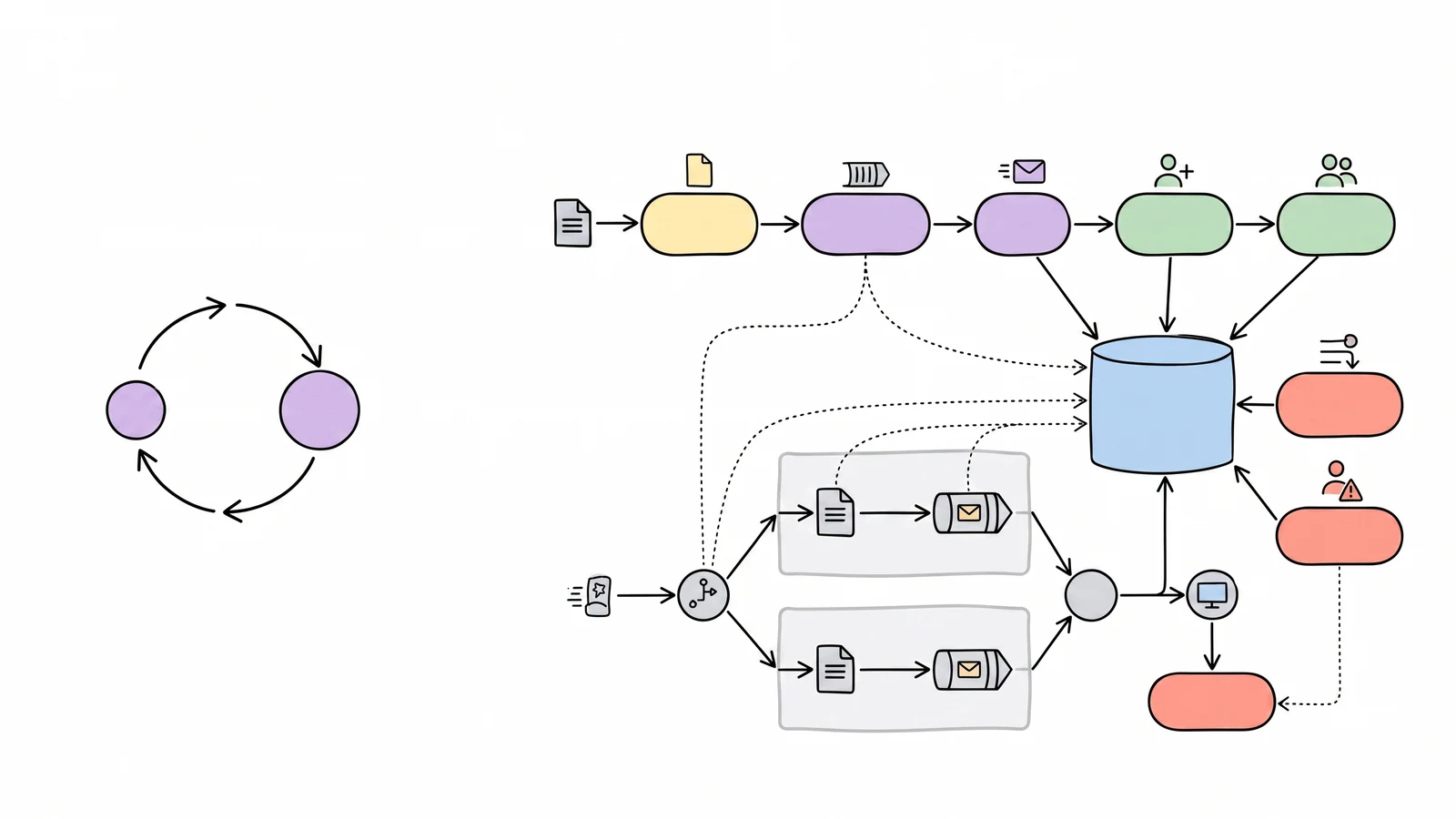
A whiteboard diagram contrasting a simple agent loop with a workflow graph containing branches, shared state, approvals, recovery, and parallel workers.
Loops are still useful local mechanisms; graphs appear when branches, shared state, approvals, exceptions, and recovery need governance.New Runtime synthesis from AI by Aakash's graphs discussion and New Runtime workflow analysisOriginal source ↗
  1. Local loopAct, inspect, and correct when one evaluator is enough.
  2. Workflow graphBranches and shared state make outcomes explicit.
  3. GovernanceApprovals, risk queues, recovery, and receipts stop hidden autonomy.

#Graphs #AgentWorkflows #Orchestration #NewRuntime

The most useful point in the Graphs batch is not that the word “graph” replaced the word “loop.” The loop is still there: act -> inspect -> correct remains a normal local mechanism. But once there are multiple outcomes, shared state, approvals, recovery, and several workers, the loop stops describing the system.

A graph is needed when the execution path itself becomes a product surface. One item can become post, watch, blocked_missing_primary_source, or deep_research. One PR can move through cohorts, layers, stale snapshots, and review threads. One desktop agent can reach send, write, or command only through an approval gate.

So I would read “graphs are the new loops” this way: loops stay inside nodes, while the graph decides who is allowed to move to the next state. It is not a pretty diagram. It is a governance layer.

In New Runtime, this is already operational reality: source resolution, draft, visual review, site, R2, OpenClaw receipt, and owner approval are not one cycle. They are a graph with receipts at external write boundaries. The next step is to make that graph explicit in data, not only in the runbook.

Recommendation

Aakash's graphs essay and the current agent tooling wave point to a broader shift: loops stay local, but graph-shaped workflows govern branches, shared state, approvals, and recovery.

Discovery graph / next reads

Continue through New Runtime

Open the graph
  1. 01topicAgent Workflows - New RuntimeExplore the agent workflows topic hub.
  2. 02topicOrchestration - New RuntimeExplore the orchestration topic hub.
  3. 03related materialAgent Loops Become Graphs When Exceptions MatterShares agent workflows and orchestration.
  4. 04related materialCodeRabbit Change Stack Makes AI PRs Reviewable AgainShares workflow graphs.
  5. 05related materialGitHub Copilot App Turns Agent Work Into a Desktop Control SurfaceShares agent workflows.

These links are also published in this page’s JSON twin and as typed edges in DiscoveryGraph v1.

Who read this page?Machine requests, hidden until opened

Loading the privacy-safe route aggregate…

Open the JSON contract