Agent Loops Become Graphs When Exceptions Matter

A loop is enough for repeated work with one stopping rule; graphs become useful when the system needs branches, shared state, parallel work, approval gates, and recovery paths.

Retrieval answer

A loop is enough for repeated work with one stopping rule; graphs become useful when the system needs branches, shared state, parallel work, approval gates, and recovery paths. The question "are we still talking loops, or did we shift to graphs?" captures a real design transition, but not a replacement.

New Runtime synthesiseditorial-diagram
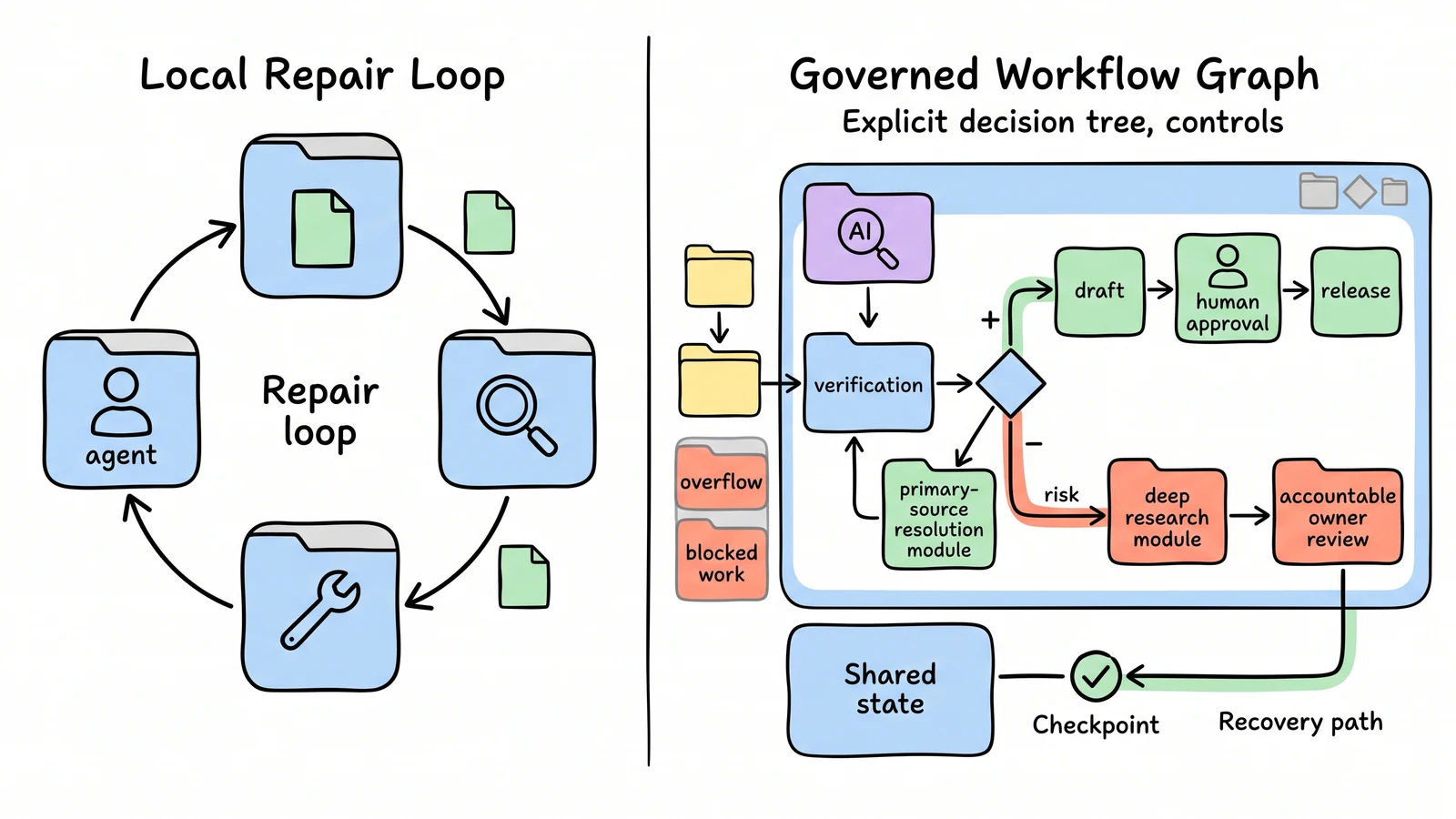
A compact act-inspect-correct loop sits beside a governed workflow graph with verification, publication, source-resolution, risk, approval, and recovery branches.
Loops remain useful local mechanisms; graphs become necessary when branches, shared state, approvals, exceptions, and recovery must be governed.New Runtime synthesis from LangGraph structures and the newsroom workflowOriginal source ↗
  1. Local loopAct, inspect, and correct when one evaluator and one stopping rule are enough.
  2. Decision graphMake publishable, missing-source, and risk outcomes explicit instead of hiding them in prompts.
  3. Human controlsKeep approval and accountable owner review as visible nodes with auditable transitions.
  4. RecoveryUse shared state, checkpoints, and separate retry paths when several loops interact.

The question “are we still talking loops, or did we shift to graphs?” captures a real design transition, but not a replacement.

A loop repeats work until a condition is met:

act -> inspect -> correct -> repeat

A graph makes the routes explicit:

discover -> verify -> publishable?
                    | yes -> draft -> approve -> release
                    | no  -> resolve source -> verify
                    | risk -> deep research -> owner review

Official LangGraph documentation treats sequences, branches, loops, parallel work, and shared state as structures inside one graph. Loops remain a local mechanism. The graph becomes necessary when several loops interact and different outcomes need different owners or controls.

When a loop is still better

Do not introduce a graph because the word sounds more advanced. A bounded repair task with one evaluator and one stopping rule is easier to test as a loop.

Move to a graph when the workflow needs:

  • conditional branches and exception queues;
  • parallel workers that merge into shared state;
  • human approval or pause points;
  • durable checkpoints and recovery;
  • separate retry policies for different actions;
  • auditable transitions between agents and deterministic code.

New Runtime Read

The newsroom is already a graph even if parts of it are described as loops. X discovery, primary-source resolution, story clustering, trend evidence, site materialization, R2 backup, OpenClaw review, and owner-gated Telegram publication do not share one stopping rule.

The next architecture step is to make that graph explicit in data: every node writes a status, every edge records why it was taken, and every external write has an idempotency key and receipt.

Loops produce persistence. Graphs govern where persistence is allowed to go.

Recommendation

A loop is enough for repeated work with one stopping rule; graphs become useful when the system needs branches, shared state, parallel work, approval gates, and recovery paths.

Discovery graph / next reads

Continue through New Runtime

Open the graph
  1. 01topicAgent Workflows - New RuntimeExplore the agent workflows topic hub.
  2. 02topicOrchestration - New RuntimeExplore the orchestration topic hub.
  3. 03related materialGraphs Are What Agent Loops Become Under PressureShares agent workflows and orchestration.
  4. 04related materialCodeRabbit Change Stack Makes AI PRs Reviewable AgainShares workflow graphs.
  5. 05related materialGitHub Copilot App Turns Agent Work Into a Desktop Control SurfaceShares agent workflows.

These links are also published in this page’s JSON twin and as typed edges in DiscoveryGraph v1.

Who read this page?Machine requests, hidden until opened

Loading the privacy-safe route aggregate…

Open the JSON contract